monday morning ministry


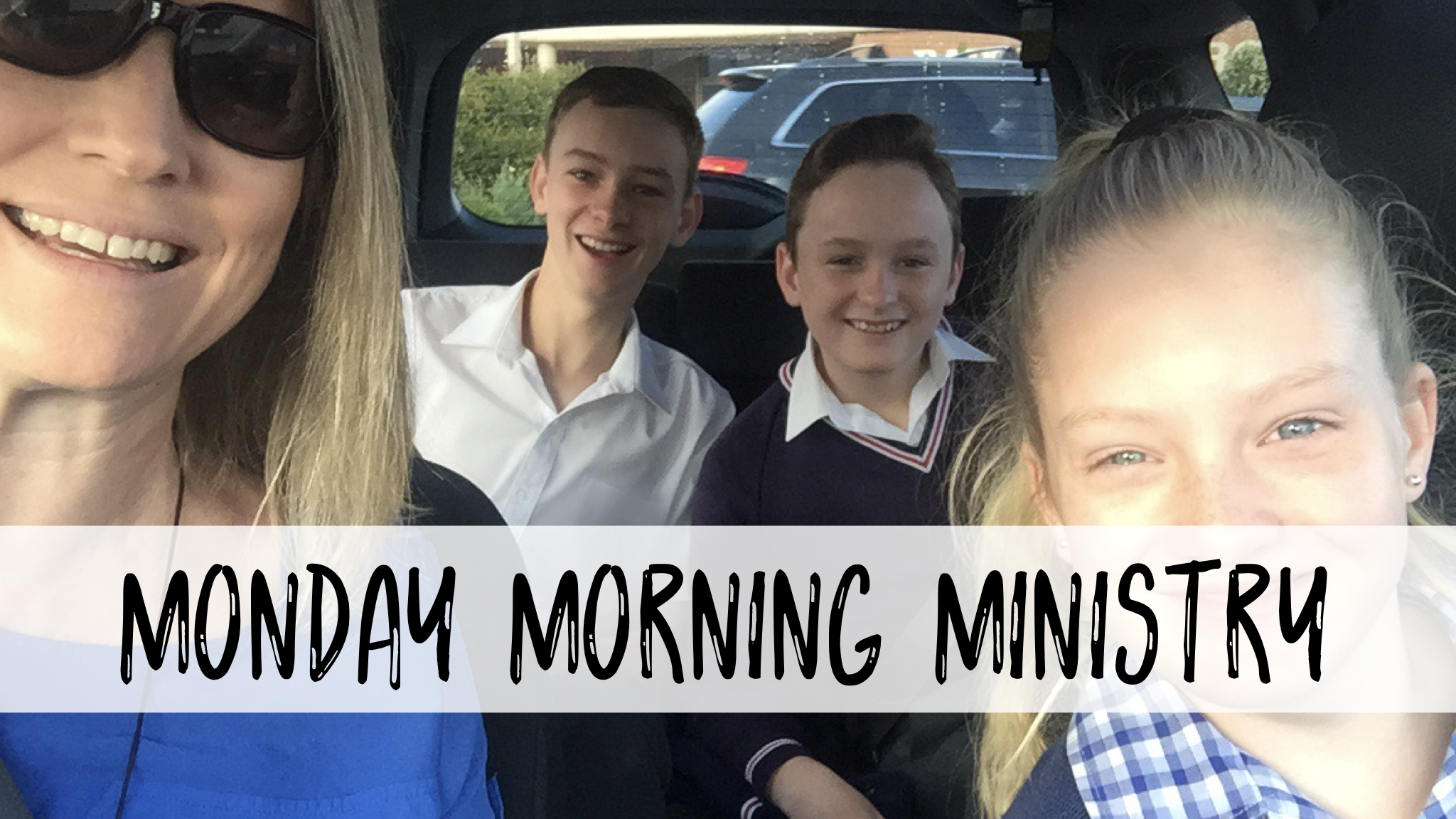
These are not my children. I borrowed them.

They’ve been seconded for an important Monday morning ministry that required availability in two categories. The first – that they needed to be somewhere at a specific time prior to 9am on Monday morning – in their case, school at 8:20am. Done. The second – they needed to be up for an early morning conversation – not a difficult task for this 15 year old deep-thinker, 14 year old sanguine and 11 year old lover-of-a-good-story. Done.

The ministry requirement is this – to help me fight a debilitating case of Mondayitis.

Although Sundays are my favourite days, they are also my longest and most physically exhausting. The love tank is full but the physical energy is depleted. Then comes Monday morning and we have our review and planning meetings – where I’m called on to bring the creativity, energy and lateral thinking. But more consistently, all I’m really able to bring is the coffee.

After a few challenging meetings, some disappointments in my own attitude and contributions, and just knowing that things were not functioning as positively or helpfully as they could, I was talking it through with a mentor. She encouraged me to consider ways to get myself in a better frame of mind and readiness for the start of the day and week.

Enter this fabulous trio.

The need to have them at school means I arrive at work 40 minutes before my first meeting – rather than 1 minute before (or after!) it starts. I have time to get a few emails processed, sort through things left on my desk and say hello to a few other people in the office. I’m more relaxed, switched on and ready to engage a better version of me.

As an externally processing extrovert, people interaction is what kick starts my engine – especially when I’m weary. Arriving at morning meetings having not actually used my voice let alone had a laugh or shared a moment of human interaction is not a great way to start. These kids ensure many laughs and a whole lot of random chats in the brief trip to the school car park.

And as an added bonus this team has totally adopted their ministry role in my life. If you ask them why I take them to school on Monday mornings they’ll tell you that they help to get my day started well and make me work better. As they get out of the car they’ll often check to see if they’ve made me laugh enough or told enough random stories. Bless them.

Some encouragements for you. Have you reflected on your own responses and best practices to be able to set yourself up to win? Who can you recruit to help you achieve that? And what might your ‘Monday morning ministry’ be? Who could you bless with some practical or emotional support? 
 

I am not the mother of a 14 year old 


February 9th was my due date.

Babies are rarely born on their due date but when a baby doesn’t make it to full term, the due date is the only one there is.

If mine was a different story, my baby would be 14 years old today. Within that there is grief to process (read here) and questions still unanswered (read here) but I can’t help but pause to think how different my life would be if I were the Mum of a teenager.

Of course it’s all speculation, but with what I can imagine my life could be so very different. My day to day schedule could be different, Work life, friendships, social activities, priorities; heart focus. I might drive a different car or live in a different house. I might have less money in the bank, more shoes at the door, a higher turn over of food in my fridge. Those of you with children could list indefinitely the way my life might be changed by the presence of a child – right now and for the 14 years before.

It’s one of those “sliding doors” moments. You know the film where they track the parallel stories of a train missed or made and the different outcomes of each.

The “what if” game can be fun (or painful) to play. Imagining the outcomes of a decision made differently, a relationship ended or started, a job gained or lost, a different path chosen, 5 mins earlier or later, a different family, the near misses and the close calls. Some of them we’re glad to have avoided but others we regret and reflect on with longing and grief.

It’s almost impossible to imagine all the impacts of a baby in my situation. It might’ve meant a different relational status, living in a different State, a different career and job (and all the implications of that), I’d probably not have written a book and experienced the opportunities that have opened up because of it …you might not be reading this blog.

So today, I am not the mother of a 14 year old and all the implications of that. But I AM so many other things. The mental gymnastics of the “what if” can be fun but also painful. They can lead us to celebration of who we are and all we have or can cause us to be stuck in the pain of missing out or the negative spiral of comparison.

What about you? How do you handle your “sliding door” moments?

miscarriage – a unique grief


If you’ve ever had a miscarriage, or intimately known someone who has, you’ll know it brings a unique type of grief. 

Discovering you’re pregnant is a giddying experience. The combination of hormones and hope; anticipation and mild panic brings a range of emotions and there’s a sudden rush to a reimagining of your future from that moment forward. In 9 months I’ll be a mother, in 6 years I’ll be a school mum, in 14 years I’ll have a teenager, in 20+ years I might have raised the next Prime Minister or the scientist who’ll cure cancer or a heart that will embrace the broken and the marginalised; or my best friend. 

The early stages of pregnancy do strange things to your body – growing a tiny human will do that. For me, it meant nausea that reduced my appetite – turning me into a perpetual grazer and a weariness that settled on me and wouldn’t shake no matter how much I rested or slept. 

The news of a miscarriage is so clinical. It’s just a black blob on the ultrasound. The potential for life has ended. Almost as quickly as possibility has been conceived it is dead. The whiplash of emotions can be profound. (read more here)

If you listen to the stories of miscarriage the grief is often marked by an isolation or loneliness. So often both the pregnancy and miscarriage happen even before an announcement is made and so it is intensely private. Many times the celebrations and excitement have been held within a tight circle of family and friends – heeding popular advice to wait until the first trimester is reached and the chances of the pregnancy reaching full term become greater. But these things can contribute to others not engaging as personally in the loss when they haven’t had opportunity to connect with the joy and potential. 

For some, like me, the oft assured temporary ‘set back’ of loss – waiting for new timing, second chances – turns into long term childlessness. The miscarriage becomes a brief flirtation with the experience of parenthood. A promise whispered, but silenced. 

For others who are fortunate to conceive again and meet their little one – the grief mingles strangely with joy. Perhaps due dates are forgotten as birth dates get celebrated. Perhaps there is a struggle to hold the public celebration of new life in tension with the seeming disregard for lost life. One so much more tangible than the other. 

When I reflect on my own journey and hear the stories of others’ I am struck by the common thread of unspoken or forgotten grief. I am constantly surprised by the eagerness to share their experience, to speak of the loss, to name their expectations, to recall the deep sadness; to question and doubt. So many words waiting to find ears and hearts to land on. 

So I’m led again to share these thoughts and ponderings. Maybe they spark a familiar feeling. Maybe they serve as an invitation. Maybe they touch an ache harboured deeply in a heart. Maybe they serve as unknowing preparation. Maybe they help. 

becoming more patient | #3 being others focussed

Have you ever had those moments when you’re pretty sure everybody around you is just trying to annoy you?

Everyone is driving slowly when you’re in a hurry. People are walking the aisles of shopping centres like they’re balls in a pin-ball machine, making it impossible to get around them. The person at the petrol pump in front of you decides now is the time to clean their windscreen back to showroom condition. The clerk processing your payment at the post office reminds you of the sloths from the movie Zootopia (check it out, great movie). Your child is attempting a world record for longest time taken to eat a bowl of cereal. Your teenager is on their third trip back into the house to get something they forgot and can’t leave without. Your work mates are reaching new heights of meeting-hijacking abilities.

Of course you have those moments, sometimes many of them in succession. We all do. If you were getting anywhere with this whole ‘becoming more patient’ idea then these are the moments that are set to derail you … big time!

Patience is the act of waiting well. It’s the ability to endure set backs and challenges without becoming anxious or irritated. Patience is indeed a virtue and one that is tested on a regular basis.

In our efforts to become more patient we’ve noted the need to take  a big picture perspective – to step back and see things in their broader context. We’ve looked at the idea of planning in order to be more patience – choosing  wisdom over reaction. And we also need to keep an important truth in mind … it’s not actually all about you!

It turns out not everyone is intentionally plotting ways to make your life miserable – even though it might seem like it. The slow driver in front of you probably has no idea you’re there. The dude at the petrol station is more worried about his windscreen than you. Your teenager is probably just forgetful or distracted. There is not, despite the seeming appearance to the contrary, a concerted focus on the part of all the people in your world to make life miserable for you.

And this makes perfect sense as you read it. But in those moments, so much of our irritation is borne out of a sense of focus on ourselves that causes us to see everything as a deliberate mission to make us frustrated.

It’s not all about you!

Next time you find yourself impatient with the actions or in-actions of another person, pause and take a moment to consider the situation from their perspective. “I wonder if that slow driver is lost, or a learner, or experiencing anxiety or dealing with a crying baby in the back seat.” “I wonder if this sales assistant is new to the job or tired from a full day of work.” “I wonder if my teenager is trying to keep too many things in their mind, or is worried about something; or is hormonal.”

Such a thought process changes nothing of the circumstances. You’re still going to be impeded or impacted by the other person’s behaviour in some way. But patience isn’t about not waiting it’s about waiting well. And when we shift the focus from ourselves we release something of the anxiety and irritation and replace it with empathy or compassion.

What might that look like for you? How might taking the focus of yourself cause you to be more patient with others?


Read more –

Part 1 – big picture perspective

Part 2 – wisdom over reaction

disciplines of gratitude


For the last few years I’ve kept a “thankfulness jar”. 


The last thing I do each night before getting into bed is to pause and write a couple of sentences of gratitude for something that happened during the day. 

Some days it is really easy. I list off fun activities, great Ministry moments, joyful interactions with friends & family, experiences of wonder, tasks accomplished or things learned. 

Some days are harder. When I’ve been sick, when work has been hard, when I’ve spent the day alone; when my heart is burdened, these are the days I want to get into bed as fast as I can to bring them to an end! 

However, when I stand before the small piece of paper with a pen in hand, looking at an ever-filling jar of other moments of gratitude, I never fail to find something to write. 

Sometimes I’m just thankful that tomorrow is another day and another chance to do better. Sometimes I’m thankful that those days that are hard are offset by many days of joy and hope. Sometimes I’m thankful for specific people who God brings across my path to bless, inspire, encourage and support me. Sometimes I’m thankful for stewed apricots or a house full of people or God’s grace or a great movie I’ve watched or sore cheeks from laughing or new stationery or a new experience …the list is as diverse as it is endless. 

The discipline of gratitude is a necessary part of grounding my heart and mind in the truth – particularly when I am weary or despairing. It resets my internal dialogue – interrupting any negative thought track by forcing me to consider something positive. 

In moments of celebration and joy this discipline draws the attention of my heart to reflect on the source of those blessings, growing my faith and deepening my trust. 

What about you? Do you have any practices of gratitude that you regularly do? Maybe a daily discipline like this could be a place to start?

why you should send handwritten notes


In my box of treasures I have a handwritten letter from September, 1984. 

In the weeks before I received it, my grandparents had been tragically killed in a car accident. They were beautiful, Godly, much-loved people and a great loss to our family and their wide circle of friends. 

Enid was an older friend of our family. She had taken the time to write so that I would get a letter of my own in the midst of all the fall out for my parents and others as they processed what was needed to deal with both their grief and practical needs. 

It was special at the time and every time I come across it I am reminded again of the gift it was to me. 

I was recently chatting with a group of school teachers with many years of experience. We were swapping stories about our students and also our own teachers when one shared a story of connecting with a 26 year old ex-student who remembered receiving a “welcome to our class” letter from her 21 years earlier

In quick succession we all shared stories of letters given or received that had continued to be significant decades after they’d be written.

An encouragement note exchanged on a youth camp. 

A letter of condolence or care from a time of particular difficulty. 

A card of congratulations for an achievement or milestone. 

A note to commemorate a special experience or occasion. 

The more stories we shared the more we were compelled to go home and pick up a pen. 

How about you? Have you kept handwritten letters that have particular significance for you? Who could you drop a letter to today?

when porn is the ‘other woman’


Pornography is insidiously addictive and destructive. Whilst it holds almost no resemblance to true intimacy (read more –5 lies porn tells) it engages the hearts and minds of men and women and distorts a person’s own sexuality. It leads to sexual dysfunction and relational breakdown. 

Given that almost 100% of boys have seen porn before they reach adulthood the reality for all couples is that porn will be an issue to address. It is a wrestle most men (and many women) will be entrapped in – addiction is rife. 

For the wife of a porn using man it is a hurtful and difficult path to walk. 

Porn feels like rejection. 

For a woman, it feels like a man’s choice to use porn is a competition that she has lost. Between the real life her and the on screen performer, the performer has won. This speaks inadequacy and inferiority into her heart from the person she is most vulnerable to.

Porn feels like unfaithfulness. 

Anyone who steals the affections, attentions and desire of one’s husband is the ‘other woman’. It is hard for a wife to not feel betrayed by the breach of the intimacy of the marriage bed to include other images, acts and preferences beyond that which has been explored and experienced together. 

Porn feels like the standard. 

Women whose husbands use porn know that what they watch is appealing to them. Rather than the wife being the standard of beauty, attractiveness and fulfilment a highly produced, orchestrated and edited image becomes the new standard. One to which no woman could possibly attain. 

Porn diminishes sexual appetite. 

Increasingly younger men are reporting decreased or dysfunctional sexual drive and capacity for arousal. This means some relationships are failing in terms of intimacy before they’ve even begun. The joy of sexual exploration and discovery together is usurped by a counterfeit experience. 

Porn is not harmless. Porn impacts those who view it and those seeking intimacy with them.

See Fight the New Drug’s “Fortify” program http://fightthenewdrug.org/get-help/ for help in getting freedom from porn addiction. Don’t do it alone. 

If you are an impacted partner of a porn user reach out to talk to someone to help you navigate what you’re experiencing. Don’t do it alone. 

becoming more patient | #2 wisdom over reaction


Are you a reactor?

Maybe it’s better if we talk about someone else … do you know people who are reactors? Those with a short fuse. Easily frustrated. Quick to snap and lash out verbally or demonstrate aggressively.

In the quest to become more patient, we have to acknowledge that impatience is about reactivity. It’s having a low tolerance while waiting for things to happen as we are hoping or anticipating, or in the time frame we’d prefer, and dealing with the shortfall inappropriately.

In the previous post becoming more patient | #1 a big picture perspective  we noted that waiting isn’t patience, how you wait is. Patience is about our capacity to not become annoyed or anxious while we wait or experience problems.

Much of that annoyance or anxiety can be kerbed when we move more in wisdom than reaction.

Wisdom tells us that the trip to work is always a little busier at school times and so we should allow ourselves a few extra minutes – rather than getting frustrated by the crazy school drop off parents (and aren’t they crazy?!) that slow down our trip.

Wisdom tells us that kids need advanced notice to wind up an activity, prepare for departure or make a transition between tasks. Rather than calling ‘we’re leaving now!’ and then rapidly growing frustrated as the time tension gets greater.

Wisdom tells us that when we are tired, hormonal or under pressure we are less emotionally sober – perhaps now is not the time for that d&m or to process a significant decision.

Wisdom tells us that our sister/uncle/cousin/sibling/friend is going to do/say/be what they always do/say/be and to make a preemptive decision about how we will respond or short circuit it. Rather than being inflamed (…again!)

Wisdom sees us know our own limitations and triggers and grow in our understanding of others’. Wisdom helps us avoid circumstances that will fuel frustration or anxiety. Wisdom plans ahead for the times that are predictably tense and makes rational decisions about the attitude and posture we’ll carry.

Wisdom also reminds us to be more tolerant of others because of how others are tolerant of us. It recalls for us the times when people allowed us to fail and try again. When people were gentle with us as we developed new or better skills, understanding and competency. When people waited for us because we forgot something or were running late. When other’s repeated something we hadn’t heard or re-explained something we hadn’t understood.  Wisdom reminds us that we’re all in need of the patience of others at different times.

What wisdom have you developed that has kerbed your impatience? What circumstances would you be able to predict a tension that would require patience in order to prepare rather than react?

Read more

Part 1 – a big picture perspective

Part 3 – being others focussed

4 apps that make my life better!


I am super grateful to be living in the age of technology. There are so many functions and aides available in the portable delight of my trusty iPhone that make my brain clearer and my days easier. 

I am not particularly techy. But I’m all for working smarter not harder – these apps help me do that. They’re not new or fancy but here’s how I use them. 


Calendar App 

This is about mind management. I keep ALL of my daily movements, appointments and events in this and I do whatever it tells me. I don’t say yes to any invitation or appointment without checking &/or entering it in my calendar. Having all this information centralised and on hand allows me to check the night before what my day will look like, eliminate the chances of a double booking and it’s programmable alerts (inclusive of allowing travel times) keep me on track throughout the day. 

Read more about the psychology behind it here – why you should remember nothing


Over – photo editing & image creation 

I use this to create all of my visuals for social media and communication. Blog graphics, quote images, invitations and promotions are all created in this super intuitive app. I import photos from free sites (such as StockSnap.io and Pexels.com) and use in-app artwork, fonts and templates to generate high res images for export to online or printing. 

There are font and image packages and upgrades available. I’ve purchased some and have found them great value but the basic package is sufficient without them.  


YouVersion Bible App 

The usefulness of this app cannot be overstated. From the benefit of having a Bible with me always (when I would not otherwise have access to a paper Bible) to its extensive range of translations and reading and devotional plans through to the audio functions – this is such a powerful app. You can book mark and highlight favourite passages, generate images of verses, interact with other users, host events …if only it could make me a coffee it’d be perfect! 🙂

Read 3 reasons to give audio reading a try

OneNote 

I am 110% sure I’m barely scratching the surface of the functionality of this app but what I’ve started to use I love. It’s a ‘digital notebook’ – a place to collate lists, notes and ideas that is always accessible. I use it to keep records and notes for meetings with individuals or teams, ideas for events and messages, and shopping lists all in the one place. Groups can collaborate via shared notebooks. Images and text can be saved as well as scribbles and drawings. 

What about you? What apps do you use frequently? Which ones would you recommend?