George Orwell is quoted as saying, “Each generation imagines itself more intelligent than the one that went before it and wiser than the one coming after.”
That checks out, right? Every generation reading this is probably thinking, “well, at least it’s true of MY generation!”
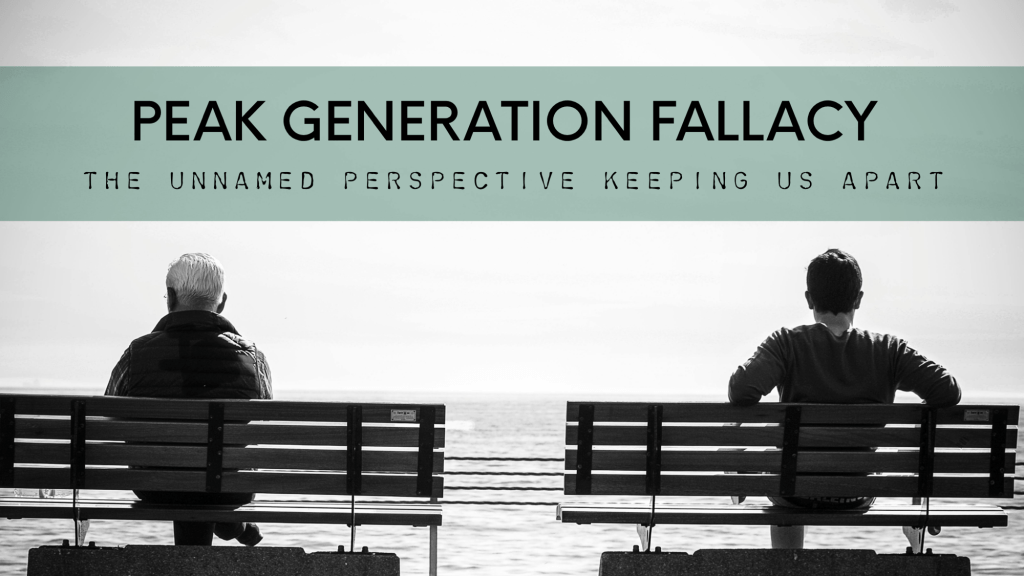
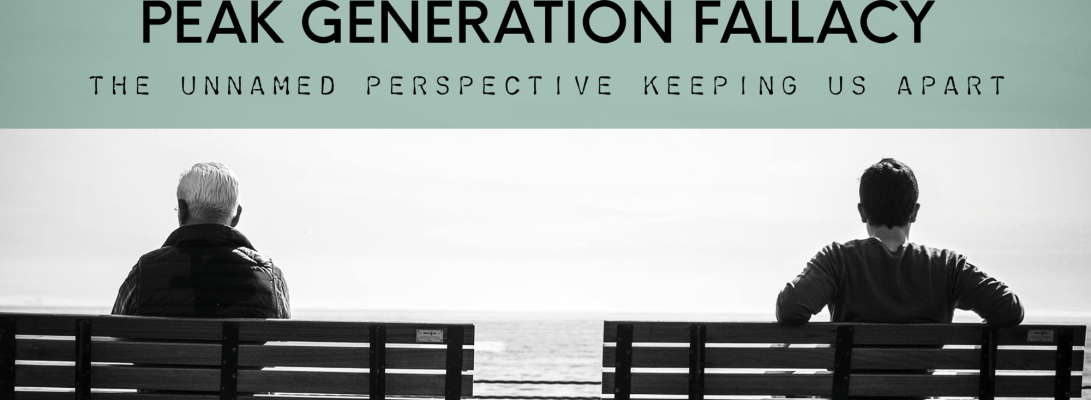
This is known as peak generation fallacy. The notion that we can all unthinkingly fall to the belief that somehow the particular generation we are part of is the one that has cracked the code! We’re the ones that have solved the problems generations before didn’t seem able to and accumulated wisdom well beyond that which our succeeding generations might ever attain.
As with most default positions or theses, it is founded in elements of truth. Every generation adds knowledge, adds technological advancements, adds research and understandings that mean we become (or have the potential to become) exponentially smarter. A simple proof of this is the recognition that right now on our hand held devices we have access to more information than our predecessors had in their entire lifetime.
Likewise, there’s definitely potential for the older generations to be wiser than the emerging generations. It is based on the assumption that the longer we live, the wiser we become, which must be tempered by the truism that living longer doesn’t necessarily make you wiser. Having more life experience and experiences doesn’t automatically make one wiser. It’s our capacity for reflection and analysis that grows us in wisdom.
Anyway you look at it, to whatever degree it may be actual, peak generation fallacy can be a default posture. And, as with any behavioural pattern or tendency, it will only be as effective as it is challenged and interrogated to be sure that it is true and serving us.
While we are believing ourselves to be more intelligent than our elders, we may create a gap of empathy, partnership or consideration between us and them and deprive ourselves of the unique knowledge and perspective they do possess. And while we believe ourselves to be more wise than emerging generations, we may be inclined to write them off, disregard their perspectives, and distance ourselves from them and they from our ability to mentor and encourage them.
Alternatively, if we embrace the idea that each new generation may be more intelligent than the one that went before, then that should inform how more established generations engage with emerging ones. We would be well served to consider the knowledge, information, skills, and perspectives younger generations have acquired. We might in fact, find satisfaction in seeing them go further to greater discoveries and efficiencies, launched and resourced by the learning and equipping of we who’ve gone before. What might it look like for us to perceive emerging generations differently? Through the lens of expectation that, fuelled by awareness of broader fields of study and research, access to larger pools of data and analysis of experimentation, they may indeed be able to teach us new things. What abiding knowledge might we offer to synergize with their new learning? How might our businesses our ministries, our families, our groups and teams be enhanced by intentionally seeking the learning of the emerging generation?
Likewise, if we are to truly consider that established generations are potentially wiser than those that are emerging, what is our own posture to the generations who have gone ahead of us? How do we seek to harvest, retain and leverage the wisdom of older generations? What intention would help to keep us from defaulting to our own wisdom and disregarding the well-won wisdom of our elders? How do we ensure that useful insight, thoughtfulness, discernment, and reflection aren’t lost to us – causing us to busy ourselves with reinventing wheels? How do we help our established generations continue in meaningful contribution despite the changing landscape and their changed life stage?
It’s called a fallacy for a reason – it’s incorrect to assume ourselves wiser or more intelligent based purely on our generational position. But while this tendency is unidentified or unnamed it can remain unaddressed even though it can be creating unnecessary and unhelpful generational divide.
What’s your take away? Where do you see this playing out in your work place, your church or organization; your family? What biases do you need to address in yourself? How might you challenge the drift to this thinking in order to champion healthy intergenerational engagement and valuing?