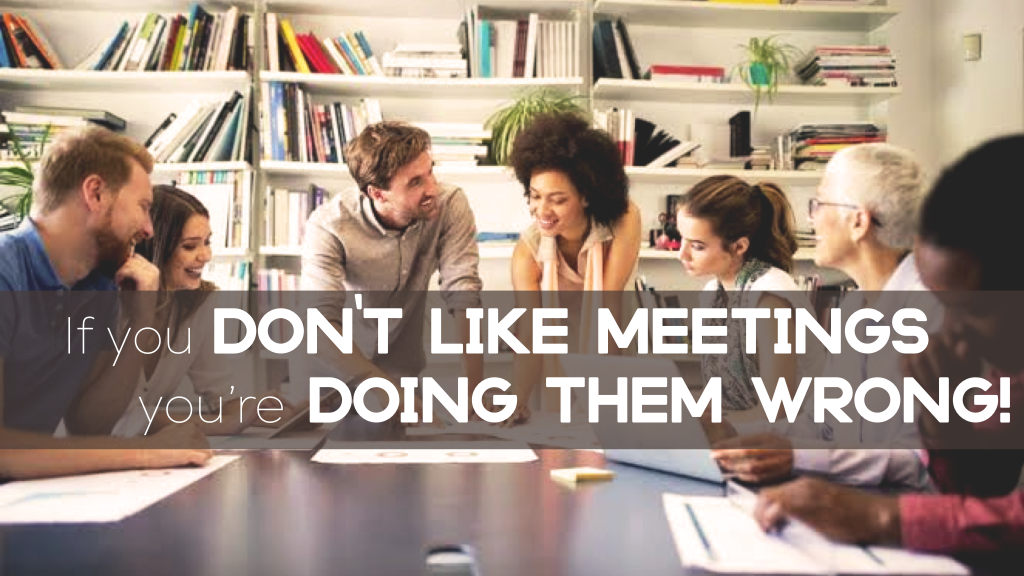
if you don’t like meetings you’re doing them wrong! (especially if it’s your meeting!)

“Death by meeting!” “Grrrr, I have to go to another meeting!” “Back to back meetings today, the worst!” Been there, felt that? Or at least heard it from others. Meetings can feel like the worst part of a job or a day. It can seem like they’re stopping you from getting stuff done. They can feel pointless or fruitless.

If that’s the case, you’re doing them wrong!
If you lead any people (or any thing), meetings can be the most powerful and effective tool in your leadership toolkit. In fact, organisational health specialist Patrick Lencioni says meetings are to a leader as surgery is to a surgeon. They are the place where all the skills, knowledge and expertise of a leader (or a surgeon) are demonstrated by doing what those skills, knowledge and expertise are designed to do.
The bad press meetings get is often less about the mechanism of a meeting itself and more about the mistakes we make or the lack of intentionality we apply when executing them.

Meetings bring your people together and so THEY should focus on doing what can only be done in person

Relationship and trust are the core, foundational characteristics of a healthy and productive team. As such, meetings should be leveraged for the ways they can contribute to a team’s relational culture. Building connection and trust is best done in person and so every meeting is an opportunity to strengthen relationships amongst your team (subsequently improving productivity, results and the felt experience of team members).

Sharing food, taking time to catch up on one another’s personal lives, learning more about each other, discovering differences and strengths, and deepening understanding of personal history and context are most successfully achieved in an in-person (or online as second best option) environment. Research also tells us that when people laugh together they will feel more relaxed and comfortable, they’ll have warm associations and memories of the team and gathering, and will trust one another more.

An intentional portion of a meeting and/or cultural expectation of meetings should be focussed on building relationship. For those who will struggle to find this “productive”, make it an agenda item that can be checked off! This will also lower participants’ fear that time is being wasted if it is an intentional and planned for element of your agenda and also part of what you are measuring in your meeting.

If it’s your meeting – ACTIVELY lead it!

Think back to some of the more frustrating meetings you’ve been in and they’ll no doubt include experiences like wandering off course, not following the agenda, unclear outcomes, mishandled conflict, one or two people dominating the conversation, unrelated content being tabled and given air time, presenters being unprepared or participants not equipped with necessary data or information or … I could go on but have probably already triggered some of you! But in your meeting, guess who is in charge of all of that. Correct, it’s you!

Participants will feel more safe and purposeful when a meeting is being well managed. Clear sign-posting language is key! “Now we move to agenda item C”, “That’s a great point but not our purview today, let’s note that for Thursday’s meeting”, “Let’s keep our answers brief in order to give everyone a chance to contribute”, and “So, this is what we’ve decided as our action step.”

DO NOT, I repeat, DO NOT check out of your own meeting! If you feel it’s got boring, irrelevant or uncomfortable in some way, imagine how those without leadership authority for the meeting might be feeling! Stay in the director’s chair and keep things moving. It will probably change your experience of the meeting as well as improving the experience for those attending.

Don’t do in the meeting what can be done by other means

In order to, as mentioned in point one, leave space for what can only be done when people are together, you’ll need to cull those things which can be done via other platforms.

Shared calendars or documents, email threads, and digital engagement platforms (Slack, Viva Engage, Whatsapp etc) are able to handle the transmission of facts, dates and data.

If (for example) an events calendar is available for all team members to access, sharing it in a meeting should be to add context or update changes, not just to read it out loud. Meetings are a good time to consolidate vision and mission and to check everyone is on the same page. Explanations or opportunities for clarifying questions are good. Reading large chunks of text or going too deep into the minutiae is a waste of the precious commodity that is your together time.

The planning portion of a meeting should be kept to a minimum. If a large event or project requires more team involvement it should have it’s own “planning meeting” or the time allocation should be well factored into the structure and communication of the meeting. (“This week we will be allocating time to plan for our upcoming super exciting event!”)

NOTE – Making this possible may necessitate an increased requirement of pre-reading, preparation or commitment to read and respond to other information as distributed. If some peopl come to a meeting unprepared, don’t punish the prepared ones by using meeting time to repeat what should already be known. Shape your culture by rewarding what you want repeated and having the “oh sorry, I didn’t read that email/article/memo” people feel the expectation to do so next time to more effectively contribute to the meeting.

Meetings can multiply impact

In a previous pastoral role I oversaw multiple ministries, programs and teams. In one instance, a regular hour long meeting with a key leader effectively “netted” me a 2 hour weekly program, significant leadership development for the members of her team and ongoing support and learning for her own development as a leader. When considered through that lens, that was potentially one of my most productive hours on my calendar!

A meeting should multiply your impact as a leader.

The investments you make in a meeting – creating healthy culture, networking team members to one another, offering learning and development opportunities, providing feedback and celebration, clarifying vision and purpose, food!!!, etc – can exponentially multiply your output beyond the chunk of time the meeting requires. As a team leader, 2 hours of effective investment in your crew will optimise the productivity of your team to achieve way more than you could possibly do in that 2 hours yourself. This is the way we must calculate the ROI of meeting time. The temptation to skip out on an hour long meeting must be hefted against the multiplication of impact lost.

Quick tips

Choose the right meeting for the specific context

A three minute standing meeting might be sufficient to keep a team moving day to day. Off site planning days have their place. Staff meeting over lunch can tick a lot of boxes at once. Varying levels of formality will be more appropriate for specific situations. Not every team, moment or decision requires a 2 hour all-in meeting. Assess the needs of the meeting and select the format that will best address them.

Don’t have people in the meeting that aren’t required

When you’re specific about what a meeting is seeking to accomplish you can be more selective in who is in attendance. Different teams and/or parts of teams will be more necessary to various stages of decision making or planning. Having the wrong people in the room could frustrate the process and frustrate them!

Prime your team members to the value of meetings

“I’m sorry to do this – a meeting is unavoidable – I know it’s annoying – I’ll try and make it as quick as possible – I’m just as irritated as you …” I already hate this meeting!! How we speak about meetings can shape the value we see in them and help orientate the expectations of our team members. “Let’s meet on this because there are important decisions to be made and you need to be part of that.” “I think if we allocate an hour to this we can identify some of the pain points and get our team back on track with this project.” “People have been working really hard on this, we need to celebrate them and help them see how their contribution is shaping our outcomes.”

Agree to rules of engagement

Value your team and their time, and build into a healthy relational culture, by having clear and implemented expectations. Speak to the behaviours and attitudes that can lead to the meetings after the meeting if they’re not addressed. The larger your team is the more articulated these expectations must be, but it is never advisable to assume everyone will contribute or behave the same way. Strong leadership is required to hold members accountable to agreed codes of conduct and to provide relational safety.

bridges, wineskin and armour (images of an unknown future)

In my previous blog, THE RIVER HAS MOVED, we saw the profound image of the Choluteca Bridge in Honduras. When Hurricane Mitch came through the area in 1998, the resultant flooding washed away the roads to the bridge and, when the waters receded, the Choluteca river had changed its course. It no longer flowed under the bridge rather had charted a new path alongside it. The bridge was left structurally sound but with no function. It didn’t bridge anything anymore.

As we find ourselves in the emerging stages of life after (and with) Covid, the Choluteca Bridge can serve as a metaphor for what many of us might be facing. The river has moved. Things have changed. Not everything is where we left it back at the start of 2020 when we found ourselves rapidly responding to the impacts on our work, family, communities, ministries and organisations as the pandemic swept the globe.

My writing ended with two questions

  1. How has the ‘river moved’ in your life, family, organisation, work, or ministry?
  2. What might you need to do differently as a result?

In this blog I want to offer two further metaphors or imagery as we consider our response to these questions.

NEW WINESKINS

In Mark 2:22, Jesus says shares this metaphor “No one pours new wine into old wineskins. Otherwise, the wine will burst the skins, and both the wine and the wineskins will be ruined. No, they pour new wine into new wineskins.”

Historically, wineskins were made from the hide of an animal, such as a goat. Partially fermented wine was stored in them. As the fermentation process continued it would produce gas that expanded the wineskin and stretched it. After the wine was consumed, to try and repeat this process using the same wineskin would be impossible as the hide was not elastic enough to stretch a second time. Instead, the fermentation process would likely split or pop the wineskin.

There are many ways this metaphor can apply to our lives – Biblical scholars often speak of the need to create new structures and new institutions, to not be rigid in holding to patterns and processes of the past but to be flexible, adaptable and stretch-able like new wineskins. But we must also acknowledge the challenge that Jesus was bringing not just to structures and systems but to us! To people’s hearts and minds. That we would submit ourselves to be new vessels for God’s mission and work. That we would be positioned ready to sustain future growth and change, elastic enough to allow for His Spirit to stretch and shape and mould us.

UNDERSTANDING THE TIMES

The Biblical story of David and Goliath is well-known. The Israelites, under King Saul, were in a battle with the neighbouring Philistine army which has been going for about 40 days and was at a bit of a standstill. The Philistines had a giant on their side (like, a literal giant who was over 9 feet tall!) and he was big, loud, strong and scary! He could lift more in a single battle weapon than most of the Israelite army guys weighed! He had been taunting and intimidating the Israelites to come and fight him. The prize was that the winner would have the entire losing nation as their servants. The Israelites were so scared they were going to lose and the people of God would go into servitude that they didn’t even send anyone to try and fight him.

David is a young boy who comes to the battle line to bring food for his older brothers. He’s not a soldier. He hears Goliath mocking and ridiculing the Israelites and he’s wondering why the people of God are so afraid. “I can do this! God has rescued and protected me in the past – he can surely equip me to beat this guy!” (You’ve gotta believe the Israelites were feeling slightly mocked and taunted from within at this point! The teenage boy, David, had more faith than all of them put together!)

King Saul approves David going to fight Goliath and the Biblical account tells us that “Saul dressed David in his own tunic. He put a coat of armour on him and a bronze helmet on his head. David fastened on his sword over the tunic and tried walking around, because he was not used to them. “I cannot go in these,” he said to Saul, “because I am not used to them.” So, he took them off.” (1 Sam 17:38-39

The picture here is of a still-developing young boy with an ill-fitting armour. Perhaps the helmet wobbled on his head and fell in his eyes and the breastplate reached to below his knees. They would have been weighty and cumbersome. Not what he was used to wearing out in the field as a shepherd, and not something he felt comfortable to wear to battle.

Physically and metaphorically, Saul’s armour was the old while David is a picture of the new. David was a new kind of warrior preparing for a different kind of battle. We know that in the end David took Goliath out with a well-executed swing of his sling shot – hitting Goliath between the eyes – the only unprotected part of his body. Felling him and allowing David to come close enough to execute him with his own sword (with the fairly gruesome detail of chopping his head off that is usually rushed over in the kids books and definitely not included in the illustrations!).

If God is doing a new thing, if we are looking to new frontiers, to different parameters of war, to a whole different battle ground – the old armour might not do the job.

As we look ahead to 2022 and beyond, we need to consider a whole new way of facing what lies before us. What has changed? How have dynamics altered? What new strategies and ways of thinking does it require of us? Might the old armour not only not serve purpose (after all, David didn’t need to protect himself from anything, did he?) but might it actually impede future progress? I can’t imagine David’s rock slinging might have been so on target if his helmet was slipping from his head and the heavy tunic was restricting the movement of his arms.

In 1 Chronicles 12, we see an older David who is king-in-waiting while the wheels are starting to fall off Saul’s Kingship. A band of men begin to assemble around David. All sorts of groups offering various battle equipment and fighting skills. Then, in verse 32, there were 200 chiefs from Issachar. The description of their contribution is that “they understood the times and they knew what Israel should do”.

As important as any tactical or practical offering is the ability to see what’s happening and respond accordingly. To know the lay of the land. Who is the opposition, what are our assets, what’s the goal, what’s the best strategy, what’s changed, what’s required, who is best, how is best, when is best?

QUESTIONS

And so we add to our previous question as we consider what we might need to do differently as a result of the changes that have taken place around us.

  1. What are we doing to allow God to renew and refresh us to be receptacles of the new wine, the new thing that He might want to do in and through us?
  2. Do you understand the times? Have you taken inventory to really know the new lay of the land so as to know what to do in response?

make zoom great again

As our perpetual state of lockdown, locked out and varying levels of restrictions drag on – the constant refrain we are hearing is how people are “so sick of Zoom“!

I put it to you that people aren’t sick of Zoom, they’re sick of bad Zoom.

I recently attended an online, 80’s themed, Murder Mystery party for a friend’s birthday! It was such a clever night and a great way to celebrate our friend while still in lockdown! We all had a character and most of us dressed up (costumes are easier online because they don’t need to be transportable and they only need to be from the waist up! No pants or shoes to match your costume? No worries!! PJ pants and ugg boots it is then!!). Each household had readied snacks and drinks. No one was complaining about being on Zoom! Saturday night at 8pm for a couple of hours and Zoom was our best friend.

People aren’t sick of Zoom, they’re sick of bad Zoom!

So what makes Zoom good or bad? Bearable or intolerable? Fulfilling and productive or life-sucking and downright depressing? Here are a few of my observations and thoughts.

A MEETING THAT SHOULD BE AN EMAIL IN PERSON SHOULD STILL BE AN EMAIL IN ZOOM-LAND

Don’t assume that a team’s desire to be together will override the frustration we all feel at being in a meeting that should have been an email. Endless recitation of facts, details, calendar items and reading through text heavy PowerPoint slides is not what meetings are designed for and are not a good spend of your Zoom-credits. Meetings exist for relationship building, collaboration, learning, vision casting and role assigning. Send the details ahead of time or circulate them for reading afterwards. Too much information sharing translates to a monologue that is hard to sustain in a physical room let alone a virtual one.

ZOOM TIME IS DIFFERENT THAN REAL TIME

There have been multiple studies and papers released about the realities of Zoom-fatigue. It takes greater effort to remain focused due to audio differences and the reality that our computer’s other open tabs and notifications beckon. We are more self-conscious and aware because we are more visible to ourselves and others than we would be in a physical meeting space – we consequently expend energy managing our appearance, body language, facial expressions etc more than is necessary in real life. There’s less “collective effervescence” – the experience of laughing together, rapidly exchanging ideas and energising creative interactions – because of the clinical need to take turns to speak and the inevitable annoyance that comes when audio intersects and gates. We are more sedentary – less likely to adjust our sitting posture. And a multiplicity of other factors that mean an hour on zoom costs us more than an hour in real life.

If you would normally meet for an hour, meet for 45mins. Normally present for 30 mins? Try 20.

Clearly communicating (and adhering to) the proposed timeline of a meeting will also help participants pace themselves and increase their capacity to remain engaged for the entirety of your time together.

ZOOM MEETINGS REQUIRE STRONG LEADERSHIP

Even more than in real life, whoever is hosting the meeting must work actively to maintain control of the meeting. Establishing and communicating expectations about how this meeting will function is important. Having a clear sense of flow – minimising down time between segments or presenters, reducing talk about the mechanics of the meeting, and making definitive statements about transitions between topics or modes – will help a meeting feel more in control and purposeful. In real life, we can use body language, non-verbal clues, physical actions, facial expressions and other means to demonstrate we are wanting to move on. This doesn’t translate so easily to Zoom and so it takes more effort to keep tight reign of oversharing or meandering contributions. But it is essential for maintaining the engagement of the entire group.

The size of your group will determine what degree of “free-flow” is manageable and helpful – whether microphones should be muted or open (for example). Leaders should feel the liberty to request participants to make changes for visual or sound quality purposes (Turn the radio off. Tilt your screen up a little. Close the curtain behind you.). Who is in your group will determine how much ‘power’ you give participants and how much you restrict to host privileges. The more interruptions that come because of mismanagement of the meeting dynamic the more frustrated and fatigued participants will become.

ZOOM SKILLS & ZOOM BUDDIES

Zoom has customised their platform to have multiple functions that can make meetings more dynamic and a more accurate replica of in-person gatherings. Whiteboard, breakout rooms, chat function, screen sharing, split screen viewing, emoji responses and other options are great for changing up the presentation mode and inviting interaction. However, they can be hard to navigate while maintaining a helpful dialogue.

“And the o….therrrrrr … thiinnnnn …ggggg … I’ll just share my scre … oh, nope, …not that .. and yes, the other thing is … ”

You’ve all done or heard a version of this. The more practiced you are in the engagement of these tools and the more advanced preparation you do, the smoother these things will flow. But if it is at all possible, I recommend traveling in pairs! A co-host who can mute the person whose dog has started barking in the background, or rearrange breakout rooms to accommodate people who’ve joined the meeting late, or interject with appropriate questions or comments participants have made in the chat allows the presenter to keep full focus on what they are communicating or on listening fully to the contributions of a participant.

VIDEO ON OR OFF?

Research indicates that having the video muted increases the energy and longevity of participation for group members, but it reduces the feeling of engagement for the presenter or leader of the meeting. It can also impact the feeling of shared experience if not all members are visible on the call. What are they doing? Are they fully engaged? Have they gone to the bathroom? Are they doing other work?

This can be detrimental to the accountability and commitment of team or group environments. If there is disparity between perceived engagement in a group it will be hard to reach consensus or for participants to conclude a meeting feeling it was effective or productive. This can quickly diminish engagement from participants – why should I have my camera on when others don’t?

A quick statement of expectation from the meeting leader is helpful to establish expectations. “It’s fine for your cameras to be off for this next segment …” or “Can I have all cameras on just while we sort out our decision on this?”

Likewise, narration from participants can bring understanding and build (rather than erode) trust. “I need to have my camera off right now because my child is doing something in the space I’m in” or “my internet is lagging so I’m switching off my camera to hopefully see yours better”.

Some notes for you, the presenter, it’s important that participants see your face well lit and well positioned (not up your nose!) in camera. And research also indicates that seeing your hands is helpful for trust and engagement from participants. If nothing else, the movement you generate on your screen will help re-engage and keep engaged those watching you. Be sure to toggle quickly between shared screen and your video screen to maximise involvement.

EMBRACE THE ZOOM!

As much as it is a distant second place to real life gatherings, Zoom has afforded us a level of relational connection and ministry/work functionality that we would not otherwise have been able to experience during these last 18 months. I would go so far as to say I LOVE Zoom because it allows me to replicate my work contexts and output in a way that means I’m still employable (!) and I am still actively engaging my gifts, skills and passions.

It is what it is and where it is for the foreseeable future. We would do well to embrace that reality and work to maximise its offerings rather than perpetuating the frustration of both attitude and experience.

In my world, Zoom has opened up opportunities that would not have existed for me in real life. Participation in multiple overseas conferences, workshops and forums. Learning from ministry leaders and key thought leaders of a status and location that would be otherwise inaccessible. Maintaining relational connection with family and friends through shared meals, celebrations and online experiences. I love Zoom!

**THE MOST IMPORTANT POINT**

Make sure you laugh! Do what you need to in order to elicit laughter from the group. Even if you can’t hear it or they can’t hear each other – psychologically we know that our brains associate laughter with comfort. We are more likely to recall a meeting positively if we have laughed at some point – even if the meeting itself was weighty or long. Laughter releases happy hormones that increase wellbeing and shift attitude. Do what you gotta do!!! It can take an inordinate amount of effort. It can seem frivolous or time wasting. It might be uncomfortable to deal with the silence (or the sound of your solitary chuckling!). But it is well worth it. Make laughter a goal of every gathering you are part of.

How about you? What steps might you take to Make Zoom Great Again and maximise it as a resource to us while we navigate these strange and challenging times?

3 things to look for in a mentor

Everyone should have a mentor (read here – 3 reasons you need a mentor) but sometimes it’s hard to know exactly who you are looking for. Here are three characteristics I believe are worth considering.

Find someone who is successfully doing something you want to do successfully. 

Be it in business, parenting, leading, discipline, advocacy, finances, study, fitness or relationships – whatever you are hoping to grow in, develop or attain – your mentor should be demonstrating elements of that competency. They should be further down the path than you. They should have the wisdom to be able to assess and articulate how they came to be successful – a person who can’t describe what they did to bring them to their current stage of life, work, serving or character will not be able to teach or lead you to a similar destination.

Find someone who allows you close. 

A good mentor will let you understand something of their life – of the path they’ve walked and the context in which they’ve developed their character, beliefs and skills. Beyond what they might teach you from their learning and wisdom, a great mentor will allow the story of their life to bring application and a shared sense of journeying.

There should also be a degree to which the vulnerability you express to a mentor is honoured with their own vulnerability. The safety of such an environment will allow the relationship (and you) to flourish.

Realise you might need more than one someone. 
Because your life is diverse and you are likely to be engaged across a number of roles or circumstances it may be most beneficial to have more than one mentor rather than expect one person to meet all your needs. Across the journey I have had a variety of mentors – each leading and investing in me in particular areas. I have had mentors around communication and preaching, generations ministry, being a female in leadership and ministry, writing and publishing, leading at the next level, and those who are more invested in pastoral care of me.

Finding one person who can be all things to you might be unrealistic.

What would you add to this list? What have you found about your own efforts to have a mentor or as a mentor others?

in series 

// 3 reasons you need a mentor
// 3 reasons you should be a mentor

being who you needed 


When you think back to your younger years you can, no doubt, identify the people who were most influential in your life …and also the glaring absences of significant adult input in areas you perhaps needed them most. 

“Be the kind of person you needed when you were younger.”

This quote resonates with me as a way to frame our reflections to position us to be the best navigators we can be (you can read more about that here – navigating life’s rough water). As we consider what we EXPERIENCED and also what we LACKED we can be more dialled in to those things in the young people entrusted to our care – be they family, friends, students or members of our ministries. 

  • Someone to validate (and help me understand) my personality

I spent most of my teen and young adult life being criticised for my personality. You’re so loud! Why are you always so happy? Stand still! Stop being so dramatic and exaggerating. I came to accept that my personality was innately flawed. There was no one else like me so there must be something wrong with me. I oscillated through varying degrees of resignation and defensiveness. 

If I could speak to my younger self I would tell her that her Tigger-ness is a gift. That her capacity to see and bring joy and celebration is needed in this world. That her optimism and enthusiasm bring light and life to those around her. I would tell her that she can learn about time, place and volume in order to not inflict herself upon others in negative ways. I would tell her that others aren’t like her and she needs to understand them and help them understand her. 

  • Someone who asked questions about who I was hoping to become

Teenagers don’t have the capacity to see very far into the future. That’s not a criticism, it’s a natural function of their forming brain. Teens are not able to perceive consequences to choices, to see value in waiting for a better option or to understand how each decision they make is shaping the person they will become. 

If I could speak to my younger self  I would ask her to keep describing and refining the future she sees or hopes for. Who she wants to be – family, work, faith, reputation, character, relationships. So that she would have a filter to process decisions and reactions through. Does this lead you to who you want to be? Does this shape your character and your reputation in a positive way? She may not listen to me – but that wouldn’t stop me asking!

  • Someone who could help me understand myself. 

When I was 11 my Dad left our family and, of course, I felt the impact. Part of my response was to be quite needy of male attention and affection and so I fought really hard to get it. I joke (with embarrassment) that I could “flirt for Australia” such was my competency at eliciting the kind of response my heart was seeking from guys. 

If I could speak to my younger self I would tell her that she is enough on her own and that she will never find what her heart is really craving in the places she is looking. I would help her to not let the vulnerabilities of her heart lead her to bad choices and regret. 

  • Someone who identified and encouraged me into my gifts 

Growing up I was blessed to have people who released me to explore my giftings and passions. I was only 15 when I led worship for the first time in our church and younger than that when I was given responsibility for the babies and toddlers ministry. I was constantly affirmed for my natural capacity to engage with kids and given leadership roles at school. I was given scope to explore my sporting abilities and also those in musical arts. 

If I could speak to my younger self I would remind her how blessed she was to have those opportunities and keep encouraging her to maximise the chances to experiment and engage. I would mentor her more intentionally to learn and grow in her understanding of God’s hand on her life and His desire to use her for His Kingdom purposes. 

What about you? How do you reflect on the people you had or needed when you were younger? How might that shape the way you invest in younger people in your world?