curiosity breeds connection – the power of empathy

When I was a young girl, I wrote poetry. Instead of journaling, I recorded all of my teenage angst and emotions in prose – book after book, page after page, pouring out my heart. I reflected on relationships and events, narrating life as I observed it. I’ve kept some of those books, although I’m not entirely sure why, since (for the most part) I have no intention of ever releasing them for anyone to read.

One particular entry, written by 15 year old Kimmy, was a bumbling attempt to process my emotions after experiencing a broken heart. I can remember very clearly the boy, the relationship, the experience. I had fallen hard, and we were as deeply invested as teenagers can be – but the relationship had come to an end.

The final line of the poem says: “People tell me to get on with my life, but he was my life.”

Could it get any more dramatic? Kimmy was clearly feeling the full depths of love lost and trying to navigate the emotional minefield and social implications of breaking up. He was my life! I have no doubt that in that moment, it felt like a true statement.

However, on the next page – dated the very next day – there was a new poem, written about a different boy! It opened with the line: “He smiled at me today.” It would appear the broken heart had recovered – and if not completely mended, had at least been distracted enough for the attention of another boy to become poem-worthy. It’s a mildly embarrassing snapshot and memory, but very real in the moment. And I dare say, a realistic capture of me in my teenage years.

That moment was decades ago now, in a very different time. If 15 year old Kimmy were navigating life today, experiencing those same emotions, the same devastation, the same yo-yoing of feelings and the same immaturity – but in an era of internet, devices and social media – I am completely certain that it all would have been plastered across my various accounts and apps.

I would have been sharing without caution or consideration of the implications – using social media as a place to vent and process my feelings. In a culture of sharing, high visibility and low filters, I doubt my level of emotional intelligence would have risen above that of any other teenager. The whole story would have been public for everyone to see. Opening myself up to the scrutiny and commentary of peers whose prefrontal cortexes were no more developed than my own.

I’m sure many would have expressed sympathy – maybe even a few sad face emojis – but then, when I shared my miraculous recovery and redirection of affection the next day, those same peers would have judged and commented again. I would have opened myself up to all kinds of criticism, and to the stories others might tell about me – about my choices, my character, my responses. All of it public. Exposed. Vulnerable.

I am eternally grateful that the era I was raised in means I just have a single copy of my handwritten words, sealed in a diary, in a box, hidden in my garage – rather than a digital footprint with a public audience and content no longer in my control.

That small vignette – this snapshot of my teenage years – compared to what life might be like if I were a teenager today, moves me to the deepest empathy for what young people face now. That one story alone makes me ache for the challenges and complexities teenagers must navigate in our current culture.

I am 100% convinced that 15 year old Kimmy would not have handled social media well. That she wouldn’t have had the maturity to make good choices about what to share or with whom. She would have been highly susceptible to the comments, likes and views of others – an my teenage years were hard enough without that!

When you think about your teenage self, what do you imagine you would have been like if social media existed back then? Not how you’d use it today – but how the teenage you would have used it.

That’s the point of empathy. That’s how we are able to empathetically engage with what young people are facing today.

Emerging generations need our empathy. They need our empathetic responses.

Empathy is the posture of seeking first to understand – desiring to fully know the experience of another in order to appreciate their perspective and support, encourage, and connect with them. Empathy moves us to question and inquire. It calls us to find a place of commonality in our shared human experience, even if that life is lived differently – in another environment, culture, era, or set of social norms.

The opposite of empathy is judgement.

Judgement comes more effortlessly. It’s easy to criticize what we don’t understand – to observe behaviour, response, decisions, and actions, and to draw conclusions rather than be drawn to curiosity.

Any time we find ourselves saying things like “those young people” or “they always” or, the classic “in my day…”, we’re perpetuating a generational gap that will ultimately cause us to lose our voice and influence.

A desire to understand will lead to far more fruitful engagement with young people. When we give them space to share their perspectives, priorities, and worldview, we nurture the kind of connection that opens doors. Allowing us to be trusted advisors and helpers.

Empathy is a muscle that must be exercised.

It’s a discipline we must choose, again and again, if we’re to stay within hearing distance of others. A posture of empathy means that moments of misunderstanding, confusion, or even exasperation become doorways – opportunities for greater connection – if we engage curiosity instead of criticism.

“I just don’t understand young people” becomes “Help me understand.”

Tell me more!
What do I need to know about how the world feels for you?
What would help you feel that I understand enough to be trusted – to be helpful – to be a voice of wisdom gained from my lived experience?

How might you come to believe that I am coming from a place of care and understanding? That my desire is for you to flourish and live the best version of life possible.

The challenge is clear for all of us. The next time we hear ourselves or others making sweeping statements or generalisations about young people, might we pause – suspend judgement – and seek first to understand.

I remember enough about being 15 to recall how certain I was that adults didn’t understand me or the age I was living in. I rejected advice, dismissed opinions, and scoffed at how out of touch old people were with life as I knew it. Young people today are no different. They are no more mature, no more cognitively or emotionally developed. The teenage brain is not just a smaller version of an adult one. Its chemistry and biology are entirely different.

Perhaps it starts with replacing statements with questions. I’m sure it starts with suspending judgement and conclusions. And we will most likely face resistance and hesitation. But each attempt – each expression of curiosity and a desire to understand – builds relational trust and maintains proximity. That proximity allows us to be of greatest value to young people: in life, in faith, in decision-making, in protecting their hearts. And ultimately, in setting them up to win.

I’m ok – but being ok is exhausting

“Are you ok?”

Well, yes, I am. I guess.

In many ways, I’m better than ok. I have my health – not just for right now, but I’m also not in a high risk or vulnerable category that would make that uncertain or a source of fear. I have a beautiful home – if I was going to be ‘locked down’ anywhere, this is a pretty sweet locale for it! I have secure work – not just because I keep getting paid each month, but because the organisation I work with has incredibly supportive and sensitive leadership and colleagues. I am well-resourced and appreciated.

There are lots of other things that make me ok. The Victorian winter has been decidedly un-wintery … lots of days of beautiful sunshine and bright blue skies where too many grey skies and shut in days might have made the heart more cloudy and gloomy too. The internet! Let’s pause for a reverend moment of acknowledgement for the gift of the world wide web to us in these times! It brings the people into my home, allows me to be present where I’d otherwise miss out, and it delivers all these fabulous packages to my home (side note – who pays for the internet shopping bills? Just checking.).

So, I think I’m ok, thanks for asking.

But being ok is so exhausting.

Holding my okayness requires so much of me, it feels like another full time job. Above all the adult-ing and general life stuff there’s an extra portion of energy required to ‘be ok’.

Living on my own has always had its considerations when it comes to boundaries and routines. Bed times, home times, meal times, play times have no element of external imposition. And the challenges for me as an extrovert living alone have been well-documented. Our current circumstances have magnified and multiplied these things. Decision fatigue is real, and the self-motivation & self-discipline demands are next level. Add to that the pervasive uncertainty, the rapid change, the empathetic grief and loss, and also some personal disappointment and hurt.

And all the while, the usual avenues for emotional energy top-ups have been altered or completely closed off. I have gone multiple days without seeing a live human being! Instead of joining a congregation for worship and ministry I record a message to a camera in my lounge room and send a link. My Physio appointment last week was the only time I’ve had permitted physical contact with another person in … well, too long! I am missing opportunities to celebrate friends or gather with family.

So, I’m weary.

It is what it is. And it could be far worse. I’m so grateful for so many provisions and blessings in this season. I’m really ok. I am. But acknowledging the reality of the extra energy expenditure releases me to be ok with the moments it feels a bit too much. It permits me to be gentle with (and even more generous to) myself.

It also raises my consciousness of the unique struggles others are dealing with and prompts me to grace when that pressure leaks out for them in fear, complaining or even aggression.

Being ok takes more effort right now. Which might be why some people are not. And might explain some of the fatigue for those who are.

reflections on gratitude (2019)

I’ve been keeping a Gratitude Jar for several years now. It started as an intentional practice to invite ongoing joy into my life and as a discipline to choose to filter a day through the lens of what it was rather than what it wasn’t.

(You can read about the why here – disciplines of gratitude)

My Gratitude Jar is a collection of small, dated pieces of paper sorted by month and waiting for me to write a reflection for every day. My practice has been to do it as part of my end of day routine. To pause and think of a couple of sentences worth of things to be grateful for. Sometimes the words flows freely and the page is too small. Sometimes the blank space is something of a taunt as I sift through a weary or sad heart to find something to write. I’ve found over the years that just the act of walking past its spot on my dresser is enough to activate the mechanism – and even if I don’t write it down, my heart is turned to gratitude. The habit of that has been a gift to me. As my friend Mel says, “I’m grateful for the gratitude.”

At the turn of the new year it’s time to dive in and read them back. I love to gather them in groups to see those things that get some more regular mentions – names that are repeated, evidences of themes and affirmations that are finding deep roots in my soul, the number of times I can be “surprised” by something before the language turns to that of expectation or acceptance.

2019 was a year of stark contrasts for me and my notes reflect the extremes. There were so many aspects of my life in 2019 that were beyond anything I could’ve imagined but simultaneously this ran parallel with times of deep loneliness and grief.

From the highlights column – some general themes.

Loving my work –

I am so grateful for a work context that has such a healthy and empowering culture. Not only do we get to do meaningful work together, we also celebrate well and have heaps of fun. I feel highly valued and appreciated, and totally resourced to be a blessing to all those I meet and minister with. I constantly reflect on how perfectly Kimmy-shaped this role is – where all of my gifts, skills, passions and experiences are utilised and where there are no limitations to exploring all God would lead me to do and be.

Amazing ministry opportunities –

Both inside and outside my BUV role, I am grateful for all of the ways I’ve been able to minister this past year. I’ve been in some great locations – locally, interstate and overseas – and in a variety of contexts – podcasts, preaching, workshops etc. I’ve spoken to some fabulous groups and been honoured by the trust of others expressed in mentoring and one-to-one moments. I’ve been encouraged again and again by the continued ministry impact of my book as it keeps finding its way to the ears and hearts of those most needy of it. I saw the amazing impact of the KidsHope relationship (and did the sad farewell to my special friend as well as ending my 13 year involvement in the program). I was blessed again and still by my involvement in the Arrow Leadership community.

Friends & family –

I regularly marvel at the high caliber of people I know. As I travel the country (and parts of the world) I am convinced I know all of the best people in those places! I say it again, you should be my friend just so you can know my friends. I am truly blessed by those who invest into my life, welcome me openly and allow me the privilege of loving and serving them. Amazing people who nurture my soul by seeing, knowing and championing me to be the best Kimmy I can.

We also welcomed a new niece-husband, 2 niece-babies and a nephew-fiancée into our family. It was so great to christen the new home with a family Christmas gathering on Boxing Day. So exciting to fill the space with stories and memories and laughter.

A refreshing church –

In 2018, it was prophesied to me that OneHope would be a church of refreshment. That I would go out (to minister beyond my previously understood boundaries) and come back to be refreshed. And that has definitely been my experience. I’ve been so blessed to truly find a home amongst the people of OneHope. A place to exercise my ministry gifts and capacity with maximum impact. A place of honour and embrace. A place of relational engagement across generations and with a diverse spread of people. It wasn’t an easy process – settling in a new church is hard work! But the rewards of persistence have been many. I’m excited for what this next year will hold – especially now that I’m living 2 mins from my home campus.

Baking and making –

There was a repeating thread throughout the year around my love for baking and making. I love the process of creating (made in the image of a creator God!) and love, love, LOVE the opportunity to bless others with what’s produced. I need to do more of it. Does anyone need some cupcakes? Or a crocheted something?

Adulting –

I did some pretty grown up things in 2019.

Like renovate my bathroom, toilet, en-suite and laundry. Of course, I didn’t actually do any of it – but I did do all the deciding and 100% of the paying!!!

But it turned out to be a well-chosen investment into the value of my home that facilitated me buying another property in Geelong. Again, I didn’t do much of the actual things but, again, I decided and paid!

#choosinghowtolive underscored all of that process. I’ll reflect more at another time on all of the aspects of lifestyle and posture that God laid on my heart that have culminated in the new iteration of The Tent (read here why I (happily) live in a tent).

The process of decluttering (I estimate I reduced the amount of things I own by more than half!!!!) was a sometimes traumatic but ultimately rewarding process. I’m glad to start here free of a lot of unnecessary things and having blessed a whole lot of others with items they’ll be making much more use of rather than them sitting in my cupboards (or in piles randomly scattered throughout the house)!

From the lowlights side of the ledger.

I struggled with living disconnected. My work was over there and my church community was over there and I was in the middle. After 18 years of living, working, churching and playing in the same area it was a massive adjustment. And, ultimately, I was just sleeping at my house. It did pretty much zero hospitality – which is what it was consecrated for – and not enough hosting of life, activity and ministry. Sure, some of that is just geography but with it came some grief for all that had changed and had been lost – and some hurts that still attach themselves there – that made for some pretty low times.

My health was a challenge. “The change”, as we delicate women-folk might reference it, has been a significant physical challenge as well as an emotionally difficult thing to process.

Also, on reading back through the gratitude notes, I’m reminded of the battle I (largely) lost to regain my confidence and rhythm in writing. It was going to be my year for getting back on the writing horse, but I didn’t manage more than a few rides before I was bucked off – and for the most part, I didn’t even mount up! I could keep the analogy going but that would be like flogging a …

gratitude in 2020

So, the jar has been reset. The first 7 days have been logged. There is great expectancy as things rev up for the new year.

My usual questions for end of year review

  • How is my relationship with God?
  • How are my relationships with family and friends?
  • Am I remaining open to “relationship”?
  • What new things have I learnt or experienced in ministry?
  • What “project” did I complete?
  • How is my health and fitness?

..are all mostly answered in the above reflections.

I’m excited for new opportunities at work and in ministry. For a new local neighbourhood to explore. For a new era of “Tent-life” to unfold – including an extension and some extensive renovations! For improving health and fitness. For deepening relationship with God and with my family and friends.

I will keep inviting and welcoming joy into my life by CHOOSING GRATITUDE.

disciplines of gratitude


For the last few years I’ve kept a “thankfulness jar”. 


The last thing I do each night before getting into bed is to pause and write a couple of sentences of gratitude for something that happened during the day. 

Some days it is really easy. I list off fun activities, great Ministry moments, joyful interactions with friends & family, experiences of wonder, tasks accomplished or things learned. 

Some days are harder. When I’ve been sick, when work has been hard, when I’ve spent the day alone; when my heart is burdened, these are the days I want to get into bed as fast as I can to bring them to an end! 

However, when I stand before the small piece of paper with a pen in hand, looking at an ever-filling jar of other moments of gratitude, I never fail to find something to write. 

Sometimes I’m just thankful that tomorrow is another day and another chance to do better. Sometimes I’m thankful that those days that are hard are offset by many days of joy and hope. Sometimes I’m thankful for specific people who God brings across my path to bless, inspire, encourage and support me. Sometimes I’m thankful for stewed apricots or a house full of people or God’s grace or a great movie I’ve watched or sore cheeks from laughing or new stationery or a new experience …the list is as diverse as it is endless. 

The discipline of gratitude is a necessary part of grounding my heart and mind in the truth – particularly when I am weary or despairing. It resets my internal dialogue – interrupting any negative thought track by forcing me to consider something positive. 

In moments of celebration and joy this discipline draws the attention of my heart to reflect on the source of those blessings, growing my faith and deepening my trust. 

What about you? Do you have any practices of gratitude that you regularly do? Maybe a daily discipline like this could be a place to start?

character is not a competition


“I’m not talking to your brother right now, I’m talking to you!”

These were some of my least favourite words when getting disciplined as a child. If I’d been fighting with one of my brothers or together we had done the wrong thing, my Mum would send each of us to our room to think about what we’d done. When she came in to talk to me I was always ready to tell her how the actions of a brother had led to my behaviour. And she would shut that down – you always have a choice, your actions were either right or wrong, this is not about your brother it’s about you. 

Character is not a competition. 

She was right. My brother’s selfishness didn’t excuse my own. Their dishonesty didn’t justify mine. Their poor management of their anger or frustration didn’t relieve me of the need to be patient or tolerant. 

Character is not a competition. 

Your character is about YOUR honesty, generosity, integrity, reliability, graciousness, humility, strength, compassion, genuineness, service, respect and patience. It is not being ‘more honest’ than the next guy or ‘more generous’ than another. Your character is about you. It’s about who you are in your unchecked self, when no one is looking; when there’s nothing to be gained as much as it is revealed in your responses to adversity, disappointment or stress.

When your character is questioned it is never a suitable defence to compare yourself to another. That can be an exceptionally low bar. Prisons are full of people who demonstrated blatant disrespect for the law and for others – they don’t become the new standard for our behaviour! Sexual misconduct isn’t minimised by comparing it to a rapist. Dishonesty isn’t made okay because ‘at least you didn’t embezzle millions of dollars’. You will always find someone whose actions are worse than yours but that doesn’t make yours better. 

Character is not a competition – it’s a continual striving to be humble and teachable to have who we are refined. To be constantly becoming more of who we could be – increasing in reliability, compassion, other’s focus, tolerance and forgiveness. A mark of poor character is a person who will point to the actions or attitudes of others as a means of deflecting the focus or requirement from themselves. 

Hear my mum’s words “I’m not talking to them right now, I’m talking to you!”

the discipline of preparing for an unknown future 


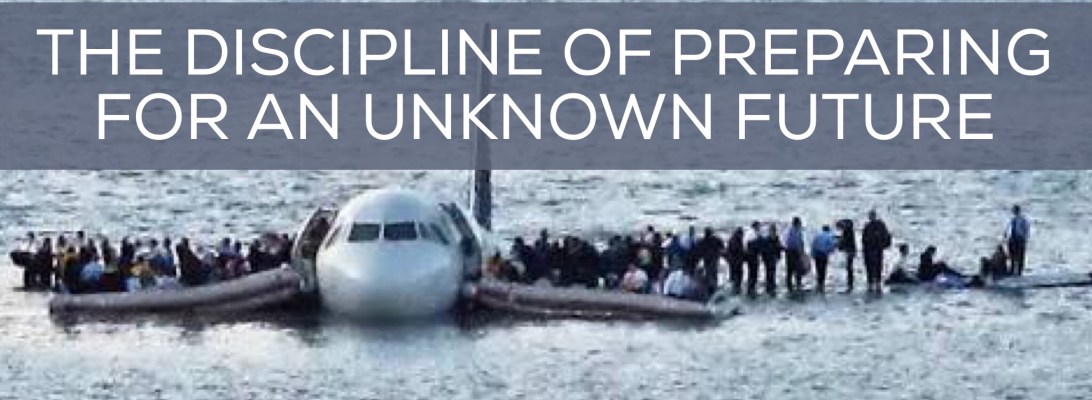
On January 15, 2009, Captain Sully (Chesley Sullenberger) was at the controls of US Airways flight 1549 out of La Guardia airport New York. Not long after take-off the plane struck a flock of geese causing the immediate loss of both engines. 

After following all the emergency procedures, including mayday communications with the control tower, Sully determined their safest option was to do a water landing on the Hudson River off Manhattan. 

There were 208 seconds between the engines failing and the plane successfully landing on the river – saving all 155 passengers and crew. 208 seconds. Less than 3.5 minutes. Where, in an unprecedented situation – not predicted or specifically prepared for, Captain Sully had to make decisions and execute actions that had weighty consequences. The lives of all on board – and potentially many on the ground had the wrong decision been made – were in his hands. 

He summarised it this way… 

“One way of looking at this might be that for 42 years, I’ve been making small, regular deposits in this bank of experience, education and training. And on January 15, the balance was sufficient so that I could make a very large withdrawal.”

Discipline. Many years of discipline. Showing up. Training. Learning. Doing. Watching. Teaching. Discipline. 42 years of multiple unspectacular flights and potentially tedious safety reviews and refresher courses. 42 years becoming sure of his own skill, an aircraft’s capacity and his crews’ competency. 42 years of delivering over a million passengers safely to their destinations with little acknowledgement beyond his pay check.

Discipline. 

For you feeling stuck in the mundane. These small deposits are shaping your life. Doing your best today. Growing, learning, adapting, persevering. This is the substance you’ll draw upon when the stretch comes, when life is difficult. 

For you in the bumper times. This is the time of filling and preparing. This is the time of storing up – joy, confidence, habits, attitudes and character that will sustain you and others in times of hurt, confusion and doubt. 

For you in the 208 seconds. Pause and recall what you know outside of this time of pressure and intensity. Remember your “experience, education and training“. Lean in to the strength that has been deposited in you knowing God’s power will be manifest in your weakness. 

How far can I go?

When it comes to the topics of “Sexuality and Relationships” and youth and young adults the two most frequently asked questions are “How will I find ‘the one’?” (refer last week’s post on making decisions) and the big one “How far can I go?”

How far can I go? It seems like a pretty reasonable question. “Where is the boundary? Where is the line that I shouldn’t cross? Tell me what I can and can’t do – define it for me and then I can manage my behaviour accordingly.” Continue reading