rejecting objectification 

objectification : treating someone as an object rather than a person 

sexualisation : to make sexual 

pornification : the influence of pornographg on attitudes, behaviour and culture 

Objectification, sexualisation and pornification … we’re soaking in it! You don’t need to look too far to see this is true. A short stroll through a shopping centre, a flick through any magazine or catalogue, 3 minutes of online activity, or one episode of a TV show and you will be bombarded with images and messages that carry these themes.
These are some of the causes behind an alarming rise in domestic violence, assaults and sexual assaults, reported sexual activity and sexual regret, sexual addiction, young women presenting with health issues relating to aggressive sexual acts, erectile dysfunction in younger males, sexual addiction and related consequences (including financial, relational and career) … and the list could go on.

“The standard we walk past is the standard we set.” Melinda Tankard Reist

Education and awareness are key. We can shift attitudes and change our culture by increasing our alertness and sensitivity to the examples of exploitation, objectification and sexualisation we see around us.

We need to start asking more questions and developing our capacity to translate subtle (and not so subtle) messages in images and language that might otherwise be accepted as common place.
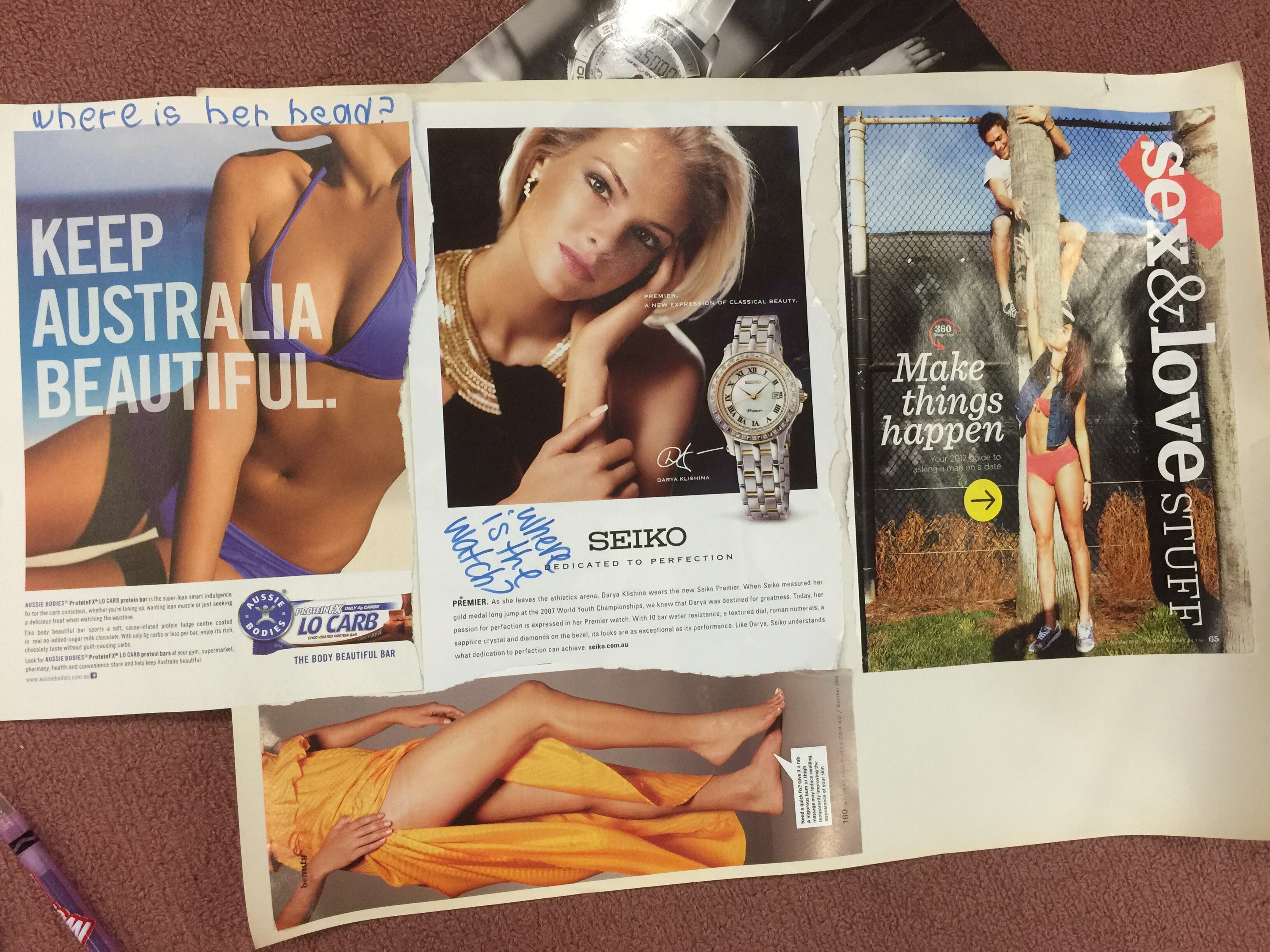

This image is of an activity conducted with youth. You can see the questions … “where is this lady’s head?” “Why isn’t she wearing a watch?” “Why is she so scantily clad to ask the guy for a date?”

The absence of a lady’s head is objectification. We don’t need to know who you ARE, we just need to use your body to make a point. The lady modelling for the watch brand is a gold medal winning athlete – she is shown neither for a talent other than her beauty or even wearing the watch that is so keeping with her ‘dedication to perfection’.

The old adage that “sex sells” is true – it must be for advertising agencies to continue to use those themes in their campaigns. But at what cost? What are the messages that we are consuming and allowing to shape our cultural understandings of human dignity and the value of people? What of the ongoing consequences for decreasing respect and distorted understandings of sexuality and intimacy? 

Time for action : what conversations do you need to start or understandings can you expand to raise your awareness of objectification, sexualisation and pornification in our culture? How can we empower our younger generations to reject the normalisation of these perspectives?


[see collectiveshout.org to add your voice to advocacy efforts]

why you should HATE porn 


The harmful impacts of porn on those consuming it, those creating it and those affected by the consequences of addiction ought to cause a degree of alarm. The ready availability and ease of access to pornographic material requires intentionality to stand against the insidious nature of its reach and consequences. 

  • It makes public what should be private 

Pornography makes ‘entertainment’ out of activities that ought to be personal and private. It is so counterintuitive to have doors on bedrooms, curtains on Windows and do not disturb signs on hotel rooms and then watch by choice the exact actions we would deem necessary to discreetly protect. 

  • It turns real people into mere objects 

Most porn depicts women as existing for the pleasure and gratification of men. As porn access and use escalates there is an increasing dehumanising of all involved. It trains watchers to disconnect from any sense of empathy, care or interest in the people as people (someones’s sister or friend) and to see them only for the functions they perform. The societal impacts of this are being documented as devastating. 

  • It promotes sex without intimacy

Sexual exploration and enjoyment is designed to be an expression of intimacy and a catalyst for deeper intimacy between loving, committed adults. Pornography is such a perverse distortion of this design intent, depicting sex entirely devoid of relational connection or love and often without consent. 

  • It normalises rape and sexual violence

Over 88% of pornographic content depicts acts involving violence or force. Non-consensual sex and aggression (inflicting real pain) against women is not only condoned but portrayed as enjoyable for the women. Doctors report an alarming number of young girls presenting with severe anal damage and associated complications as a result of rough and inappropriate sexual activity. 

  • It is a common but poor sexual educator 

Young people are viewing porn before they have even had their first crush or kiss and well before any formal education from schools (or even parents). They are exposed to an insane level of sexual learning before their brains are even able to process what they’re seeing or the reactions it illicits in them. It is shaping the sexual appetite and expectations of people who are often without a counter-message about the truth of healthy sexuality and intimacy. 

  • It is as addictive as any drug 

Addiction to pornography is a well-documented, life destroying scourge. Research reveals impact on job retention, financial security, educational success, family/relational health and general mental and physical wellbeing as the result of an all-consuming obsession with watching porn. Like any drug, an increasing amount or level of stimuli is required to achieve the same degree of arousal, enjoyment or release. Some youth have reported watching more than eight hours of porn per day!

We should HATE porn. For the gross distortion it is of something innately precious. For its numerous negative and destructive consequences. For the themes of dishonour and abuse of power. 

This website is a useful resource for education, advocacy and also practical support to fight sexual/pornographic addiction. Check it out – fightthenewdrug.org   

breaking the cycle


How often have you found yourself in a repeated thought loop or behaviour pattern and wondered why? Why do I keep acting this way? Why do I keep finding myself in the same place of regret or shame?

You may watch others who appear to be caught in the same cycle. 

The reality of how our hearts and brains are wired is that we can find ourselves on a predictable and repetitious path – when left unchecked. 


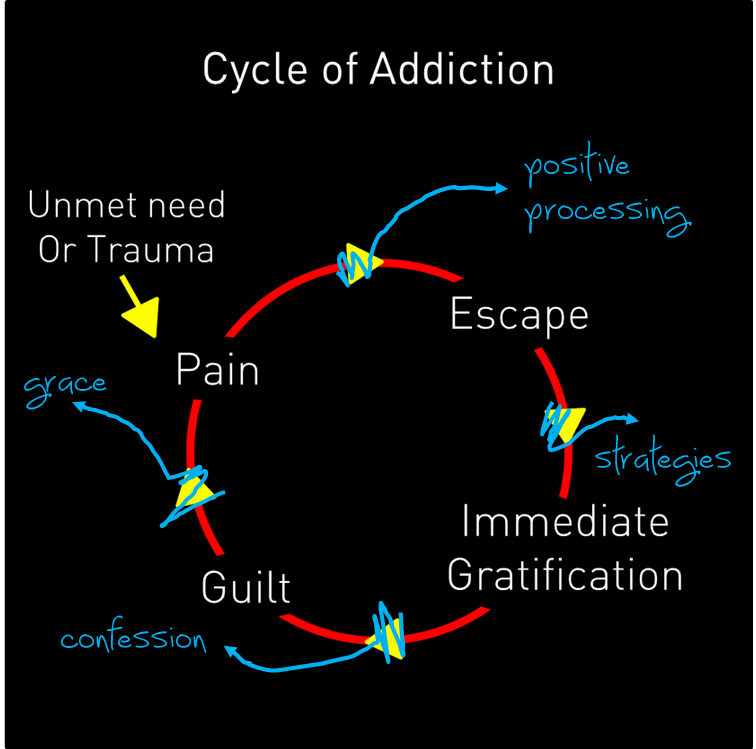
How the Cycle of Addiction works. 

  • UNMET NEED/TRAUMA

We experience a disappointment, loss, trauma of any kind, failure or relational dysfunction. This will look different for every individual – our personal life experiences, personality, degree of emotional intelligence or intellect, family support and all manner of other factors shape how we will respond and how significantly we will be impacted. 

  • PAIN

We feel sad, we feel wounded, we feel lonely, we feel embarrassed. Again, the depth, breadth and severity of those feelings will vary  between people. There is not a collectively determined response to pain that would make that predictable or able to be assumed – for ourselves or others. What one person may find devastating might barely impact another. 

  • ESCAPE 

We are psychologically predisposed to try and stop or avoid pain. If you touch something hot you pull your hand away immediately. Pain is our mental and physical sign that something is wrong and it triggers an immediate desire to escape the source or remedy the wound. 

  • IMMEDIATE GRATIFICATION 

Our natural tendency is to go for the quick fix. We scoff a block of chocolate or turn to other substances for relief and escape. We look for anything that might momentarily relieve us of our pain or discomfort. 

  • GUILT 

At the height of pain and in our rush to escape it we can often make poor choices. An ill-advised relational connection, exessive alcohol consumption, violence, pornography, drugs or other decisions that lead to feelings of regret once we are more emotionally sober. 

This causes more pain and the cycle repeats. 

Each time we head back around the cycle we can find that we need increasing levels of stimuli to meet the need for escape and gratification. We might need to drink more or engage in riskier activities in order to achieve the same sense of relief or release. This, in turn, leads to greater guilt and more intense pain – and you can see how that can lead us to feel trapped in the cycle. 

BREAKING THE CYCLE 


At every stage of the cycle we can find an ‘off ramp’. 

  • PROCESSING INSTEAD OF ESCAPING

Telling a close friend about the pain, journaling, releasing the pent-up emotion with a good cry, prayer & worship – exploring ways to let the emotion out and processing it through rather than trying to escape it. 

  • EMPLOYING STRATEGIES RATHER THAN LOOKING TO A SHORT TERM FIX

Perhaps some physical exercise or fresh air might be a better option. Smashing out a gym session rather than smashing down a slab! Knowing the people to call. Meditating on the truths of God and His Word. Making decisions before the pain is felt about the kind of behaviours that are most helpful rather than reaching for the quickest, easiest options when pain strikes. 

  • CONFESSION INSTEAD OF GUILT 

The power of guilt is that its secrecy keeps us captive. ‘What if people find out?’ The act of confession – to both God and other people – disarms the enemy’s ability to manipulate and condemn us with guilt. Perhaps a counsellor, doctor or leader is the most appropriate outlet for this or maybe it’s a parent or trusted friend. 

  • GRACE OVER PAIN 

Confession positions us to receive grace – from God and from others – and perhaps most significantly, from ourselves. The reality is that there is always an option to make a better choice next time or to continue to offload emotional baggage rather than hoarding it. We are given a second (and third, and fourth…) chance. There is opportunity to redeem our hurt or our failure for our good or the benefit of others. Grace. 
Question : How might the illustration of the cycle help you to understand your own responses or the behaviours of others around you? 

how far can I go?


“How far can I go?” Easily the number one question – spoken or not – of Christian dating couples in relation to physical intimacy. “How far is too far?” Or asked another way, “What is the absolute most we can get away with without actually sinning?”

I’ve heard all manner of answers to it, from the ‘click and whistle’ approach (cause you can’t get up to too much if you’re hands are clicking and your lips are whistling!) all the way through to justifying everything outside of vaginal intercourse (which leaves a whole lot of options!).

It reflects the natural bent of the human heart – but particularly the young person as they explore their emerging independence and self-governance – to know where the boundary is so that we can run right up close to it. How close to the fire can we stand without getting burnt? How far can I go?

It’s the wrong question. 

We don’t ask it with some other boundaries.

When standing on the edge of a very tall building we’re more likely to ask ‘how far BACK from the edge do I need to stand to be safe?’ And only the brave (or stupid) would venture too close. Because we know that the consequences of finding out where ‘too far’ is would be dire!

We need a better understanding of sexual intimacy. 

While they may be true, ‘God says’ or ‘the Bible says’ are not adequate boundaries. They’re a good start but ultimately unsustainable without a greater sense of purpose and intent. An understanding of why God wants us to honour our own and one another’s sexuality (including His intended design for us to experience and explore our sexuality in covenanted marriage, the preciousness of our physical person and His desire to keep us from heart-wounding) is needed to carry beyond the legalism to a deeply held desire for God’s best for us and for the other.

Externally imposed rules and boundaries are no match for internally determined desires, goals and intentions. A deeply held understanding of and a conviction around God’s best is needed to make good personal choices and also to process any sense of falling short. 

God desires that we would not be wounded sexually through abuse, rejection, confusion or manipulation. He doesn’t intend for sexual intimacy to be a thing of comparison or competition. God doesn’t want us to carry the heart burden of sexual regret or remorse as well as other potential physical consequences.

God designed us as sexual beings and, as with everything He made, it works best when experienced as He intended for us. God’s love for us compels Him to draw a boundary around our sexual exploration and engagement.

Honour as a boundary. 

Whilst boundaries around the where, what and when of physical intimacy are helpful and accountability to them necessary – the greater value of honour will ultimately fuel the kind of self-control and determination required to succeed. Honour of God’s will and heart for us, honour of our own sexuality and the gift it is intended to be in its created context and honour for one another – a deeply held sense of protection and preservation of the other’s dignity, purity and heart. 

Instead of “how far can I go?” other questions to ask …

What do I hope for in a potential future marriage relationship – how can I protect that now? How do I best honour the other person? Is this in line with God’s design for my sexuality and for sexual intimacy? How can I manage my own lust and desires? How far back from ‘the edge’ should I stay to keep from falling? What decisions do I need to make and practices should I put in place that will set me up to win?


a new perspective – from the clouds

The view out of my plane window on a descent ready for landing gave me the illustration of a new perspective. 

We transitioned from brilliant sunshine and a vibrant blue sky through scattered clouds and the ground below became visible. There were the patchwork pieces of properties divided by roads, thin fence lines and rows of sprawling trees. I could clearly see the outline of the individual clouds casting shade in mirror form on the landscape, turning bright green paddocks into a darker shade and clear blue waters into murkier tones of grey. 

We then flew over a residential property. A stately established home with neat gardens, a vegetable patch and a few sheds all surrounded by a very large hedge of trees that had clearly been tended and grown over many years. Just as we came near I saw someone walk out into the front yard; stop and look up and around. 

From my vantage point I could see that there was a cloud of perfect size and shape to cast a shadow over the entirety of the property – following the hedge line almost exactly – while the area outside that boundary was bathed in brilliant sunlight. 

And I thought to myself, I bet that person has concluded that today is an overcast day. Maybe they retreated inside rather than endure the cold, grey of the air around them? Maybe they decided they wouldn’t hang the washing out or go for that walk or spend some time in the garden because the weather was inclement and uninspiring?

I wanted to tell them that it was a beautiful day! The sun was glorious. The sky was radiant. But it would’ve been hard to believe from where they stood. 

I wonder if that’s not like life in other ways for us sometimes? Where things for us seem grey, bleak, uninspiring …and yet, not too far away there is brightness and warmth and joy to be found? 

Perspective. 

friendship that goes the distance

After knowing each other for 25+ years, going to the same church for 16, being travel buddies for 7 and housemates for 5 – my best mate Jacqui (aka, Jac, Jacster, Bert to my Ernie, radio call-sign Cuddly Bear) moved overseas in March 2014.
Many sad faces.

We navigated the transition and now, 2.5 years later, we’ve settled into a new kind of friendship. While we were always confident we’d be able to sustain a long distance friendship we have both been pleasantly surprised to see our bond strengthen and grow.

Here are some things we’ve learned along the way.

Jacqui’s 3 tips

  • Know where your friend is!

The more you understand the context in which your friend is doing life, the better you’re able to share in the journey. It’s a huge blessing that Kim has been able to visit me, see where I live and work, and meet my friends and wider community. Though it’s not quite as good as her re-locating and living with me, having her understand so much of my life now is probably the next best thing.

If you can’t visit, make the effort to get to know about their new home, ‘meet’ the people in their world, ask for photos of the chaotic traffic they encounter. And if you’re the one who has moved away, make sure you stay aware of the place, the people and the circumstances that your friend is still living in. Keep asking the questions that help you stay connected to their world.

  • Don’t expect your friend to guess how you are!

Don’t you just love how a good friend will know exactly how you feel without you having to say a word? Physical distance is a pretty significant barrier to your typical cues of mood (like facial expressions, tone and body language) so it’s unfair to presume that your friend is going to know how you’re feeling and why.…unless you tell them. Resolve to always answer the, “How are you?” question honestly. Help your friend out by removing the guess work, by being open with where you’re at and what you need from them.

  • Decide not to be jealous.

Life is better – and certainly way more fun – with friends! Be a part of helping your friend to thrive in their new/changed environment by encouraging them to invest in new relationships. Be secure enough to know that it won’t change the depth of your friendship. It may even be that your own circle of friends is expanded as a result (I’m convinced that some of my new friends like Kim just as much, if not more, than me)!

Kim’s 3 tips

  • Don’t wait for BIG news – share ALL the news!

Keeping up with the little things is how our friendship remains current and connected. Rather than waiting for the time to write a big long email or to have an extended call/Skype, dropping a quick ‘hello’ message or update on a situation as it’s unfolding is far more reflective of ‘normal’ friendship and keeps one another in the loop.

FaceTime while you’re preparing dinner or doing other things rather than waiting for uninterrupted time (if it’s hard to find) – ultimately, it’s those ‘real-life moments’ that are most absent from long distance friendships and technology makes it possible to experience them together.

  • Don’t rain on the other’s parade.

When something significant happens in each other’s life it’s easy to go straight to the “Oh, I wish I was there!” or “I can’t believe I’m missing this!” This can seem like an expression of connective longing and missing but really is just a big buzz kill. I know you miss me, but isn’t this exciting?! Celebrate first. Champion each other publicly. Don’t make the other’s success or joy about your disappointment or exclusion.

Jacqui and I agreed to assume that we’re ALWAYS missing each other – we only need to express that when doing so is helpful – like when something particularly poignant is happening or when that feeling is overwhelming (refer Jacqui’s second point).

  • Develop new traditions and fun ways to interact.

We make a point to share random ‘awkward moments’ or laugh out loud experiences as soon as they happen. We send links to random vines or gifs that remind us of each other. We have a note book that we each write in and send back and forward with others who are travelling to and from Thailand (we tried the post but it got stolen so now we only trust personal human couriers). It is essentially writing the story of our friendship over this season and it’s fun to read back on it each time it arrives on our side of the world. We celebrate birthdays and important events with secret deliveries or surprises through third parties. We are one another’s number one fan and champion each other whenever the chance arises.

Long distance friendships are hard to sustain but relationships that matter are worth it. Some greater intentionality, adjusting expectations and lots of communication and it’s possible that, like us, you find your friendship bond continuing to strengthen.

img_5106-1

are you the one the one you’re looking for is looking for?


“Describe your ideal partner.”

It’s the stuff of magazine and online quizzes and random questions from well-meaning people at church. What’s on your list? In your ‘quest’ for a partner, what are you looking for? Inevitably this leads to speculation about whether one is too ‘picky’ or not. Matched by another’s assertion to ‘not settle’ because you ‘deserve a good one’ (as opposed to the others who clearly don’t?).

Unfortunately, the narrative around prospective dating or marriage relationships can be intensely focused on what an individual WANTS from or in a partner. We probe others about their preference or tease them about the ‘kind of girl/guy they like’. I’ve lost count of the number of people who’ve asked me to give some sort of list or description of the guy I’m ‘looking for’.

Andy Stanley flips that question on it’s head and instead asks,

“Are you the one the one you’re looking for is looking for?”

When you imagine the kind of guy YOU would want, and then you imagine the kind of girl that guy would want, are you that kind of girl? If you think of the type of girl you would want to marry and envisage the type of guy she would be looking for, are you that guy?

To personalise it, the kind of guy that I would want to marry would want to marry a girl who was strong in her faith, growing in her walk with God, refining her character through submission to the Holy Spirit and wise counsel, sure in her sense of self, a person who apologises and forgives, a person who loves her family and friends, someone who is generous and open-hearted. Because if they didn’t want to marry that kind of girl, then they probably are not the kind of guy that I would want to marry. And so it follows, that if they’re the kind of guy that I would want to marry, then I need to be exactly that kind of girl.

It sounds like linguistic gymnastics but the shift in focus is profound.

Relationships and marriages that work and flourish are others focused. They are made up of two people who are intent on being their best, giving their best and helping the other to be their best. When it comes to considering our future partner, given that we most likely have little knowledge of if or who that actually is, the only activity we can do to impact the potential outcome of a prospective relationship is to ensure that we are growing into the best version of ourselves.

Of course, the upside of this is that we become the best version of ourselves!

Not just FOR a partner, but because the best version of ourselves is exactly who we ought to be striving to be. We benefit from constant growth and development and the fact that a future partner might benefit also, is just a bonus!


3 reasons you should try audio reading


I don’t want to overstate this but audio reading changed my life! 

It first started when I discovered that, with the tap of a button, a charming little man would read the Bible to me via the YouVersion Bible app on my phone! Brilliant! He reads while I brush my teeth. I can interact with him – repeating phrases out loud to gain meaning for this external-processing brain of mine. He even knows how to say all those tricky Hebrew names (some of them make me giggle and I mock him as he says them). 

Then I got onto Audio books. As a long time subscriber to numerous podcasts I’ve been an in-car listener for a while but with the help of the Audible app I was able to get to those books that I’d been meaning to read one day. 

Here are 3 reasons I think audio reading is a tool worth considering, if you haven’t already. 

You can redeem your time 

Audio reading can transform your daily exercise, getting ready for work or bed, commuting time (or any other activity that doesn’t require you to speak or listen) into productive ‘reading’ time. I listen to my daily Bible readings while putting a load of washing on or walking to the shops for milk. 

I have ‘read’ 3 books in the last month. Something I would never find the time to do (outside of a holiday) but the audio reading has turned otherwise non-reading times into reading times. (I also read at 1.25 or 1.5x normal speed – because I like the thrill of it!)

It’s called working smarter not harder. 

It is super portable 

Given the ability to host audio reading on your smart phones it means it’s with you everywhere. In an unexpected delay, wait time or slice of quiet when you might have wished you’d been more prepared with something to do – voila! There it is, ready and waiting!

Thank you technology, you’re lovely. So handy. 

Great leaders are readers 

John Maxwell says it, “Leaders are readers“. People growing in their capacity to lead themselves and others are those who draw from wisdom and research, from the expert and experienced to broaden their own knowledge and understanding. 

If you’re like me, you might find it hard to prioritise work time to read. Or to find joy or engagement in the silent practice of reading (I’m a well-documented raging extrovert – silent reading was my least favourite time at school even though literature and language were my strength subjects) – particularly for learning (I find novel reading can draw me in a little more effectively than non-fiction). 

Audio books might just save your mind from inevitable decline by gaining the learning and developmental stretch that all good leaders ought to be pursuing. 

What about you? What has your experience been with audio reading? Do you find it a help or hinderance to your reading disciplines?

the illusion of a disappearing God


Have you ever watched an illusionist at work? 

Which cup has the pea? How did that coin get behind my ear?  How did you know it was the Queen of Hearts? Where did the lady go?

So many questions!

Illusionists used to be called Magicians. A few abracadabras and a wave of a magic wand and the proverbial rabbit would pop out of the hat or the neverending multicoloured scarf would appear. But we all knew that they didn’t have such superpowers as to make cute pets appear and disappear. So they owned it for what it was. An illusionist is one who is able to make it seem like something has disappeared. 

We know when we’re watching that it hasn’t actually gone away – we just can’t work out where it is. (If you’re up for a spoiler – watch here for the disappearing handkerchief trick explained.)

In Psalm 10 v 1  David says, “Why, Lord, do you stand far off? Why do you hide yourself when I need you most?”

Where are You God?

Ever asked that question before? Ever wrestled with that sinking, desperate feeling that God is somehow absent? He’s busy elsewhere right when you need Him? Ever found yourself searching to see Him – is that Him way off in the distance?

David is looking for God in the midst of seeing a whole lot of bad things happening. The wicked are prospering, evil seems to be winning, greed and self-focus appear to be rewarded, and people are rejecting the laws of Love. Where are You, God?

As the Psalm continues we follow David’s journey of discovery. Oh, there You are! You are helping the oppressed, comforting the broken, hearing the cry of the weary and wounded; defending the defenceless. You weren’t gone afterall, I just couldn’t see You. 

The illusion of a disappearing God. 

Oh God, give us eyes to see You. When You seem far away, when You feel absent or hidden. Help us find You amongst the wickedness, the brokenness and the pain. 

Amen.