character is not a competition


“I’m not talking to your brother right now, I’m talking to you!”

These were some of my least favourite words when getting disciplined as a child. If I’d been fighting with one of my brothers or together we had done the wrong thing, my Mum would send each of us to our room to think about what we’d done. When she came in to talk to me I was always ready to tell her how the actions of a brother had led to my behaviour. And she would shut that down – you always have a choice, your actions were either right or wrong, this is not about your brother it’s about you. 

Character is not a competition. 

She was right. My brother’s selfishness didn’t excuse my own. Their dishonesty didn’t justify mine. Their poor management of their anger or frustration didn’t relieve me of the need to be patient or tolerant. 

Character is not a competition. 

Your character is about YOUR honesty, generosity, integrity, reliability, graciousness, humility, strength, compassion, genuineness, service, respect and patience. It is not being ‘more honest’ than the next guy or ‘more generous’ than another. Your character is about you. It’s about who you are in your unchecked self, when no one is looking; when there’s nothing to be gained as much as it is revealed in your responses to adversity, disappointment or stress.

When your character is questioned it is never a suitable defence to compare yourself to another. That can be an exceptionally low bar. Prisons are full of people who demonstrated blatant disrespect for the law and for others – they don’t become the new standard for our behaviour! Sexual misconduct isn’t minimised by comparing it to a rapist. Dishonesty isn’t made okay because ‘at least you didn’t embezzle millions of dollars’. You will always find someone whose actions are worse than yours but that doesn’t make yours better. 

Character is not a competition – it’s a continual striving to be humble and teachable to have who we are refined. To be constantly becoming more of who we could be – increasing in reliability, compassion, other’s focus, tolerance and forgiveness. A mark of poor character is a person who will point to the actions or attitudes of others as a means of deflecting the focus or requirement from themselves. 

Hear my mum’s words “I’m not talking to them right now, I’m talking to you!”

trump, leadership & the language of abuse


When I was 13 years old, there was a boy in my Year 8 classes at school who would often grab me in my crotch. 

I would get to class quickly and try to position myself between two occupied seats but he was that guy with enough social clout to tap the person next to me on the shoulder and tell them to move or even get that done with just the flick of his head. 

I would sit my school books or pencil case on my lap as a deterrent. 

I remember him laughing. I remember feeling so unsafe. I remember not understanding why – what was he trying to communicate, how was I supposed to feel or respond?

Maybe he didn’t really know either? Where had he got the idea? What goal was he trying to achieve? What did his actions reflect of his understanding of sexuality or intimacy or respect for women? 

And then, then you hear the recording of Donald Trump – a 59 year old man (at the time), successful in business, of high social profile, educated, and relationally and sexually experienced. He is clearly heard to say about women, “when you’re a star …you can do anything. You can grab them in the p—y. You can do anything.” 

So, it’s just because you can? It’s just because no one tells you not to? 

Why is HE doing it? Does he think it’s sexy? Has it worked as a pick up measure in the past? Does he think women like it? Does he consider it foreplay? Does it feel like a conquest?

Whatever the motive and whatever the personal justification, he has ultimately given voice to the misguided behaviour of a 13 year old boy – and males of all ages – that ‘because you can’ supersedes all other filters for choosing a behaviour or action. The lack of respect for others (particularly women), the obscene level of narcissism, the depraved distortion of sexual intimacy and honour of another’s sexuality, the right of another to feel safe in their person – free from the expectation that someone might just grope their genitals at any time …all that and more just falls away. 

This is the fertile soil that nurtures abuse and entitlement and this man has just put language to it. 

This IS leadership. It is terrible leadership – but it is leadership. It is a person of influence using language of permissiveness and dishonour to shape the culture they are leading. 

This really is not okay. 

Our young men need to hear a different narrative and be called to champion a higher standard. Our women need men who will esteem and protect them – for everything they are – including their sexuality and physicality but extending deeper to their mind, their soul; their hearts. Our countries need leadership that embodies respect for every human and renders unacceptable anything that demeans or diminishes. 

Trump’s profoundly inappropriate attitude and words (including his lame charade of an apology) and the response they’ve received ought to be a wake up call for us all. A call to check our language, check our privilege, and check our leadership. 

We can do so much better than this. We must. 

serving up justice


“Everyday, many young people in our world are sexually exploited. We want to be part of the solution to this problem.”
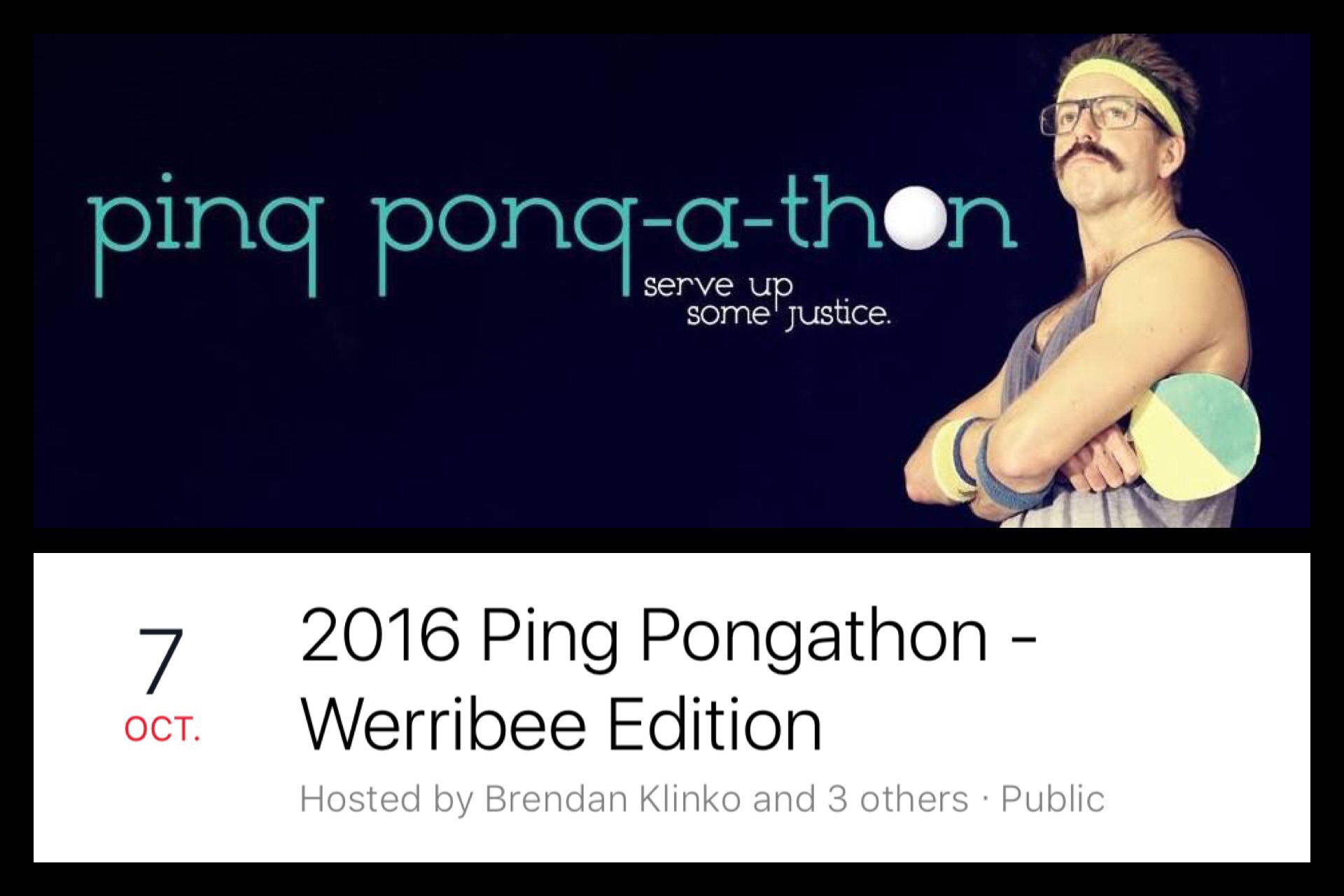
This comment has been repeated in my FaceBook newsfeed these past few weeks as our community is preparing for our annual involvement in the Ping Pong-a-thon. The Pong is a 24hour table tennis event that mobilises guys and girls of all ages and capacities to “serve up some justice“. 


Today, more than 20 million people are victims of human trafficking globally. Participants in the Pong raise awareness and funds for a number of frontline organisations working to rescue and restore exploited and abused young people in Sth East Asia.

This cause and this event have completely captured the heart of our church family and as a Church leadership we throw a whole lot of energy and resource behind it. 

Here’s why we do …

  • Justice is at the heart of the gospel. Jesus’ mission was to bind, heal, restore, comfort & free (Isaiah 61:1) and every act of justice makes the world look just that little bit more like the kingdom of heaven. The Church should be (and generally is) the most generous givers and most active in seeing justice for all.
  • Those who have are responsible for those who have not. We are called to ‘speak up for those who cannot speak for themselves’ (Prov 31:8). Events such as these make us aware of the need and highlight the abundance of our freedom and capacity to advocate for those born, manipulated or sold into the most depraved of circumstances. 
  • Serving together grows community. Beyond the cash and awareness raised for the cause, events such as these gather people together around a mutual focus who might not otherwise connect – including people not previously part of our faith community. It’s provided a great leadership opportunity for our coordinator as well as involving many others – donating, promoting, Pong-ing, catering, etc. 
  • People are looking for a way to actively engage. How often do we see the news and hear the statistics and feel like we are powerless to make a difference? This event is a ready made movement to join that is supporting organisations making significant impact (see 2015’s Ping impact here

We look forward to our event kicking off and anticipate the ongoing personal, kingdom and justice benefits as it unfolds. 

why you should remember nothing


In the opening pages of his book “Getting Things Done”, David Allen proposes that one of the keys to mind, task and stress management is to aim to remember nothing. 

I read it, several years ago now, and was pleased to be given a goal I could attain. Yes! I can do that. I do that already. I constantly forgot events, what I had to buy at the shops, the tasks I needed to achieve at work, that thing I promised to take to my friend – pretty much everything. 

“The goal is to not remember anything.”

Of course, he wasn’t advocating complete absent-mindedness or forgetfulness so much as an intentional way to remove from one’s mind the requirement to remember. 

Your mind doesn’t have a mind of its own. 

You know this because it’s often the case that we remember things at the wrong times. We remember that we need to buy milk while we’re sitting in the car but not while we’re standing in the middle of the supermarket wondering why we came in there (and filling a shopping basket with everything but milk). In the middle of the night we remember that we need to take cash for the parking meter but not when we’re walking out the door. 

Our brains don’t have their own filing systems and so if we do need to remember something our mind has to actively hold that data – making our brains more busy and increasing the chances of being overwhelmed by the quantity of information and, ultimately, the risk of forgetting a lot of things. 

The solution is reliable systems of information storage and reminders. 

Our brains will release the need to hold information if it knows that it has gone somewhere predictable and useful. That’s why writing things down in the middle of the night often allows you to go back to sleep. 

If you write something on a napkin at a restaurant and shove it in your pocket – your brain knows you may well forget that it’s there and send it through the wash. But if you enter it into a diary that you reference consistently, set an alarm on your phone, or add it to a list you actively engage with, your brain knows the information will be recalled and can then let go of it.

I credit this one idea as being nothing short of life changing. No jokes! It massively reduced the number of double-bookings or return trips to the shops but, more importantly, it also lifted the busyness from my mind. It made me feel less pressured. It shifted that feeling of “I think I’m meant to be doing something right now” and the frustration of poor time management leading to unnecessary pressure. 

You should try it. Try not to remember anything. 

Practically speaking for me it means I have everything in my calendar (synced to my phone) – I mean EVERYTHING. I have the same meeting every Monday morning at work but it’s in my calendar. If someone asks to meet with me or invites me to something I check my calendar and if it says I’m free, I’m free. I can trust it. 

I use my phone to remind me of all manner of things. My morning alarms have a notation that tells me what my first activity for the day is or what I need to take with me. Every event has reminders set before them (factoring in travel time) which means I can stay present where I am without fear of losing track of time. I have an active shopping list on my phone that I reference every time I’m at the shops (“extra” things like birthday presents as well as basics like groceries). 

There are all manner of apps and programs, and paper and digital aids that can help achieve the goal of not remembering anything. 

If it can free your brain – even just the slightest bit – surely it’s worth a go?

can I introduce you to my friend? 


A while back friends of mine invited me to dinner to introduce me to a Single male friend of theirs. I was more than happy to attend. I think there should be more of it!
Friends who host such introductions  …

  • provide socially dynamic, safe and helpful ways to make initial explorations of potential for further interaction
  • give contextual understanding of the other person through the work/family/sport/church environment they know them from
  • become an immediate overlap of the worlds of 2 otherwise strangers
  • provide something of a “reference” for character and any sense of perceived compatibility 

Singles – I know some will be uncomfortable with this idea but I encourage you to consider it as a natural function of community. It doesn’t need to be forced or uncomfortable. Have the conversation with people you trust and be open to the potential connections that could ensue. 

Friends of Singles – don’t do this by surprise or stealth. Honesty about your intentions is good. Or at the very least, an honest conversation with all involved to ensure they are open to the idea and trust your knowledge of and care for them. When you’re dealing with adults understand that the outcome is not your responsibility. If, as two adults, your introduced friends choose not to go any further with the connection or after some time things go askew – it’s on them not you. If, for all you are able to know, they are both well-adjusted, independent and house-trained individuals then you make the introduction and allow them to make the next wise choice. 

In teen and young adult stages of life there is a much more natural social community. As adulthood creeps in (real jobs or career focus, marriage, children etc) large group interactions or events where ‘new’ people are likely to be introduced become less frequent. It requires greater intentionality to continue to maintain social networks and particularly to consider those Singles who might still benefit from such environments. 

Can I introduce you to my friend?

Think of it this way – you know and like me and you know and like him – this is a significantly positive start! 

Go on. Why not give it a go? Ask the questions. 

stop saying “they” when you talk about the church

I LOVE the Church! 

Jesus committed to building it and He intends to come back for it and until then it’s the hope of the world! It’s the means by which Christians are built up in faith, pointed to Jesus and mobilised for His mission. It’s a community that can reveal and represent the love of Father God to those yet to encounter Him. It’s a mechanism to mobilise those who’ve experienced the greatest of love, mercy and grace to extend it to the least and the last to bring transformation to the world. I love the Church – even in all her brokenness and dysfunction. 

I am grieved anytime the Church falls short of all it can be and do. I hate when the Church does a bad job of showing Jesus to others and advancing His gospel. I am disappointed when people are let down by the Church. I am eternally frustrated by those within who have such negative and critical things to say about her. 

But then I remember why. 

Because the Church is me. It’s you. It’s not an entity or organisation beyond the people who are in it. You are the Church. You are the “they”. 

Of course, each church will have its leadership and many will have paid staff of varying sizes and makeup, but these roles aren’t the Church. They exist to help you and I to be the Church. 

God calls us to connect to a faith community and invest ourselves in it. He gifts us to serve one another so we might experience and express the fullness of that and so together we might be a force for His Kingdom in our local area and beyond. To see the broken restored, the wounded healed, and the bound set free in Jesus’ name. 

So if “they” are not doing something right, enough or at all. If “they” don’t have suitable programs for specific demographics, sufficient leadership or quality of volunteers. If “they” haven’t got the budget for further facilities or to staff opportunities. If “they” aren’t active enough in the community. If “they” aren’t welcoming of new people. If “they” aren’t providing mentors or developing leaders. If “they” aren’t employing new technologies or advocating for justice or … or mowing the lawns frequently enough! 

Let’s remember who “they” are. 

God gives vision and authority to leadership to guide us. But He gives each of US to our churches to partner with Him in His ministry and mission. When you speak of ‘the Church’, you’re talking about me, you’re talking about you! 

what you can do to live free!


On April 26, 2003, Aron Ralston – an experienced hiker – was climbing alone in Horseshoe Canyon, Utah. As he descended a slot canyon a 360kg boulder dislodged, crushing and pinning his right arm against the canyon wall. 

Ralston was trapped for five days – rationing his food and water, drinking his own urine, and eventually slipping in and out of consciousness and delirium. On May 1, he infamously amputated his own arm (you might want to read that back again to get the full gravitas)!! He cut his own arm off! He fashioned a tourniquet, broke the ulna and radius bones and then sawed through his skin, veins and nerves with a largely blunt knife (I hope you read that quickly because – ew!).

Once free, he had to rappel down a 20m wall (one handed) and hike the 13km to his vehicle. He met a group of hikers on the path who gave him food and drink and alerted authorities (who had commenced searching after Ralston’s family reported him missing). He had lost 25% of his blood volume and 18kg of overall weight. 

It is an amazing, barely believable story. The lengths he went to in order to be free. It causes us all to wonder what we would do in a similar situation. The extremity of his circumstances clearly propelled him to act beyond what a person would otherwise even consider let alone be capable of. 

Ralston was determined to free himself from the rock because he knew his prospects there were slim and getting slimmer. He knew that so long as he remained pinned to that rock the likelihood of dying in that place would increase. He determined to be free – at the cost of his arm and unimaginable pain and discomfort. So much so that he reported he was “looking forward to the amputation and the freedom it would give.” 

“It is for freedom that Christ has set us free.” 

– Galatians 5:1

Paul reminds us that the price for our freedom has been paid by Jesus on the cross so we can LIVE free. The eternal consequence of our sin has been sorted, we’re restored to relationship with Father God, life to the fullest is on offer – freedom.

But do you ever feel stuck? Trapped? Ever feel weighed down? Or burdened? Ever feel bound to a habit or caught in an unhealthy relationship? Ever feel pinned down by guilt or shame? Ever overwhelmed with regret or entangled by sin?

That is not the language of freedom! Those experiences are not the marks of free people!

If Jesus has done what’s necessary FOR freedom – perhaps we have to look at what WE need to be doing to LIVE free?

Aron was willing to do whatever was necessary to release himself from his trapped position. 

What do you need to let go of to release yourself to live free? What drastic, maybe even painful, measures might you take to free yourself? What hard decisions, painful disciplines, difficult conversations, deliberate re-learnings, or intentional first steps do you need to action to see you move toward the freedom Christ desires for you? 

change what busy feels like


One particularly hectic day/week at work I was feeling the pressure and my emotions were fraying. 

My colleague noted my frenetic state and copped the list in response. You know the list. When you start rattling off *everything* that needs to be done and it becomes more overwhelming the longer you talk.

Psychologists would call it “catastrophising”. Making everything dire and disastrous in our minds. Speaking a “worst case scenario” narrative using negative and defeatist language. We do it for sympathy. We do it to try and make sense of why we feel so out of control. 

But my colleague totally pulled me up with his response. He waited until I got to the end of my list and said “yeah, but you love all those things!”

You love all those things. 

He was right. I did. I do! Everything on that list was part of a job I love, for a cause I believe in, for people I care for, using my skills and passions, for the joy and benefit of others. 

Something shifted for me in that moment. I didn’t get any less busy – but my posture to the busyness changed. The heightened emotion was deducted from the equation which freed some brain and heart space to more effectively apply myself to the tasks at hand. 

I love all those things! I love what I do and what I do it for. 

That was a few years ago now and I can honestly say I haven’t been overwhelmed by my workload since. That’s not to say I haven’t had patches of being crazy busy. But each time I feel the pressure building and the tension rising, I hear that statement again – “but you love those things!”

The brain is a powerful muscle. Our thoughts and internal dialogue are significant in determining our emotional well-being, stamina and capacity. 

Give it a try. Next time you feel that familiar rise in tension remind yourself “I love these things!” Sometimes you’ll need to dig deep to find the love – to move beyond the task itself to its bigger purpose. But once you find it, you might just find the space to take a deeper breath and power on more effectively. 

what would someone look like if they looked like you?


When I was about three years old my mum walked past my room to hear me disciplining my dolls. 

“One …two …four!”

Mum was about to correct my counting when I continued, “aren’t you glad I didn’t say three?”

You can probably guess that the old count to three was one of our family’s discipline strategies. And here my lucky dolls were getting a reprieve by me not saying three before they had a chance to rectify their behaviour. 

Most learning for children happens by modelling and mimicking. They learn language, counting, basic life skills (like dressing and eating) all by watching adults and older children. This is also true about intangibles like attitude and character. 

As front row audience members to the day to day lives of their parents, family and friends, they absorb something of their values, morals and ethics. This is largely positive, except for the part where they pick up on the inconsistencies between our speech and behaviour or where they accurately mirror attitudes or tendencies of which we are unaware or not proud. 

“Whatever you have learned or received or heard from me, or seen in me—put it into practice. And the God of peace will be with you.”‭‭ Phil‬ ‭4:9‬

Paul says, “Put into practice what you learned from me, what you heard and saw and realised.” (The ‭MSG‬‬)

Now, I’m completely ok with people putting into practice what they learned from me. I am an intentional leader and teacher. They’re hopefully learning some good gear! But what you hear, see and realise or observe? I’m not so sure all of that is ideally replicated. 

Whilst I think Paul is a little nuts to make this declaration, I like what it demonstrates of the recognition that he was a person of influence and authority and that with such privilege came a high degree of responsibility. He was aware. He knew that beyond what he said, people would be looking at what he was doing and saying. 

How about for us? If others are repeating our speech, what do they sound like? If they’re adopting our values, what are they like as a citizen, a friend, a worker, a family member? If they were to give like we give, would they be generous? If they were to accept and include like we do, would they be non-judgmental and embracing? If they were to extend grace as we do, would they be first to apologise and quick to forgive? 

Everything you’ve heard and seen and realised


Our response to this ought not be one of condemnation and guilt but conviction and inspiration. 

We don’t get to choose IF we influence but we do get to choose how and to what.