character is not a competition


“I’m not talking to your brother right now, I’m talking to you!”

These were some of my least favourite words when getting disciplined as a child. If I’d been fighting with one of my brothers or together we had done the wrong thing, my Mum would send each of us to our room to think about what we’d done. When she came in to talk to me I was always ready to tell her how the actions of a brother had led to my behaviour. And she would shut that down – you always have a choice, your actions were either right or wrong, this is not about your brother it’s about you. 

Character is not a competition. 

She was right. My brother’s selfishness didn’t excuse my own. Their dishonesty didn’t justify mine. Their poor management of their anger or frustration didn’t relieve me of the need to be patient or tolerant. 

Character is not a competition. 

Your character is about YOUR honesty, generosity, integrity, reliability, graciousness, humility, strength, compassion, genuineness, service, respect and patience. It is not being ‘more honest’ than the next guy or ‘more generous’ than another. Your character is about you. It’s about who you are in your unchecked self, when no one is looking; when there’s nothing to be gained as much as it is revealed in your responses to adversity, disappointment or stress.

When your character is questioned it is never a suitable defence to compare yourself to another. That can be an exceptionally low bar. Prisons are full of people who demonstrated blatant disrespect for the law and for others – they don’t become the new standard for our behaviour! Sexual misconduct isn’t minimised by comparing it to a rapist. Dishonesty isn’t made okay because ‘at least you didn’t embezzle millions of dollars’. You will always find someone whose actions are worse than yours but that doesn’t make yours better. 

Character is not a competition – it’s a continual striving to be humble and teachable to have who we are refined. To be constantly becoming more of who we could be – increasing in reliability, compassion, other’s focus, tolerance and forgiveness. A mark of poor character is a person who will point to the actions or attitudes of others as a means of deflecting the focus or requirement from themselves. 

Hear my mum’s words “I’m not talking to them right now, I’m talking to you!”
serving up justice


“Everyday, many young people in our world are sexually exploited. We want to be part of the solution to this problem.”
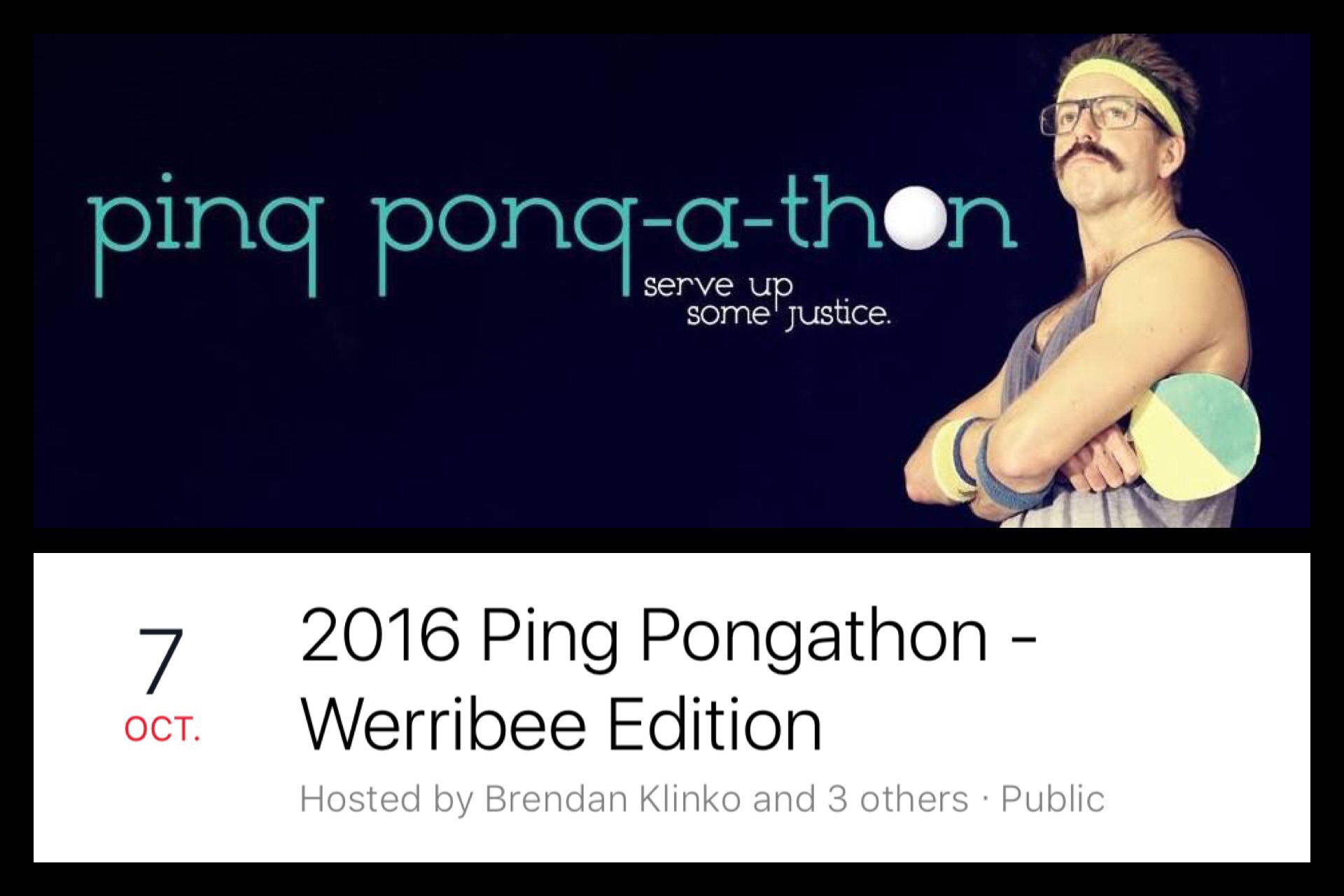
This comment has been repeated in my FaceBook newsfeed these past few weeks as our community is preparing for our annual involvement in the Ping Pong-a-thon. The Pong is a 24hour table tennis event that mobilises guys and girls of all ages and capacities to “serve up some justice“. 


Today, more than 20 million people are victims of human trafficking globally. Participants in the Pong raise awareness and funds for a number of frontline organisations working to rescue and restore exploited and abused young people in Sth East Asia.

This cause and this event have completely captured the heart of our church family and as a Church leadership we throw a whole lot of energy and resource behind it. 

Here’s why we do …

  • Justice is at the heart of the gospel. Jesus’ mission was to bind, heal, restore, comfort & free (Isaiah 61:1) and every act of justice makes the world look just that little bit more like the kingdom of heaven. The Church should be (and generally is) the most generous givers and most active in seeing justice for all.
  • Those who have are responsible for those who have not. We are called to ‘speak up for those who cannot speak for themselves’ (Prov 31:8). Events such as these make us aware of the need and highlight the abundance of our freedom and capacity to advocate for those born, manipulated or sold into the most depraved of circumstances. 
  • Serving together grows community. Beyond the cash and awareness raised for the cause, events such as these gather people together around a mutual focus who might not otherwise connect – including people not previously part of our faith community. It’s provided a great leadership opportunity for our coordinator as well as involving many others – donating, promoting, Pong-ing, catering, etc. 
  • People are looking for a way to actively engage. How often do we see the news and hear the statistics and feel like we are powerless to make a difference? This event is a ready made movement to join that is supporting organisations making significant impact (see 2015’s Ping impact here

We look forward to our event kicking off and anticipate the ongoing personal, kingdom and justice benefits as it unfolds. 

can I introduce you to my friend? 


A while back friends of mine invited me to dinner to introduce me to a Single male friend of theirs. I was more than happy to attend. I think there should be more of it!
Friends who host such introductions  …

  • provide socially dynamic, safe and helpful ways to make initial explorations of potential for further interaction
  • give contextual understanding of the other person through the work/family/sport/church environment they know them from
  • become an immediate overlap of the worlds of 2 otherwise strangers
  • provide something of a “reference” for character and any sense of perceived compatibility 

Singles – I know some will be uncomfortable with this idea but I encourage you to consider it as a natural function of community. It doesn’t need to be forced or uncomfortable. Have the conversation with people you trust and be open to the potential connections that could ensue. 

Friends of Singles – don’t do this by surprise or stealth. Honesty about your intentions is good. Or at the very least, an honest conversation with all involved to ensure they are open to the idea and trust your knowledge of and care for them. When you’re dealing with adults understand that the outcome is not your responsibility. If, as two adults, your introduced friends choose not to go any further with the connection or after some time things go askew – it’s on them not you. If, for all you are able to know, they are both well-adjusted, independent and house-trained individuals then you make the introduction and allow them to make the next wise choice. 

In teen and young adult stages of life there is a much more natural social community. As adulthood creeps in (real jobs or career focus, marriage, children etc) large group interactions or events where ‘new’ people are likely to be introduced become less frequent. It requires greater intentionality to continue to maintain social networks and particularly to consider those Singles who might still benefit from such environments. 

Can I introduce you to my friend?

Think of it this way – you know and like me and you know and like him – this is a significantly positive start! 

Go on. Why not give it a go? Ask the questions. 

what would someone look like if they looked like you?


When I was about three years old my mum walked past my room to hear me disciplining my dolls. 

“One …two …four!”

Mum was about to correct my counting when I continued, “aren’t you glad I didn’t say three?”

You can probably guess that the old count to three was one of our family’s discipline strategies. And here my lucky dolls were getting a reprieve by me not saying three before they had a chance to rectify their behaviour. 

Most learning for children happens by modelling and mimicking. They learn language, counting, basic life skills (like dressing and eating) all by watching adults and older children. This is also true about intangibles like attitude and character. 

As front row audience members to the day to day lives of their parents, family and friends, they absorb something of their values, morals and ethics. This is largely positive, except for the part where they pick up on the inconsistencies between our speech and behaviour or where they accurately mirror attitudes or tendencies of which we are unaware or not proud. 

“Whatever you have learned or received or heard from me, or seen in me—put it into practice. And the God of peace will be with you.”‭‭ Phil‬ ‭4:9‬

Paul says, “Put into practice what you learned from me, what you heard and saw and realised.” (The ‭MSG‬‬)

Now, I’m completely ok with people putting into practice what they learned from me. I am an intentional leader and teacher. They’re hopefully learning some good gear! But what you hear, see and realise or observe? I’m not so sure all of that is ideally replicated. 

Whilst I think Paul is a little nuts to make this declaration, I like what it demonstrates of the recognition that he was a person of influence and authority and that with such privilege came a high degree of responsibility. He was aware. He knew that beyond what he said, people would be looking at what he was doing and saying. 

How about for us? If others are repeating our speech, what do they sound like? If they’re adopting our values, what are they like as a citizen, a friend, a worker, a family member? If they were to give like we give, would they be generous? If they were to accept and include like we do, would they be non-judgmental and embracing? If they were to extend grace as we do, would they be first to apologise and quick to forgive? 

Everything you’ve heard and seen and realised


Our response to this ought not be one of condemnation and guilt but conviction and inspiration. 

We don’t get to choose IF we influence but we do get to choose how and to what. 

the power of gossiped encouragement


None of us is immune to the positive power of encouragement. 

I’m not talking about empty praise – I’m talking about true encouragement. Words that give courage through genuine affirmation of repeatable actions and admirable qualities. Or the steadying empowerment of a well-timed and well-meant “you’ve got this!” There’s nothing like encouragement to inspire and energise us; to champion us on to better and greater. 

Encouragement doesn’t count until it’s spoken. 

It might sound obvious but just because you’ve thought encouraging things doesn’t mean you’ve encouraged someone. In fact many live in the discomfort of being unsure about themselves, their performance or their contribution because encouragement remains uncommunicated. You have to say it. Write it. Sing it. Post it. Convey it with a high five or a knee squeeze. Don’t hold it in. 

Okay. Let’s assume you’ve got that part sorted (yeah?) the next step is gossiped encouragement. 

Gossiped encouragement magnifies personal encouragement. 

Let’s say Dave does something particularly great. I tell him. I let him know what was so great and how I or others were impacted by the greatness. He’s chuffed. 

But then I bump into Steve and I say “Steve, you won’t believe how great a job Dave did – let me tell you all about it.” Steve is pleased for Dave. 

Then Steve catches up with Dave and casually mentions that he’s been talking to me and heard great things about the job Dave did. Dave’s sense of chuffed-ness just went through the roof. 

Dave realises I must have really meant what I said. I haven’t just said it to his face, I’ve repeated it to others. I get to esteem Dave in the eyes of his mate Steve. And for me personally, I’ve spread a bit of positivity and communicated something of what I value and appreciate  too. 

So there’s two simple steps for us to follow when the opportunity comes to encourage someone. 

1. Do it!  

Don’t hold it in. Communicate with content and purpose the encouragement-worthy attributes or actions of others. 

2. Tell someone else!

Multiply the power of encouragement by gossiping it to others. Speak to their parents, friends, coworkers, spouse or team-mates. Give others a chance to appreciate their encouragement-worthiness too. 

Go on. Do it now. 

Who should you encourage RIGHT NOW? 

Who else can you tell? 

LOVE YOUR BODY for what it can do

I was a super active kid. My Dad jokes that I never got in trouble from him because I never stood still long enough to be told off!

I started in gymnastics when I was 4 and my coach called me Elastic Girl. I loved athletics and had long-held records for high jump and long jump in my primary & secondary schools. As a teen I could “sit & reach” 24cm beyond my toes. I played every school sport a girl could play – spending many days at inter-school competitions for volleyball, hockey (!), softball, tennis – you name it! I made it to district and state competitions in swimming and athletics. I was AIS coached for hurdles. I loved to dance. I had great explosive strength and speed and was also highly flexible. 

I would race my brothers on the beach in summer or on bikes around the court where we lived. I loved swimming but would spend most of my water time trying to beat my “number of somersaults under water” record or perfecting back flips off the edge. 

I don’t remember ever thinking about my body for anything other than its functionality. And for that, I loved it. I was strong and fit. Agile and athletic. 

My thighs & glutes were large and muscly which made shopping for pants difficult, and my arms weren’t thin like my friends rather they were defined and my shoulders were too broad for some tops. But I was able to rationalise that in my mind. Those clothes were made for thin girls, not athletic girls. I’d find another style more suitable. 

It wasn’t until I was in my late teens and early twenties that I started to consider a different perspective. When “athletic” became code for overweight. When not fitting into certain clothes became more about not fitting in. When the opinions of others filtered through to make me self-conscious. When I was told I couldn’t attend an event because I wasn’t attractive enough. When someone told me I looked chunky in my basketball uniform. 

I suffered with an eating disorder for almost 8 years – the consequences of which lingered longer still. 

I’ve been thinking about this as I sit by a pool on holidays feeling particularly fat. There’s no where to hide when it comes to swimwear and there’s no shortage of slim and taught bodies to show me what the other can look like. And there’s truth to it, I am overweight. There’s no denying that I’m carrying more weight than is healthy for my frame. 

But then I remembered. I remembered the 30 minutes of rock scaling around the island’s point, the multiple 40 min bike rides in scorching heat and up killer inclines. I remembered that despite some aches and pains I’ve walked thousands of steps each day, I’ve perched on the back of a motorcycle; swum in a pool. I love what my body can do. I want to shed weight so my body can DO more without pain or restriction. 

Young girls – love your body for what it can do! It can cartwheel and flip. It can run and leap and twirl. Love your strong legs and your powerful lungs. Love your energy. Love your freedom. Love your balancing and stretching. Love your brain and your smile. Love that your arms can give squeezy hugs and throw a ball and build things. 

Women – love your body for what it can do. Love that it carries your heart and sustains your ability to love and give generously. Love that it feeds your mind and leads you to ingenuity and creativity. Love that it can grow an entire human person and push it out and sustain its life – your body is amazing! Love that it can walk and ride and jump and dance. Love that it can self-heal (it can self-heal people!!!). Love the fatigue it feels from busy days, the blissful feeling of rest or a nice hot cleansing shower. 

Love your body for what it can do. 

Encourage others to love their bodies for what they can do. Let’s raise a generation of young women who love what their bodies can do more than what they can look like. 

What do you love that your body can do?! 

Go on. 

Say it. 

being who you needed 


When you think back to your younger years you can, no doubt, identify the people who were most influential in your life …and also the glaring absences of significant adult input in areas you perhaps needed them most. 

“Be the kind of person you needed when you were younger.”

This quote resonates with me as a way to frame our reflections to position us to be the best navigators we can be (you can read more about that here – navigating life’s rough water). As we consider what we EXPERIENCED and also what we LACKED we can be more dialled in to those things in the young people entrusted to our care – be they family, friends, students or members of our ministries. 

  • Someone to validate (and help me understand) my personality

I spent most of my teen and young adult life being criticised for my personality. You’re so loud! Why are you always so happy? Stand still! Stop being so dramatic and exaggerating. I came to accept that my personality was innately flawed. There was no one else like me so there must be something wrong with me. I oscillated through varying degrees of resignation and defensiveness. 

If I could speak to my younger self I would tell her that her Tigger-ness is a gift. That her capacity to see and bring joy and celebration is needed in this world. That her optimism and enthusiasm bring light and life to those around her. I would tell her that she can learn about time, place and volume in order to not inflict herself upon others in negative ways. I would tell her that others aren’t like her and she needs to understand them and help them understand her. 

  • Someone who asked questions about who I was hoping to become

Teenagers don’t have the capacity to see very far into the future. That’s not a criticism, it’s a natural function of their forming brain. Teens are not able to perceive consequences to choices, to see value in waiting for a better option or to understand how each decision they make is shaping the person they will become. 

If I could speak to my younger self  I would ask her to keep describing and refining the future she sees or hopes for. Who she wants to be – family, work, faith, reputation, character, relationships. So that she would have a filter to process decisions and reactions through. Does this lead you to who you want to be? Does this shape your character and your reputation in a positive way? She may not listen to me – but that wouldn’t stop me asking!

  • Someone who could help me understand myself. 

When I was 11 my Dad left our family and, of course, I felt the impact. Part of my response was to be quite needy of male attention and affection and so I fought really hard to get it. I joke (with embarrassment) that I could “flirt for Australia” such was my competency at eliciting the kind of response my heart was seeking from guys. 

If I could speak to my younger self I would tell her that she is enough on her own and that she will never find what her heart is really craving in the places she is looking. I would help her to not let the vulnerabilities of her heart lead her to bad choices and regret. 

  • Someone who identified and encouraged me into my gifts 

Growing up I was blessed to have people who released me to explore my giftings and passions. I was only 15 when I led worship for the first time in our church and younger than that when I was given responsibility for the babies and toddlers ministry. I was constantly affirmed for my natural capacity to engage with kids and given leadership roles at school. I was given scope to explore my sporting abilities and also those in musical arts. 

If I could speak to my younger self I would remind her how blessed she was to have those opportunities and keep encouraging her to maximise the chances to experiment and engage. I would mentor her more intentionally to learn and grow in her understanding of God’s hand on her life and His desire to use her for His Kingdom purposes. 

What about you? How do you reflect on the people you had or needed when you were younger? How might that shape the way you invest in younger people in your world?

skin hunger – our need for physical intimacy


I love massages!! Any kind. Feet. Head. Crazy Thai ones where they stretch and contort your body like a pretzel. Soothing oil ones with dolphin music playing. I like getting my nails done. I love getting my hair washed or done. 

I love physical touch. It’s a weird statement to make but an acknowledgement of truth that is perhaps more pertinent in context to my status as a living-alone Single. Ultimately, all of those things above are more than just self-pampering, they’re a means to have my skin hunger somehow satiated. 

Skin hunger is a need for physical touch – not necessarily sexual in nature. It is a studied phenomena in psychology. Unmet skin hunger has been associated with failure to thrive in babies and infants, and increased anxiety, depression, stress and sleep dysfunction in children and adults. Each individual will have a different level of skin hunger and consequently, the absence of physical touch will be felt more acutely by those whose need is greater. 

Some stages and styles of life are innately more rich in physical contact. Living arrangements that involve others will almost always include physical touch – perhaps of an intimate or sexual nature, maybe because of the presence of small children being nursed, held and wrestled with, or even in the more incidental contact that happens as people work together in the kitchen or move around each other in the bathroom. Certain work environments are more physical – various fields of medicine and therapy, working with children, or coaching certain sports.

Physical touch affirms my presence. It is one thing to grasp my own hand or rub my own neck – but it is different to experience those things externally. It’s a tangible recognition that I hold a place in the physical realm; that I relate kinaesthetically to other people and things around me. 

Physical touch releases hormones that increase wellbeing and decrease stress. 

Physical touch communicates non-verbally a sense of belonging and connection. 

What does physical touch look like for a Single person? 

How is skin hunger appropriately satisfied in non-sexual or romantic contexts?

As I mentioned, I am a physical touch kind of person. I’m likely to grab your arm while I’m talking to you. I will normally go in for a hug and a cheek kiss when greeting someone I know. I love love love (love love) holding babies – especially soothing them to sleep. I love little person hugs and high fives. I even like the absent minded touches kids do when they’re talking to you – playing with your hair or leaning against your leg. I love big hugs from big people – I make sure my Dad gives me a couple every time I see him. For some, pets are a large part of their skin-hunger-meeting regimen. 

Skin hunger is connected with our need for intimacy and equally needs to be met in healthy and helpful ways or we will find ourselves seeking to satisfy it inappropriately. Identifying the degree of skin hunger we feel is important to being able to manage it intentionally. 

What does that look like for you? Or for those in your world? 

navigating life’s rough water


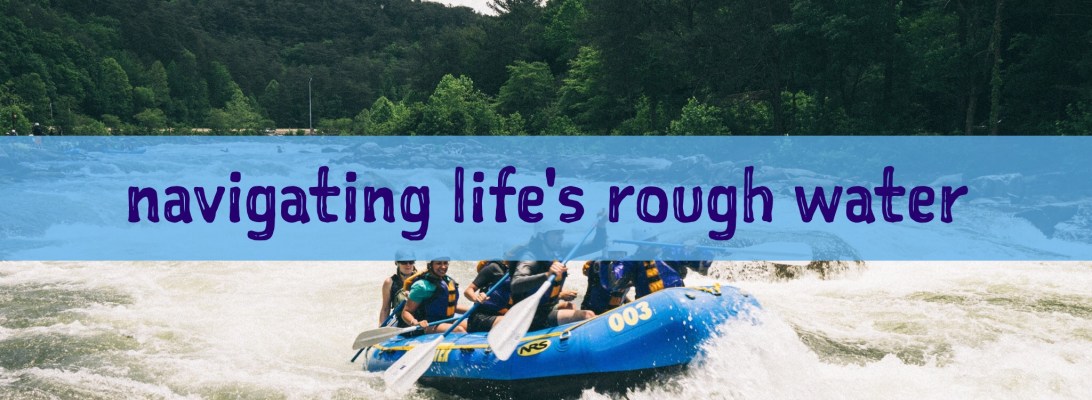
Have you ever been whitewater rafting? Its a high adrenalin activity where you jump in an inflatable raft and hurtle down a river. The whitewater or rough patches of water come where high current waters hit rocks, obstacles and banks and, when combined with significant drops, they make navigation quite difficult. It’s considered an extreme sport. 
When you make the decision to pay someone to let you risk your life in this fashion, you are given a guide or a navigator. He or she gives you the basic instructions and lets you know the directions they’ll be shouting at you as they try and get you to the end of the river run in one piece. 

A friend and I had this experience in New Zealand a few years back. The water was freezing and the terror real in amongst the patches of smooth water where we floated merrily along and were able to take in the stunning views and peaceful surrounds. 

I think in life as in whitewater rafting the role of navigator or guide is crucial. But I think in life, we are much less attuned to our need to have one or be one – in whitewater rafting there’s a sense your life depends on the guide – you’re listening and responsive!

Parents, mentors, teachers, leaders and anyone older or more experienced than ourselves can be as life impacting as a navigator guiding us down a dangerous river. 

“Up ahead there is a sharp drop and then the current will want to pull us left … When you hear me call it, we’re going to want all of us at the back of the raft and then we’re going to be ready to paddle out.” The navigator has been down this river before. The navigator has tried or seen different ways to handle this potential danger spot and has some tips on how to get through it most safely. The navigator knows and embraces their role to keep all participants safe while also letting them have an exciting adventure. 

There is nothing that we encounter on the ‘river’ of life that others haven’t seen or experienced before us. What a tragedy it is as adults to watch young people fall into the same traps, be surprised by the same big drops or to be so furiously paddling through smooth waters they don’t take time to enjoy them. 

We need to embrace our role as navigators for anyone who would come behind us. Yes, there is a need for people to sometimes learn through experience of failure or error but to let others fly head long into what we know to be dangerous or damaging without at least giving a shout out is neglectful and, well, mean. 

We need to nurture relationships that position us to be influential voices in another’s life. I feel like my greatest success in this area has come through honest sharing of my failures and wounding. I once had a young person say of a particular part of their journey that was similar to mine “I just want to make sure I don’t do what you did” – it stung a little, but ultimately? I don’t want them to do what I did either. 

We need to invite the navigator to speak into our lives and circumstances. We need to embrace with humility the learning and wisdom others can impart from their journey.