becoming more patient | #2 wisdom over reaction


Are you a reactor?

Maybe it’s better if we talk about someone else … do you know people who are reactors? Those with a short fuse. Easily frustrated. Quick to snap and lash out verbally or demonstrate aggressively.

In the quest to become more patient, we have to acknowledge that impatience is about reactivity. It’s having a low tolerance while waiting for things to happen as we are hoping or anticipating, or in the time frame we’d prefer, and dealing with the shortfall inappropriately.

In the previous post becoming more patient | #1 a big picture perspective  we noted that waiting isn’t patience, how you wait is. Patience is about our capacity to not become annoyed or anxious while we wait or experience problems.

Much of that annoyance or anxiety can be kerbed when we move more in wisdom than reaction.

Wisdom tells us that the trip to work is always a little busier at school times and so we should allow ourselves a few extra minutes – rather than getting frustrated by the crazy school drop off parents (and aren’t they crazy?!) that slow down our trip.

Wisdom tells us that kids need advanced notice to wind up an activity, prepare for departure or make a transition between tasks. Rather than calling ‘we’re leaving now!’ and then rapidly growing frustrated as the time tension gets greater.

Wisdom tells us that when we are tired, hormonal or under pressure we are less emotionally sober – perhaps now is not the time for that d&m or to process a significant decision.

Wisdom tells us that our sister/uncle/cousin/sibling/friend is going to do/say/be what they always do/say/be and to make a preemptive decision about how we will respond or short circuit it. Rather than being inflamed (…again!)

Wisdom sees us know our own limitations and triggers and grow in our understanding of others’. Wisdom helps us avoid circumstances that will fuel frustration or anxiety. Wisdom plans ahead for the times that are predictably tense and makes rational decisions about the attitude and posture we’ll carry.

Wisdom also reminds us to be more tolerant of others because of how others are tolerant of us. It recalls for us the times when people allowed us to fail and try again. When people were gentle with us as we developed new or better skills, understanding and competency. When people waited for us because we forgot something or were running late. When other’s repeated something we hadn’t heard or re-explained something we hadn’t understood.  Wisdom reminds us that we’re all in need of the patience of others at different times.

What wisdom have you developed that has kerbed your impatience? What circumstances would you be able to predict a tension that would require patience in order to prepare rather than react?

Read more

Part 1 – a big picture perspective

Part 3 – being others focussed

becoming more patient | #1 a big picture perspective 

On the scale of zero to ‘please don’t make me wait for anything, ever’ – how patient are you? How patient would others say you are?

Patience is defined as

the capacity to accept or tolerate delay, problems, or suffering without becoming annoyed or anxious

Waiting is not patience. Patience is about how you wait. Experiencing delays, problems and suffering doesn’t mean you’re a patient person – because we all experience those – the attitude with which you journey them is the determiner of patience. Doing things for a long time doesn’t mean you’re patient – it just means you’ve done things for a long time! Doing things without becoming annoyed or anxious is the key characteristic of patience. Our attitude, our grace, our tolerance, our peace and calm, our lack of reactivity, our persistence – these are all indicators of our degree of patience.

Relationships are where, simultaneously, our patience can be so profoundly tested and also where our patience is so intensely required. Impatient people make for unpleasant work colleagues, parents, partners and friends. Impatience expressed through frustration, snappiness, aggression, huffing and puffing or irritating repetitiveness (‘are we there yet?’) are killers of healthy relationships.

We all need to become more patient for our relationships to be positive and enjoyable.

As a quick thinker, speaker, mover, responder and decider, I constantly wrestle with impatience. I want everyone to move at my pace and sometimes do poorly at managing the lag time between when I get something and when others do … seriously, hurry up already!!!

TIP #1 – WE NEED A BIG PICTURE PERSPECTIVE! 

Often our impatience comes from being way too caught up in the moment to understand its significance (or lack of) in the big picture.

Like aggressively racing around someone in traffic only to be stopped beside the same car at the next traffic light. In the big picture of a trip to work, that car going a bit slower isn’t actually going to make us late. But our frustration in the moment can cause us to act irrationally or become unnecessarily emotional (and potentially make unsafe choices).

When children are learning to tie their shoe laces parents or teachers can become frustrated by the need to do it – ‘when are you going to get this yourself!?’. But there aren’t many adults who still need their parents or work mates to tie their shoes. They do get it. Keeping that in mind helps us to be more tolerant in the moment. This won’t be forever – even if it feels like it will.

So much of our intolerance and impatience is related to growth. We want others to get what we get; to know what we know and think like we think and respond like we do. But, often, they don’t have the same knowledge, wisdom, emotional maturity, life experience, perspective or skills and so are unable to respond the same way we would until they do.

When we zoom out our focus to see the big picture it grows our empathy and changes how we gauge others’ actions. Keeping the end in mind can drastically increase our grace, compassion and understanding in the now.

What do you think? How would keeping the big picture in mind shift your ability to be more tolerant and patient in your relationships?

Read more

Part 2 – wisdom over reaction

Part 3 – being others focussed

will you be lonely at Christmas?


Christmas is fast approaching! The more organised have crossed off lists, the semi-organised have started writing lists and everyone else is definitely considering thinking about lists …soon …maybe. 

For many, Christmas plans are predictable. Traditions have been well established and you know where you’ll be for each part of the day (or 3 days), who will be part of each gathering and what the general format of each occasion will be. 

For others, Christmas represents looming fear. Plans are unconfirmed. Perhaps circumstances have changed since last year – a divorce, death, you (or others) have moved, work situations have changed, family life has shifted – and so you’re not really sure what it will look like. 

If you know someone who is alone NOW is the time to check they have a place to go and people to be with. Now is the time when the pending loneliness might be starting to niggle at their hearts and their peace. Now is the time they might be wondering if they ought to prepare for a quiet day alone. 

So NOW is the time to extend the invitation. A simple “what are your plans for Christmas Day?” will reveal those without any. And a follow up to be included in a specific aspect of your plans will, at the very least, have them know that if they spend the day alone it will be by choice and not by force. 

Celebration days can be difficult for Singles or those living far from or without extended family. “Everyone” talks of busy, tired, full and fun times that can contrast sharply with some people’s experience and that is part of the feeling of loneliness. 

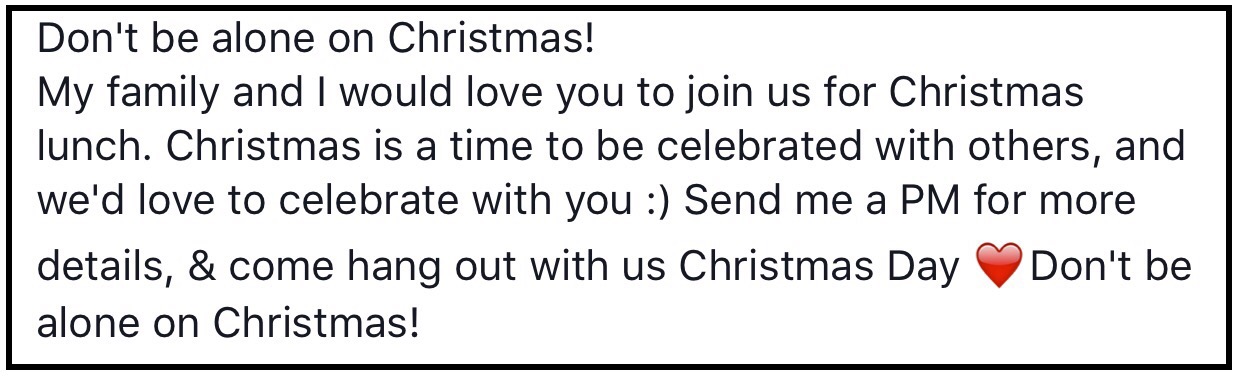
My friend posted this on FaceBook today and I love it. 


Who are you spending Christmas with? Who could you check in with? To whom might you extend an invitation to ensure they’re not lonely this Christmas?

I can’t believe I don’t have a baby 


I’m over 40 and I’m Single and childless …and I just can’t believe it. 

Sometimes I am hopeful that might change, sometimes I’m quite at peace and content if it doesn’t, sometimes I’m overwhelmed with the grief and sadness of it – but mostly, I just can’t believe it. 

I just can’t understand how this is the way my life has gone! All I’ve ever wanted to be is a wife and mother. Instead, I continue to experience so many other amazing things that I didn’t expect, or even imagine would be part of my life. I have so many other roles – a friend, an Aunty, a Pastor, an author, a speaker, a leader, a traveller – I love so much about my life. But I just can’t believe I’m not a mum. 

I love babies. I love children. They seem to love me (well most of them). They run to give me hugs, they fall asleep in my arms; they each have their special nicknames, hugs and traditions. I have a well-developed ability to sleep literally anywhere (including standing up – true story) at any time which I am sure would be a handy skill to have as a sleep-deprived new mum. I have a full heart and an empty home.

I am supremely confident of God’s nearness and His love. He leads me, He defends me, He grows me in wisdom and in His grace. He comforts me. He blesses me abundantly. While I completely trust His plans and purposes for my life, I don’t completely understand them. I’m sure He knows what I long for. 

I can’t believe I don’t have a baby. 

My Singleness doesn’t feel like it has an end date. I can marry at any time – and I hold the deep hope that I will on an open hand. There’s a biological reality to my capacity to conceive and carry a child on which the window is rapidly closing, or may have already closed. 

I can’t believe I’m not a mum. 

I think it’s okay to say that out loud. I feel like it’s healthy to express that in context to a greater sense of contentment and peace. Because the sense of disbelief is actually the feeling that rises most regularly. Sometimes it’s so strong it physically arrests me and I literally stop what I’m doing and shake my head – I’m sure I have a confused expression on my face. 

And then? Well, then I take the next step forward into whatever else is happening and whatever else is coming. 

camps are the best!!


When I was 7 years old I made my own response to Jesus at a camp. Mum & Dad were Camp Parents at a teen camp which meant I got to tag along and I can still recall many details of the moment when I was touched by Jesus in a personal, powerful way. 

Camps were a significant part of my faith journey as a youth. I lived in a small country town where only a handful of teens were part of my church. It was incredibly important for me to connect with a broader network of Jesus followers to ground and inspire my faith as I navigated my teen years. 25 years later some of the people I met at those camps are some of my closest friends and key players in my continuing God-story. 

As a Youth Pastor I have seen and championed the value of camping to the discipleship of young people. There are many reasons for their value but I think among the most impactful is the intentional setting aside of time and attention to make oneself open to the plans and purposes of God. 

There’s a new environment – a beach, a mountain, a view – at the end of a physical trip that marks a disconnecting from the routine, familiarity and comfort of home. There’s the need to sign up, save up and plan towards it that builds expectancy for what might happen. There is a new community created for the set time – relationships started and built in that set apart environment. There’s the worship and teaching sessions on a Saturday or Tuesday morning – normal “Sunday” activities engaged in a new way at a new time. There’s a leadership team who have been gearing up for this and are prayerful and hopeful for real God encounters and transformation – giving of their time and money to create an opportunity for young people to experience all that God has for them. 

Research points to camps as being a major contributing factor for faith retention and development. 


Critics of camps will point to the concern that camps generate an artificial spiritual ‘high’. They might observe behaviour afterwards and question whether or not that experience was authentic. I have ridden that wave as both a camper and leader. My belief is that ANY encounter with God is used by Him to draw us closer to Him. We don’t ever return to the same kind of ‘normal’; what we learnt is not un-learnt. The discipleship journey for everyone – particularly young people – is a series of steps and missteps as our faith increases and our personal story of God expands. 

I can’t recommend camps highly enough. The research is in. The testimonies are strong. The investment of time and money is worth the reward it reaps. 

What about you? How have camps been part of your faith journey? What involvement have you had in seeing camps impact others? What resources have you found to make camps most effective? 

5 lies porn tells


Porn is increasingly acknowledged as the prominent sex-educator of children. Young people are being exposed to porn well before they’ve shaped any sense of understanding or appreciation of sexual intimacy, let alone experienced it in an appropriate context. 

Porn lies. It presents perverse fantasies and entirely unrealistic scenarios as ‘normal’. And many are experiencing this education and degree of desensitisation without a contrary voice to bring perspective and truth. 

Porn lies. 

  • Porn depicts violence as enjoyable and normal. 


These statistics are horrific but they reflect the reality of the content of pornography and the narrative it writes. Aggressive, injurious and demeaning behaviour is met with no resistance or even feined enjoyment. Interviews with teens have revealed unmet expectations from boys and trauma for girls who were surprised to discover that the reality was far different from the movies they had seen.  

  • Porn shows lack of consent as a turn on.

A rise in reported rapes and sexual assaults finds some of its explanation in a genuine lack of comprehension on the part of pornified men of the place of consent. Porn implies that women are ready for sex anytime, any place and that their resistance or refusal is part of the game; the conquest. 

  • Porn asserts sex is a spectator sport. 

Not only does porn depict sex acts in public places or with multiple people present but the increased societal acceptance of porn means that public viewing and sharing has become more common place. Young people’s first exposure to porn can often be on a school bus or train or in a classroom where youth deem it acceptable to not only watch it themselves but include others in the experience. 

  • Porn infers anal sex is pleasurable for females.

Women in porn react affirmingly to anal sex when the reality is that doctors have reported an alarming number of young girls presenting with severe injuries, infections and potential long term damage from untreated wounds. 

  • Porn suggests exposure to porn is harmless. 

Increasingly younger men are experiencing erectile dysfunction and an inability to engage in physical intimacy rather than “virtual intimacy”. Addiction to porn is rife with people reporting spending as much as 8 hours a day watching – leading to loss of sleep and related health implications, ineffectiveness in work or study and for some, loss of employment and relationships. 

To say nothing of the links between the porn industry and sex trafficking, the impact of porn use on spouses and families, legal implications and related consequences. 

Porn lies. 

Don’t believe it. And rise to speak a voice of truth to those susceptible to entanglement in its deception. The hearts and health of our young people require us to help them discern reality from fantasy. Our women demand our advocacy. ADDICTED men and women need our support. 

Read here for a VicHealth issued summary of research findings. 

Read also – why you should hate porn

how broken relationships are like credit card debt


A while back I received a credit card in the mail that I hadn’t applied for. My handbag had been stolen the month before and I suspect the thief had used my details to apply for it – not thinking to change the address to his/her own. I notified the bank immediately, forwarding the police report as evidence, and was assured the card would be cancelled and all was sorted.

In the months that followed I discarded mail from the bank without even opening it, assuming it was promotional material. Until I got a very official looking letter from a debt recovery agency informing me I had an outstanding debt of more than $8,000!

Eight. Thousand. Dollars.

In the nine months since the card was activated there had been no activity. However, the initial charge of $30 for the annual membership had remained unpaid and accrued fees for late payment and interest compounding to now be a debt of over $8,000!! (The matter was clarified and has thankfully been resolved.)

As someone who has never used credit (other than that little old thing we call a house mortgage!) I’ve not really understood how people can amass such large personal debt … until I saw the impact of a $30 charge left unchecked for a few months. It doesn’t take long to multiply!

The same goes for avoided conflict. The smallest of unchecked offences can compound to significant relational dysfunction when left unresolved. A debt of forgiveness unsought or unpaid, a misunderstanding left un-clarified, a miscommunication not corrected; an opportunity for reconciliation not embraced can see a seemingly insignificant amount of hurt or disappointment fester and grow to become an almost insurmountable rift. A truth withheld can cause more damage when revealed down the track.

The longer it is left unresolved the larger it can become in our hearts and in our memories. It becomes a foothold for bitterness, anger, rejection and wounding to grow. It impacts our capacity to give ourselves wholeheartedly to new relationships and interactions when we are carrying around an old wound or offence.

What about you? Is there a debt of offence you need to cancel? Is there a payment of forgiveness or apology that you need to make before it compounds further? Can you resolve to not let relatively small issues become massive ones by dealing with them sooner? 

launching adults • when they don’t get married 


Imagine this. You have a 26 year old daughter. She meets *the* guy and after a period of dating he pops the question and you’re on the track to launch your daughter into the world. 

There’s an engagement party. Friends and family gather to express their excitement and joy. A handsome collection of towels, platters and salad bowls are given to the happy couple and stored away while preparations for the BIG day roll on. 

The house is bought or a rental property secured and furniture is purchased or gathered from friends and family looking for a charitable reason to upgrade their own. 

The bride is treated to a Shower or Kitchen Tea – where the women in her world huddle to exchange recipes and tips, play random games with pegs, stock her pantry and laundry closet with hundreds of dollars worth of consumables and thirty tea towels and, more importantly, let her know that there are women in her world cheering for her and supporting her in this next stage of her life.

Then comes the wedding day. People come from interstate and even overseas. They file into the church in their finery – the married ones reminiscing about their own special day and everyone feeling the privilege of sharing in such a sacred and momentous occasion. Then they eat and dance and raise their glasses as parents and best friends speak blessing and hope on behalf of everyone. The wedding gift registry has been bought out; providing tableware, appliances, linen and decorative items to ensure the couple are well established as they create their first home. And the questions commence about when you might be expecting the arrival of your first grandchild. 

Now imagine this. 

Your daughter is 26 years old. 

And she moves out of home. 

That’s all. 

Perhaps she has a housewarming. Maybe she receives a couple of cards and a few candles or table runners. 

Exchange your daughter for a son and though there’d be some differences in the narrative the end result is similar. A well celebrated, highly affirmed, and practically supported launch into the world. 

The contrast ought to raise a few questions for us. 

Who knows if there is marriage in their future or not. Maybe there are still the engagement, showers and wedding to look forward to. But maybe not. 

What do you think? How do we launch adults with any sense of ceremony and passage without the engagement and wedding process? What is missed for those exiting home and establishing themselves independently without these experiences? What mechanisms might there be to facilitate intergenerational connection or verbalised support? 

celebrating for singles


I was recently out for birthday milkshakes with a little friend who had just turned 11. We share a love of all things birthday and were talking about that as we wandered the shops. Her main case for the joy of birthdays was that “Christmas and Easter are great but they’re about everybody, your birthday is just about you.” Good call. 

I have 4 reasons I love birthdays. 

  1. I get to be loved on by my friends and enjoy the affirmation and affection of others. 
  2. I get to express my gratitude for the people who share my life. 
  3. There is a chance to reflect on the year that has passed and acknowledge growth, change, successes experienced and challenges faced. 
  4. It’s all fun and cake! There are special meals, outings, singing, and all the joy that comes with celebrating. 

Every person gets that experience once a year. Birthdays are the best!

If you get married, you add two more celebrations to the calendar. Your spouse’s birthday and your wedding anniversary. Two extra opportunities to celebrate the above four things in your home. 

And then, if you have a child you add three more annual celebrations. The child’s birthday, Mother’s Day and Father’s Day. Three extra opportunities to celebrate the changes in your home and life, to affirm your love and appreciation for one another, to give cause for a weekend away or a special dinner out; to eat cake and share joy. (And of course, extra birthdays with every additional bundle of joy.)

So, how do we reflect on that for the Single person? 

At the very least, it probably could cause us to consider afresh the significance of a Single person’s birthday for them to both give and receive the affection, gratitude and celebration of another year of life together. 

Perhaps it might also cause us to consider including Singles in celebrations where their place in other’s lives can be affirmed?

Think about the Singles in your world. What do you think this means for them? Maybe it’s worth some consideration or a conversation.