
3 ways to use social media (for good)

When it comes to social media, I think many of us have a bit of a love-hate relationship with it. There are so many positive aspects about the connectivity it can generate, the relationships it can develop, maintain or strengthen and the exposure it can bring to many forms of information and inspiration. But there are also well documented aspects of social media that lead some to avoid it. Here are three redemptive uses of social media that I believe could make it one of our greatest assets in making the world a better place!!

1. Advocate & support

Social media provides a powerful platform to raise awareness, profile and funds for deserving people and causes.

Through social media, we are connected with needs and opportunities that might not otherwise come to our attention. From the comfort of our own couches we can donate to worthy causes, support individuals in their world changing efforts, sponsor research initiatives, support small business, petition governments and change agencies, and shine a spotlight on need and injustice. We can also share stories of courage, inspiration and hope.

The simple act of ‘liking’ a post increases its reach, ‘sharing’ or re-posting even moreso and our comments offer encouragement and support to the person or organisation – cheering them on to bigger and better accomplishments on behalf of those who need it most.

So whether it is the opportunity to support a friend’s child in the “Jump Rope for Heart” skipathon, or sign a Collective Shout petition to take steps to rid the world of sexual exploitation, or read a story that awakens our hearts to injustice, or sponsor a young person travelling overseas to understand more of the needs of the world, or donate goods to a prison or homeless ministry, or donate to aid men’s mental health, or like, share or comment on the activity of someone championing another worthy cause … or to utilise the platform to raise funds or awareness for those things God puts on your heart – do it!

A sure fire antidote for the draw of social media to be about self-indulgence, comparison, appearance management or complaining is to consider how we might use the platform to draw attention to what matters and use our voices on behalf of those without one.

2. Honour & encourage others

There are no shortage of places a person can turn to if they’re looking to be torn down. Even without trying we can find ourselves on the end of others’ (or even our own) criticism, judgement and exclusion. Social media offers a place to reverse that experience and to bring encouragement, affirmation and honour into one another’s lives.

Special occasions – birthdays, graduations, achievements, Mother’s/Father’s/Valentine’s Days, anniversaries, new jobs, farewells (etc) – are a great opportunity to publicly honour people of significance in our lives. Those we admire, those we are proud of, those we desire to champion and celebrate. And even on no-special-occasion-at-all days! What a great opportunity social media presents to say a kind word or two – to or about another person. To pause just a little longer to find words to articulate what you appreciate about them or how they are positively influencing your life and the lives of those around them.

I love the chance to share a photo and a ‘shout out’ to someone who is giving their all and living their best life. How grateful are we for people around us who do that in a way we can aspire to and be encouraged by!? Why wouldn’t we take the opportunities to share that sense of gratitude with others and give their spirits a boost in the process?

But even more than that, we can honour and encourage just in the ways we react to other people’s sharing. I often hear people talk about social media being a place they find hard because, for them, it breeds jealousy and discontent. What mental and/or heart shift might we make to see or hear of another’s success or enjoyment and choose to celebrate them rather than give voice to the negative or self-focussed emotions that might otherwise threaten to come to the surface? What we speak out to others we speak into our own psyche also – the choice to affirm or celebrate can do as much for our own wellbeing as it does for the object of our comments.

3. Spread joy!

If you have a bad customer service experience at the shops or on the phone to your insurance company. If you have opinions on the ineptitude of …**insert people of greatest annoyance here** (other road users, politicians, attendants at McDonald’s drive thru windows, people who misuse apostrophes etc). If you have a grievance about, well, anything or anyone – you will no doubt find some cathartic relief in bashing out a well-worded (or otherwise) rant on social media and then find a degree of satisfaction in the responses of others. People are very ready to jump on board with their own stories or deep empathy for your plight.

I’m just not sure it really helps much in the long run. In some cases, it does nothing more than rally people towards judgement and bullying. In most cases, it achieves nothing positive.

Social media platforms are perfectly poised to be a mechanism to bring joy, hope, life-giving encouragement and edification. To bring laughter to someone’s day (I find a story of your own epic failure is a great way to get people laughing!!), to acknowledge difficulty and share burdens, to speak words of peace, promise and potential into another’s circumstances. To give a cyber high-five to people who are succeeding at being an adult (you know, doing all the things!) or a cyber hug to those living through difficult seasons.

It’s a good question to ask of what you post yourself – and also a posture to adopt in your responses to what other’s post – does this spread joy? Does this perpetuate positivity? Does this point people toward things that are beautiful and creative and life-giving and hope inspiring and people honouring and smile inducing and motivating? When you could respond in jealousy, will you choose celebration? When you could dismiss or minimise the needs and hurts of another, might you choose words of empathy and compassion? When you could highlight the negative, would you choose instead to emphasise the positive?

Thoughts for action :-

Do you use Social Media in these positive ways? How might you change your online engagement to utilise these platforms to advocate and support, honour and encourage and spread a little more joy?

Humility Check-up

How humble are you? Let’s say, on a scale of 1 – 10 … 1 being the extreme of arrogance and pride and 10 being Jesus Himself … where would you sit? It feels like a bit of a trick question really, doesn’t it? How does one adequately reflect on their humility levels … in all humility!?

Humility is the act of valuing the dignity of others more highly than your own. Beyond just ‘thinking of others before yourself’ it’s actually surrendering your dignity; your ‘image’ in the eyes of others. It’s laying yourself down for the sake of bringing dignity to those around you. In Philippians 2, Paul talks about us having the same “mindset” as Christ and goes on to describe Jesus’ humility … first, to come to earth as a man (even though He is God) and secondly, to submit Himself to death on a cross (the most humiliating of deaths).

It takes humility to admit a lack of humility … and it is also the nature of pride to blind us to the ways in which a lack of humility presents itself in our lives.

So, time for a humility check-up! Maybe some of these things will highlight the areas for us where humility is most lacking.

You might be lacking in humility if …

  1. You boast in yourself
    Proverbs 27:2 says “Let another praise you, and not your own mouth …” We all react negatively to someone blowing their own trumpet but a sign of pride at work in our lives is the need to self-promote. Do you find yourself boasting and bragging? Do you need to receive credit for the things you’ve done or said or the part you’ve played in another person’s success?
  2. You get defensive
    To a certain extent, defensiveness is just reactive boasting. We are defending an incorrect perception, justifying our own actions or acting to ensure we don’t appear wrong, weak or lacking in anyway. “I was not!” “It was her idea!” Defensiveness (which is different to working together to reach mutual understanding) is a form of appearance management that often comes out our mouths in sharp tones and biting remarks.
  3. You fight or get angry
    The substance of fighting is very nearly ‘always’ a sense of selfishness – beyond just defending ourselves we move to an aggressive desire to get our way, to be right. A lack of humility sees us convinced that those things are the most important – beyond caring for others. We very rarely fight on behalf of another person – we aren’t fighting for their dignity, we’re fighting for our own. Anger is a complete disregard for the heart of another person, it is to set your heart against them in hatred and aggression.
  4. You avoid confrontation
    On the flip side – avoiding confrontation can be just as much a reflection of a lack of humility as fighting. Instead of putting our own needs first and fighting FOR something we elevate the potential for our own discomfort, embarrassment, awkwardness or hurt over bringing resolve to interactions or relationships. When conflict is non-combative it is actually a healthy part of life and relationship. It’s in those moments of communication, compromise and negotiation that we bring about the best ideas and the strongest relational ties.
  5. You are impatient or intolerant
    STOP! I know what you’re thinking! “I wouldn’t be so impatient or intolerant if other people weren’t so annoying and intolerable!!” (Yes, I can read your minds – creepy isn’t it?) Impatience and intolerance are emotional reactions to things not happening like we would want or in the time frame we want. It is all about us. Humility requires that we care less about our own needs and our own plans in deference to care and concern for others.
  6. You make bad choices
    Humility breeds wisdom. Humility encourages us to seek wise counsel, to submit ourselves to another’s expertise or experience, to ask questions and admit that we don’t know it all or may not have all we need in and of ourselves to navigate life successfully. Humility sees us valuing the best decision over our need to look like we have it all sorted.
  7. You give in to insecurity
    There’s not a person on the planet who hasn’t had moments of feeling insecure, unsure, nervous, inadequate or embarrassed. It’s all part of the human experience!! But when we give in to insecurity in a situation, we have allowed the protection of our own dignity to override whatever the potential outcome might be. When we don’t go and speak to a new person at church or we don’t pray out loud in a group or we don’t offer to help in a team because we feel insecure, we are saying that the welcome of the new person, the ministry to others, the gift of serving other people is less important than our own dignity. Timidity and shyness are not synonyms for meekness and humility.
  8. You hold a grudge
    Our inability to forgive or to move on from offense can reflect a lack of humility. It is not to minimise the hurt or the wounding that we experience at the hands of others – either carelessly or intentionally – but we hang on to the idea that our wounding requires that someone else would pay, that they would be wounded also. Aside from the fact that often the objects of our grudges or un-forgiveness don’t even realise they are – we bind ourselves up in bitterness and offense which will only grow poisonous fruit in our own lives.
  9. You are a worrier (**mutters under breath*** “control freak”)
    Pride tells us that we need things to be how we need things to be and the only way to assure that is to do them ourselves. While we acknowledge that different people have varying capacity and skills to keep things in order and make them run smoothly, could it be that our need for control stems more from a lack of humility? Are we working to protect our dignity and serve ourselves rather than trusting others and trusting God?
  10. You are unteachable
    I don’t need to tell you how annoying those people are who seem to know everything about everything …always! Of course, I’m not talking about you – but I’m sure you know people like this! Or perhaps, just perhaps, you have an unteachable spirit yourself sometimes too. When we dismiss others as having nothing to teach us, when we are not open to input in our lives, when we mentally write people off for being too old, too young, too female, too something and don’t entertain the possibility that we could learn – we reflect a hardened heart and an unteachable spirit. Prov 12:1 says those who hate correction are stupid (yep, Bible word … “stupid”!!). A lack of humility can make us stupid.
  11. You are arrogant
    Arrogance is when a lack of humility seeps out of your pores! Those who are boastful, proud, haughty, self-righteous, never ever ever ever wrong (and even if they are wrong and they know they’re wrong they manage to twist and turn things around to make it look like they were not wrong!) are demonstrating a lack of humility that will inevitably be their undoing. We know people like that, right? But maybe, if someone ever intimates to you that you are appearing even the slightest bit arrogant, humility might cause you to self assess and make some corrections (rather than defend, fight, get angry, blame … etc).
  12. You have secrets
    What do you try and cover up? What are you desperately hoping no one ever finds out about you? What character trait, behaviour, addiction, relationship or action would you hate to have another person know about? When we are actively seeking to appearance-manage, to coordinate our own P.R. and Press we are protecting our dignity above even the truth! Humility doesn’t require public announcements in the local paper, but it also doesn’t allow for secrecy and cover ups.
  13. You are ungenerous
    Not just with your money or your things, but with your words and your time and your interest. Do you struggle to encourage others because you don’t want them to look better at something than you? Are you holding back on contributing to another person’s life – practically or relationally – because it will cost you too much, or because they will then have more than you? Humility requires sacrifice.

Father God, I want to grow to be more like Jesus – open the eyes and ears of my heart – reveal the areas of my life where I lack humility. Amen.

life is too short to hate your job


In July 2016 I clocked up 13 years in my job. I celebrated by spending the weekend with 9 young adults who are not only a sensational group of committed ministry leaders but also some of the finest individuals I know.

On Sunday, they stood on the stage at church and shared something of their passion for discipling youth and desire to grow in God. All of them have come up through our church’s youth ministry and are now wholly invested in the emerging generations.

They are a snapshot of why I love my job so much. They represent the fruit of the thirteen years I’ve been in this role. They (& others like them) benefit from and contribute to a culture that has been God-breathed – a way of doing ministry and community that I have given my whole self to. They are a gift to the Church that will keep on giving long after I’ve gone (either from the church or ‘gone gone’).

It’s hard to imagine a better way to have spent the last thirteen years. I certainly don’t regret having done so!!

We spend about a third of our waking life at work. That has to cause us to consider what we’re doing with such a significant portion of our lives.

Our work needs to be an endeavour worthy of such an investment. Either because our job role serves a vision or mission that positively impacts people and communities and sees other people empowered to do the same. OR because working there releases funds or time that allow us to fulfil a similar purpose. And if it’s neither of those – it should at least be fun!

Life is far too short to hate your job.

Life is too short to waste a third of it in meaningless employment or employment that inhibits you’re ability to engage your discretionary time more meaningfully.

Sure there are times when we’ve just got to take the job we can to pay the bills and feed the family. There are times when we take the job we can while looking for the job we want. But we need to prioritise work that matters or that resources us to engage in other things that matter.

At least we came!

Most Sundays at church I get to stand on the platform at some point and look out at all the brave souls who have made it to church that morning. I say ‘brave’ because I think sometimes (most times?) the well-dressed, sweet-smelling, generally-got-it-together people looking back at me are not really indicative of the true story of what it took to get them there!

For some reason, getting up on a Sunday morning – even an hour later than you probably do for work – can be the hardest task of your week. Kids that neversleep in decided to do it TODAY (or they wake at an hour that is un-godly … even on God’s day!!)! The ‘leisurely’ breakfast went feral when one of the children decided to be ‘helpful’ with a whole box of cereal. The weekly ‘you’re-not-wearing-a-basketball-uniform-to-church’ and the ‘no-you-can’t-wear-your-flowergirl-dress’ (or a combination of both) battles have been waged … with tears … from everyone! Husband/wife decided to drive “that” way instead of “your” way and then parked in the“wrong” place and did that “thing” they always do …etc etc … Continue reading

married at first sight & back to school photos

One of my favourite times on the Facebook calendar is back to school week. My newsfeed is flooded with naaawwww-worthy photos of ‘firsts’. First days of school (massive backpacks on little legs and hiding under seemingly enormous sun hats; school dresses triple hemmed and ‘shorts’ that reach down to mid-calf), first days in a new year level or a new school. Last first days for those at the other end of their schooling. Some show the side by side photos of the changes made across the years – tracking the inevitable growth and accompanying differences. Moving from teary hugs and farewells at the classroom door to the increasing independence that sees a child walking or riding off on their own or with friends.

I love it! It marks a new season, acknowledges the passing of another year, signifies for the family yet another shift in life stage and rhythm and celebrates the success and potential of movement through education and other life markers. And it’s pretty stinkin’ adorable, too.

Running parallel with that this year, was the start of another season of Chanel 9’s super successful ‘reality’ show, Married at First Sight. “Successful” in terms of its ratings, not in regards to its success in bringing couples together who actually stay together. It’s a psychological and relational train wreck that produces fascinating television viewing and boosts the social profile of those who participate (surely that’s part of their purpose for being there, right?). But it also highlights underlying cultural and personal expectations that the narrative of a ‘normal’ or ‘fulfilling’ life is centred around finding your soul mate and living in marital bliss.

In the lead up to the show’s airing, one participant, Sarah, recorded a sound byte that played on repeat,

“I’m 38 years old and I have nothing to show for my life.”

As she looks at her life and she applies the known methods for measuring it, she finds herself with nothing to show for it. This comment (and the fears and feelings that framed it) represent her justification for applying for the show. She’s 38, she’s not married and has no children – time is a’wasting! It’s time to employ emergency measures!

At a cursory glance, this comment is dismissible as untrue. Without knowing anything much about her we could readily identify things she might have to ‘show’ for herself. Lives invested in, experiences she gathered, career and other successes she’s enjoyed. But I think we need to listen to what she’s saying. To lean in a little more and seek to understand more fully what her comment is echoing of a message society sends (in both subtle and more overt ways) of how a life should be measured and celebrated. And particularly how that translates for a Single and/or childless person.

For those who are married, each anniversary is an opportunity to reflect with gratitude and celebrate the achievement. High five, us! We made it through another year! Social media gives opportunity to publicly affirm one’s spouse and for the couple’s community to congratulate and encourage them.

For parents, milestone days – the birth of children, firsts of all kinds, ‘before & after’ pictures denoting achievements, changes and growth, performances and of course, birthdays, engagements and weddings – all bring opportunity to gather friends and family (in real life or online spaces) to again, celebrate, and encourage. To reflect on the journey till now; to dream and plan together for the future.

To use Sarah’s language, these are many of the things you have to “show” for the years you have lived, the transitions you’ve navigated and the impact you’ve made on the earth. These are the things publicly celebrated. They are acceptable, anticipated and even requested opportunities to share with others the rewards of the labours of time, money, energy, expertise and sacrifices of all kinds that bring about these moments.

So, if you are not married and don’t have children – how does your life’s journey get marked and acknowledged? In what moments are the community of a Single person called to gather to celebrate, publicly affirm and encourage, to invest advice and energy, to reflect growth and change, to honour success and draw others in?

Commonly, Singles report that attempts to share moments of celebration, difference or success are often perceived as self-absorbed or self-promoting (“why are you making such a big deal about your birthday?!“) or met with jealousy (“I wish I were Single so I could travel more!“).

The success stories told usually include friends, colleagues or family stepping in to facilitate those celebrations and affirmations. My friend Nancy is a champion at this! She enthusiastically and creatively celebrates the birthdays, new jobs, buying a home, graduations, return from holidays and moving days of her Single friends to ensure they’re well marked. And to draw his or her community into expressions of encouragement and celebration.

Think about the people in your world (specifically but not exclusively Singles and/or childless). How can we act to ensure they know what they ‘have to show’ for the life they’re living? What moments of reflection, celebration, affirmation and gathering can we be part of facilitating?

counting days – living an intentional life


Imagine your life until now was turned into a book. 

If someone were to read it – how would you feel? “Oh yeah, you should read that, it’s a great story!!” Or would it be more like “let’s skip that bit you don’t need to know the details of that!” Or, “that’s just me doing nothing for 13 days straight!” Or “don’t look at that part, it’s not my best work!”

I’m deeply convicted to consider the fact that every day that I live is a page in the story of my life that I’m writing with God. Looking ahead, I would be most fearful of sections where I’d need to say “oh yeah, I was waiting for something to happen and so I didn’t do much then” or “I had an opportunity there but because of fear and/or laziness I did nothing with it” or “I’m ashamed of how I treated myself, others around me, my walk with God at that time.”

How do you want the story of your life to read?

It might not need to be a best selling page turner – world changing amazingness on every page – but surely we want it to be the story of a life well-lived. Nothing wasted. A life of meaning and purpose, right?

What do you want your story to read like?

Moses prays (in Psalm 90) “Teach us to number our days.” Show us how to count each day and make each day count. Show us Father, how to start each day seeking YOUR purpose and plans and to live intentionally toward them. Help us write a story that brings You greatest glory. 

I am responsible!


After a trip to Rwanda to visit her sponsor child, Brooke Fraser, a Christian musician wrote a song that included the lyric “Now that I have seen I am responsible.” 


This became something of the theme for the “Thai Team 2017” – a group of people from my local church who signed up for a Short Term Mission trip to Thailand.  They considered it as they were exposed to experiences that were heartbreaking and confronting. Dark places that most need the shining Light of Hope and Truth.

As a team, one of our greatest fears is that the impact of the confrontation and inspiration of this trip might fade as time and distance increases. It happens a lot. People are confronted or deeply moved, but then life settles back to its normal rhythm and nothing much has changed. 

So we repeat that phrase – now that I have seen, I am responsible! I can’t unknow what I know or un-see what I’ve seen. I can’t walk away from the need without asking God to show me the part He’d have me play in meeting it. I can’t enjoy the privilege of wealth and circumstance without considering how I might leverage it for those without.

We are responsible. 

It is just as true for us here in our day-to-day as it is for the Thai Team. We believe that God brings people and circumstances across our path for a reason. When He leads HIS people into the spaces where there is need it’s because something of His activity in those people is the answer. We can trust that He will supply what we require to respond as He asks.

How about you?

Who has God led you to? To what need has He opened your eyes? What’s the passion of your heart? What hurt do you feel or injustice do you find intolerable?

Now that we have seen – we are responsible.

Listen TO THIS PODCAST to hear more reflections from the Thai Team 2017 trip. 


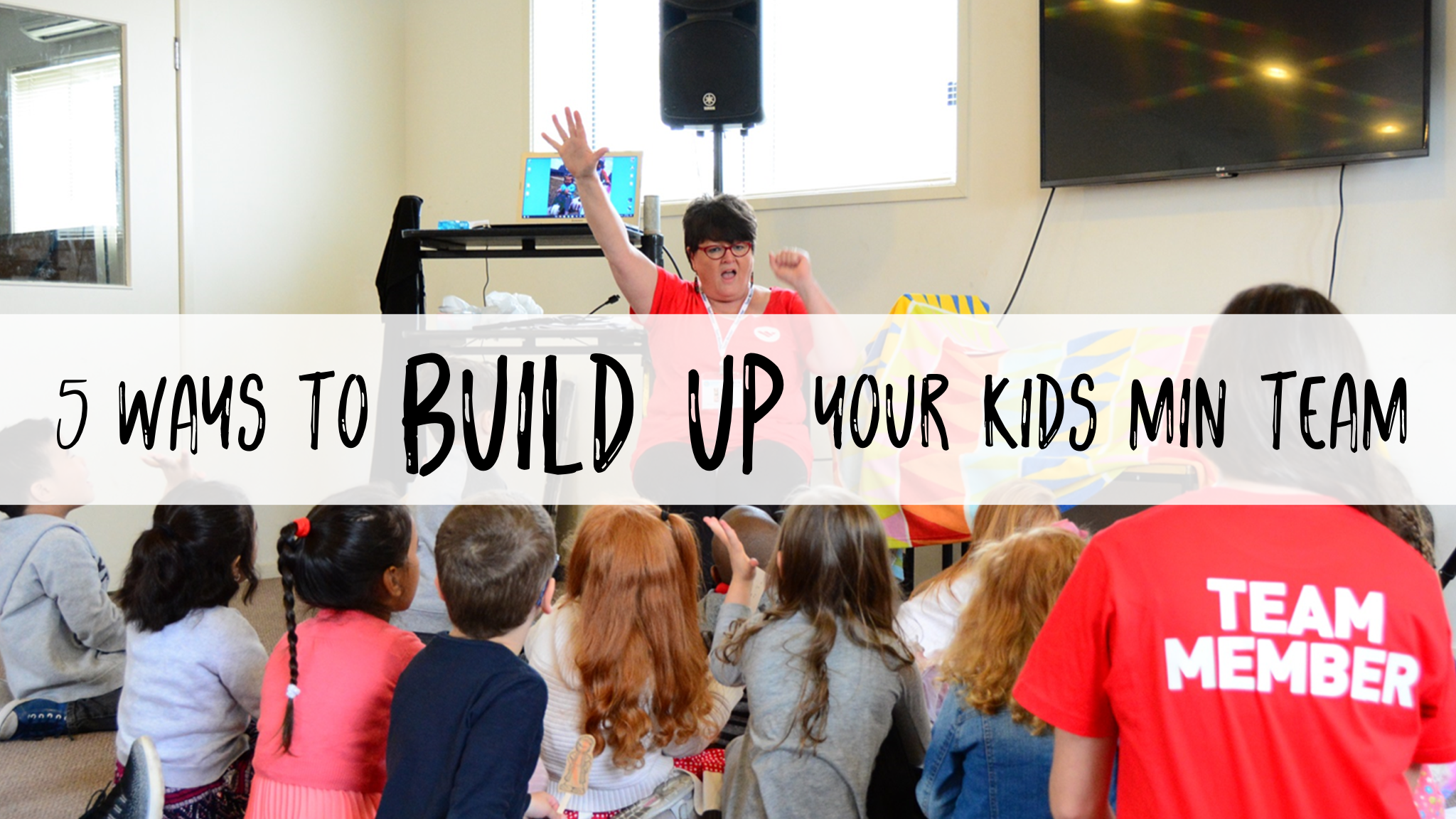
5 ways to build up your kids min team


Kids Ministry is an exciting and exhausting place to serve. Those who do it well will absolutely love it and give their all to it – but that doesn’t mean they are immune to feelings of doubt or fatigue.

Here are 5 very simple yet super effective ways you can make your Kids Min Team better – building them up in their sense of purpose and energy to continue to invest in our kids and community.

1. Thank them

Give them a high five at sign in. Tell them you appreciate their commitment to your children. Help them understand the impact their serving has on you and your family. Remind them of the important part they play in your church community. Drop them a note, give them a FaceBook shout out, or speak it out loud.


2. Know their names

Make the effort to learn and remember their names. Get to know them. Find out what year they’re doing at school, what they’re studying at Uni or where they work. Try and discover what they do for fun, what their favourite chocolate is, what music they listen to or what sport they follow. Your effort will communicate such high value to them.


3. Bring them coffee

Because Sunday mornings are hard y’all!! Surprise them with coffee or breakfast donuts and fruit. Buy the night team a pizza for supper or bring slurpees on a hot day.


4. Give them feedback

When your kids remember something they learned at Kids Min or when they tell a story about something their leader did – pass it on. Help them understand how their influence reaches beyond the scheduled ministry times. Encourage them to know the impact they are having in your kids’ lives.


5. Serve with them

Join the team – Kids Min teams ALWAYS need more members – and multiply their ministry effectiveness by adding your own gifts and skills. If you can’t be part of the scheduled ministry times, find ways to serve from home or during the week.

PICK ONE (or more) – and do it NOW!

Guarding hearts not computers

On October 10th 2017 Amanda Todd, a 15 year old Canadian girl, was found dead in her home. Her suicide was attributed to cyber bullying at the hands of ‘friends’ and strangers alike.

It started when a photo of her topless (which she uploaded at the request of strangers she was connecting with via video chat) was circulated on the internet. What followed was a series of tragic events – she struggled with anxiety and depression, turned to alcohol and drugs, her family moved towns, she changed schools twice, she had sex with a guy-friend, she was physically attacked … On September 7th she posted this video online …

http://www.youtube.com/watch?v=KRxfTyNa24A

Her story has sparked a lot of discussion about the perils of social networking and the need for greater regulation. Whilst this heartbreaking story is a cautionary tale of the pitfalls of internet use (the need for adequate monitoring, the degree of ignorance our teens tend to have to the permanency and scope of choices made in those ‘now’ moments, the cruelty of teens to one another, the speed with which those things can escalate etc) my heart broke to watch this video for a deeper reason.

I watched this and wept for a girl who was completely at the mercy of others to determine her own sense of self and to know her value and worth. Every step of this story is reflective of her search for significance in the responses and acceptance of others who are seeking exactly the same thing in their own (dysfunctional and depraved) way. I see a girl who would no doubt have felt she had no other options than the ones she chose.

I wonder if this couldn’t be a great resource to parents and leaders looking to engage and invest into youth? Perhaps this is a video you could watch with your teen and discuss it together? It would be a great opportunity to help them see the various “t-intersections” Amanda faced and the choices she made at each – workshopping some alternatives or ways she might have avoided some of the situations she found herself in.

Our young people are inundated with opportunities, interactions and decisions that are beyond their maturity and capacity to handle alone. Let’s be intentional about having preventative/pre-emptive conversations with our young people. Firstly, to equip them to navigate life in positive and healthy ways. But secondly, (and of infinite importance) to develop relationships of trust, safety and openness that will stand your young person in great stead to look to you (or other significant adults in their world) when they find themselves in circumstances beyond their ability to navigate alone.

Just a thought.