curiosity breeds connection – the power of empathy

When I was a young girl, I wrote poetry. Instead of journaling, I recorded all of my teenage angst and emotions in prose – book after book, page after page, pouring out my heart. I reflected on relationships and events, narrating life as I observed it. I’ve kept some of those books, although I’m not entirely sure why, since (for the most part) I have no intention of ever releasing them for anyone to read.

One particular entry, written by 15 year old Kimmy, was a bumbling attempt to process my emotions after experiencing a broken heart. I can remember very clearly the boy, the relationship, the experience. I had fallen hard, and we were as deeply invested as teenagers can be – but the relationship had come to an end.

The final line of the poem says: “People tell me to get on with my life, but he was my life.”

Could it get any more dramatic? Kimmy was clearly feeling the full depths of love lost and trying to navigate the emotional minefield and social implications of breaking up. He was my life! I have no doubt that in that moment, it felt like a true statement.

However, on the next page – dated the very next day – there was a new poem, written about a different boy! It opened with the line: “He smiled at me today.” It would appear the broken heart had recovered – and if not completely mended, had at least been distracted enough for the attention of another boy to become poem-worthy. It’s a mildly embarrassing snapshot and memory, but very real in the moment. And I dare say, a realistic capture of me in my teenage years.

That moment was decades ago now, in a very different time. If 15 year old Kimmy were navigating life today, experiencing those same emotions, the same devastation, the same yo-yoing of feelings and the same immaturity – but in an era of internet, devices and social media – I am completely certain that it all would have been plastered across my various accounts and apps.

I would have been sharing without caution or consideration of the implications – using social media as a place to vent and process my feelings. In a culture of sharing, high visibility and low filters, I doubt my level of emotional intelligence would have risen above that of any other teenager. The whole story would have been public for everyone to see. Opening myself up to the scrutiny and commentary of peers whose prefrontal cortexes were no more developed than my own.

I’m sure many would have expressed sympathy – maybe even a few sad face emojis – but then, when I shared my miraculous recovery and redirection of affection the next day, those same peers would have judged and commented again. I would have opened myself up to all kinds of criticism, and to the stories others might tell about me – about my choices, my character, my responses. All of it public. Exposed. Vulnerable.

I am eternally grateful that the era I was raised in means I just have a single copy of my handwritten words, sealed in a diary, in a box, hidden in my garage – rather than a digital footprint with a public audience and content no longer in my control.

That small vignette – this snapshot of my teenage years – compared to what life might be like if I were a teenager today, moves me to the deepest empathy for what young people face now. That one story alone makes me ache for the challenges and complexities teenagers must navigate in our current culture.

I am 100% convinced that 15 year old Kimmy would not have handled social media well. That she wouldn’t have had the maturity to make good choices about what to share or with whom. She would have been highly susceptible to the comments, likes and views of others – an my teenage years were hard enough without that!

When you think about your teenage self, what do you imagine you would have been like if social media existed back then? Not how you’d use it today – but how the teenage you would have used it.

That’s the point of empathy. That’s how we are able to empathetically engage with what young people are facing today.

Emerging generations need our empathy. They need our empathetic responses.

Empathy is the posture of seeking first to understand – desiring to fully know the experience of another in order to appreciate their perspective and support, encourage, and connect with them. Empathy moves us to question and inquire. It calls us to find a place of commonality in our shared human experience, even if that life is lived differently – in another environment, culture, era, or set of social norms.

The opposite of empathy is judgement.

Judgement comes more effortlessly. It’s easy to criticize what we don’t understand – to observe behaviour, response, decisions, and actions, and to draw conclusions rather than be drawn to curiosity.

Any time we find ourselves saying things like “those young people” or “they always” or, the classic “in my day…”, we’re perpetuating a generational gap that will ultimately cause us to lose our voice and influence.

A desire to understand will lead to far more fruitful engagement with young people. When we give them space to share their perspectives, priorities, and worldview, we nurture the kind of connection that opens doors. Allowing us to be trusted advisors and helpers.

Empathy is a muscle that must be exercised.

It’s a discipline we must choose, again and again, if we’re to stay within hearing distance of others. A posture of empathy means that moments of misunderstanding, confusion, or even exasperation become doorways – opportunities for greater connection – if we engage curiosity instead of criticism.

“I just don’t understand young people” becomes “Help me understand.”

Tell me more!
What do I need to know about how the world feels for you?
What would help you feel that I understand enough to be trusted – to be helpful – to be a voice of wisdom gained from my lived experience?

How might you come to believe that I am coming from a place of care and understanding? That my desire is for you to flourish and live the best version of life possible.

The challenge is clear for all of us. The next time we hear ourselves or others making sweeping statements or generalisations about young people, might we pause – suspend judgement – and seek first to understand.

I remember enough about being 15 to recall how certain I was that adults didn’t understand me or the age I was living in. I rejected advice, dismissed opinions, and scoffed at how out of touch old people were with life as I knew it. Young people today are no different. They are no more mature, no more cognitively or emotionally developed. The teenage brain is not just a smaller version of an adult one. Its chemistry and biology are entirely different.

Perhaps it starts with replacing statements with questions. I’m sure it starts with suspending judgement and conclusions. And we will most likely face resistance and hesitation. But each attempt – each expression of curiosity and a desire to understand – builds relational trust and maintains proximity. That proximity allows us to be of greatest value to young people: in life, in faith, in decision-making, in protecting their hearts. And ultimately, in setting them up to win.

“I have lost the back of my chair” – security, support, & singleness

There’s a people group in Northern China – the Uyghur people. When the women lose their partners, they enter a period of mourning that is quite ritualized. As part of this they have a phrase they repeat over and over that, when directly translated to English, means “I have lost the back of my chair.”

It’s a rich and relatable metaphor for all genders, ages, and stages. I have lost the back of my chair.

Go on, do it now. Lean forward from wherever you’re sitting and imagine the chair back (or bedhead, or wall) was no longer there. What would you have lost?

Rest. Support. Comfort. Security.

This is a great physical representation of what it can often feel like for Singles – particularly those who are single-again through divorce or death. I have lost the back of my chair, I’ve lost my security, my rest, my support, my comfort. Without that behind me I am unprotected, I am potentially destabilised, and I am more easily fatigued.

Writer Anabelle Crabb talks about the concept of learned helplessness in marriage. The reality that in a marriage roles are delegated to each partner that make the household functional. They’re assigned by skills or expertise, or interest and passion; or more pragmatically due to other circumstances (who is working in or out of the home, schedules, life stages etc). Over time, as you continue doing these tasks you get better at them. One of you is the master of the roast, one of you does all the tech programming, one of you keeps track of finances; one of you is the grocery shopper. But as you get better at it, the other partner who no longer does it at all unlearns it. Not only are they not perfecting or improving, they’re atrophying in capacity as it gets longer and longer since they last had to do or remember it. And so, when a person finds themselves Single-again they need to relearn a whole lot of things and compensate for the loss of the skills and responsibilities of the other. The same might be true for people living away from family and friends. New to an area or establishing themselves independently. Experiencing changed circumstances.

That’s where community can step in. Here’s how church family gets to be family to those without family. Here’s where the village can embrace and support. We say ‘don’t worry, we’ve got you, we’ll be the back of your chair. You can rest into us. You
can rely on us. You can depend on us to be your support and your strength.’ For those who’ve lost the back of their chair – or those who through various circumstances find themselves without one.

But, to keep the chair analogy going just a little longer, what would happen if the back of your chair was there sometimes but not others? If every time you leant forward you weren’t sure if it would be there when you sat back again? Sure, any offering of help is great and any relief offered ought to be welcomed. But for the benefit to be sure enough for a person to feel truly unburdened consistency is an important factor.

That’s where the security comes in. We need to be reliable means of support to others. Not just to offer once to mow the lawns but to commit to doing that regularly. Not just to program your TV or network your printer – but to be willing to come back when it stops working or needs upgrading.

It’s true for all of us. Whatever our living situation and personal circumstances. We need each other and life is made more manageable and enjoyable when we don’t need to sit forward as it were. Where we can truly recline with confidence that we are held and supported.

Big Questions from Little People

I love hearing from parents about the ‘awkward’ conversations they have with their inquisitive children.

“Miss 6 wanted to know what ‘sexy’ means.”

“I overheard my kids calling one another ‘gay’ while they were fighting. When I asked them to stop they wanted to know what ‘gay’ meant!”

“My daughter was reading the Bible and wanted to know how Lot’s daughters got pregnant.”

Most times these conversations aren’t quite as traumatic as we make them out to be for the purposes of telling an entertaining story, but more often than not these questions catch us off-guard. We know that “ask your mother/father/teacher/pastor” is hardly an acceptable response – even if it does seem to be the first one to come to mind – and the next one is usually something like “you’re not meant to ask that question for another couple of years!”

I’m often asked for ‘advice’ to help navigate the more sensitive discussions parents are called upon to conduct. I’m certainly no expert but here are my three top tips that may be helpful for those of you preparing for such conversations (or hiding here online to buy time to respond to that question you were just asked!)! 🙂

1. Ask clarifying questions before launching into your response

2. Don’t overshare.

3. Check their comprehension.

A mum was driving with her kids in the back of the car when one of them piped up and asked “Mum, where do I come from?” The mum took a deep breath and launched into a stilted recount of the process of creating human life until her daughter interrupted and said “no, I mean, what hospital was I born in!?” Apparently they had driven past one and she wondered if that’s the one she ‘came from’!

Ask clarifying questions.

A child once asked his mother what sex was and before replying she said “why do you ask?” The son said, “Because Dad said he would play with me in two secs!”

Clarifying questions are helpful to make sure you’re answering what they ACTUALLY want to know and not giving unnecessary (and potentially unhelpful) information.

Once I was watching television with a friend and her 8 year old daughter. The show made reference to AIDS and Miss 8 turned to us and asked “what’s AIDS?” The mother blanched! She whispered to me, “how am I meant to explain that? … intravenous drug use and risky sexual behaviours …” I turned to Miss 8 and said “it’s a disease in the blood.” At which point she turned back to watching the tv.

Don’t overshare.

You know your children better than anyone and can probably best assess their level of cognition and emotional maturity to know how much information they really need to satisfy their curiosity or give them a degree of peace in relation to what they’re asking. By asking clarifying questions you can find out what it is that they are really concerned about. You can discover what they are mentally calculating and processing and how much information will be helpful for them to come to a satisfactory conclusion … for now. They will no doubt have additional questions as they process the information you give them, as their intellect develops and as they are ready to process more details or more complex ideas.

Before your chat is over (and potentially again at a later time or date), check what they have understood from what you’ve said. “Tell me what I just said in your own words.” or “How would you answer that question if someone else asked it?” “Do you have any other questions?” “Has that helped you understand?” Whatever you can ask that satisfies you they have received your information as correctly and usefully as possible.

Check their comprehension.

Finally … don’t forget to keep sharing the stories with other parents (& me). We can all learn something from your experiences … and they do make the most entertaining stories! 🙂

isolation and living alone

There are only so many times a living-alone-Single-extrovert can hear the words ‘isolation’, ‘social distance’ and ‘cancelled’ before the weight becomes a little too much to carry and it has to leak out of my eyes! Yesterday I had a significant ‘moment’ (think tears, snot, a few little hiccup-y gulps and one or two audible groans!).

Last month I shared a post how long ‘til the realise I’m dead? and it seemed to resonate. Single people commented repeatedly “This is exactly how I feel!” and married responses repeated the sentiment “I’ve never even thought about this before.”

The same people who worry about not being discovered to have died are bound to be experiencing an additional layer of anxiety in the face of these shut downs and measures of separation to responsibly manage the movement of COVID19 and it’s impact on our health care system and to protect our most vulnerable.

CHECK ON THEM!

Social media is being flooded with posts from Introverts saying this is their idea of heaven. From what I understand, the cancellation of social events and being ‘forced’ to stay at home are the stuff their dreams are made of! 🙂 HOWEVER, even the most introverted of introverts could acknowledge that, as much as they love being alone and are personally energised by that time to recharge, there’s also the reality that without the interruption of exchange with others there can be an un-health that shapes their thought life. As much as they can do without social interactions, the circuit breaker of other people’s engagement in their thought processes and internal dialogue is a healthy and necessary thing.

CHECK ON THEM!

As organisations (like mine!) move to working from home (can we just pause for a praise break that we live in such technologically advanced times – so many opportunities to stay working and connected through online platforms!) while this is a fantastic provision – it’s also a socially isolating move. Many living-alone-Singles rely on the accountability and regular interactions of work life and will struggle without it. As churches move to streaming their services, be reminded that it’s not just the sermon or worship our congregations will be missing (in fact, these things have been out-source-able for a long time now) it’s the connection to one another, a sense of engagement in something bigger than themselves, the opportunity to keep regular relational accounts with one another – to give and receive prayer and encouragement.  (My church has set up an online/phone prayer service to facilitate this – what a great initiative!)

CHECK ON THEM!

For those of us living alone who have the love language of physical touch – this experience has another layer of impact. The social distancing protocols don’t apply within your households. You might sleep closer than 1.5m to your spouse. Go ahead and TRY convincing young children not to invade your (or each other’s) personal space – that’s not happening! So, even in a time of physical disconnection you’re experiencing some connection. In my regular life I can go days without physical touch and now, it’s mandated! In my little ‘moment’ yesterday, this was part of my processing … how long do I have to go without any physical connection?

CHECK ON THEM!

I messaged my friends – the ‘her is ours now’ family referenced in this blog being family to those without family – and shared about my little meltdown and said “I decided you could adopt me, then if we need to isolate I’ll isolate with my ‘family’”. The response was, essentially, an affirmation that they thought I already WAS adopted, and that if we get shut in as family-units then my place of shut in is with them! “If ‘Her is ours now’ then ‘her corona is our corona now’ too!”

Of course, we’re prayerful that the measures our country are employing now might avoid a complete lock-down. Things are changing daily as we continue to track the spread and learn what we can from other countries (another praise break – how grateful are we for all the fabulously smart and compassionate people in our medical system?!) and there’s no real point in leaping ahead to worst case scenarios. Being sensible and caring in this moment is our best next step. If I came to know I was infected I would never intentionally expose them to the virus.

But, I can’t tell you the relief that came to me in my emotionally charged episode, to have my friends make it clear that I won’t have to be alone. It was such a circuit breaker for my fear, loneliness, overwhelm and distress. There’s a plan, an option.

CHECK ON YOUR LIVING ALONE FRIENDS.

If only to give them a safe place to process the emotions they might be feeling. Each of us will travel an experience like this differently as it’s shaped by our lifestage, personality, health status and other factors. Let’s do what we can to grow in our understanding and empathy for one another.

how long ’til they realise I’m dead?

img_2899

I wondered if it was just my overactive imagination, or perhaps the product of watching too many true crime documentaries, but a quick poll of some of my Single friends tells me I’m not alone in asking this question. How long could I be dead before people would notice I’m missing?

I’ve seen the news reports – I’m sure you’ve seen them too – where neighbours alert authorities to an unpleasant smell, an overflowing mailbox or dogs barking incessantly and the subsequent inquiries reveal someone who has died. Clearly, some time ago. And it had gone seemingly unnoticed until now. It’s one of my worst fears.

As someone who lives alone and quite independently, there are often long stretches of time between points of check in. Frequently, when travelling between locations – the office, home, from one work visit site to another, church, a friend’s, the gym, a family event – I’ll find myself calculating the amount of time there is until the next point that my absence would be noticed. My church friends might just assume I’ve slept in or I’m speaking at another church, the gym has my money and doesn’t check to see why I didn’t show up to a class I’ve booked, my work colleagues could assume I’m having meetings or working offsite … it leaves substantial chunks of time in which I could be dead (or in less dramatic but still significant difficulty!) and no one knows yet.

I spend a lot of time on the road. That same active imagination allows me to envisage a scenario where I’m involved in an accident of some catastrophic, fatal nature, and the attending emergency services have to find out who I am. They could discover my home address but no one would be there. They could knock on a neighbour’s door but it depends which door they chose as to how helpful that would be. They could try the last number called in my phone – but that could be someone that I don’t even know personally. Anyway, these are long drives, I’ve had plenty of time to (over)think.

I recently saw a conversation thread on an online chat forum that raised the topic of Singleness and Illness. Pertinently, several Single post-ers commented on bouts of sickness that saw them home-bound for multiple days without anyone inquiring or offering assistance. For many, it was not so much the issue of being unable to look after themselves or requiring medical care but the fear attached to the experience. What if my condition worsens? How long must it be before someone notices my absence?

Of course, the answer is simple and, perhaps, obvious. A Single person who is sick just needs to make sure they let someone know they are, right? But the flip side of that is the often larger fear of Singles that they are perceived as needy or overly focussed on themselves. “Hi Pete, just ringing to let you know I have a bit of a cold coming on.” “Lucy, it’s 8:07, I’m leaving home. It’s 8:52, I’ve arrived at work. It’s 4:39, I’m going home via the supermarket.”

Every time I speak (write) something like this out loud it’s met with an enthusiastic cry of “yesssssss!” from Singles and a general sense of relief to hear that someone else knows and understands. That maybe they’re not so strange, or needy, or self-focussed – that maybe, just maybe, this reflects a legitimate heart cry to be known, looked-out-for and not too far beyond the reach of care or interest.

Couples and families, next time you’re feeling “checked up on” you might consider the gift that is to you. When you’re someone’s someone, they generally care about where you are! They keep short accounts. They check if you’re not where you’re meant to be when you’re meant to be. There’s a blessing in there that you could be mindful to appreciate.

And all of us, check in on your Single friends! Notice when they’ve not been in touch for a while, inquire about their health, show interest in their movements and schedule. It doesn’t take much to keep everyone connected … and off the news!

your single friends need you (probably more than you need them)

A few years ago I was sitting with my housemate and we both got a text message from a married friend. She was letting us know that she’d had some medical issues arise. There’d been some preliminary testing that was either worrisome or inconclusive enough to warrant further investigations. So she was going to have more tests done and was asking for us to be prayerful.

My friend and I both thought to respond in the same way and I sent a message back including “I hope you have some friends journeying this with you”. We later discovered that this was considered to be a strange kind of response. There she was informing us as her friends and inviting us to be part of the process – why were we questioning whether she was including her friends? Ultimately as a married person the need to contact friends was triggered far later in the process than it might have been for a Single person. A Single person who is experiencing negative health symptoms would probably contact a friend straight away. A Single person would seek the opinion of a friend or family member to know if they should go and get that checked out. A Single person might let a friend know that they’re going to a doctors appointment and perhaps even invite them to come along. So by the time further testing was required a Single person may have included their friend/s a lot more in the process. The reality is that for the married friend she had been processing all that with her husband up until that point.

Single people can have different expectations and requirements of friendship.

For a Single person, their friends are the entirety of their network of advice giving, problem-solving and listening. For those who are married and in a family environment a friend serves a different purpose. If circles of trust were to be drawn a spouse might find themselves at the very core and then friends at varying stages of distance in the widening concentric circles. For a Single person without a spouse at that core, often friends are drawn into a place of higher trust, of higher reliance; of higher connectedness.

What this creates is a potential power and need imbalance in friendships. Where the Single person requires more of you than you require of them. Where your name would be listed closer to their inner circle than their name would to yours. A friend of mine recently recounted a revelation she’d had of this when her Single friend asked her to come around to look at her new flooring. She thought it was an odd request until she connected with the fact that she would have had numerous interactions with her husband over new flooring and not felt the need to tell others – whereas her Single friend might not have had any engagement about her floors with anyone else. Perhaps a trivial example, but a helpful illustration of the different experiences.

This plays itself out in many ways, including socially. Where a planned social gathering might be additional to your weekly social calendars and fuller household, it can be the entirety of a Single person’s social connectedness. Where a cancelled dinner or a lack of invitation might result in you having a more quiet night at home, for a Single that could equate to being completely alone.

My friend Nancy and I talked about this recently as we sat across from one another at dinner. I made the observation that I needed that interaction more than she did. She’s married and is also a mum and as we talked some more she reflected, “I don’t think I had ever really considered how much my relational tank is filled incidentally and how that shapes how many friends I need, what I need from them, and the time and space I have to give them.”

What that means is that a Single person needs to maintain a lot of relationships to ensure their input and output are sufficient to experience the human connection we are built for. Even for me, as a highly extroverted and socially and relationally competent person, that can be EXHAUSTING! There’s a lot to balance to ensure that there are enough of those once a week, once every fortnight, monthly catch up types of relationships to spread across the day to day of life in order to keep the relational tank at a healthy level. That need makes us vulnerable. There’s great risk attached to this reality that we probably need you more than you need us.

Singles, identify and own this reality. You need others. It’s risky. It’s exhausting. It takes intentionality and purpose but you can create the kinds of relationships that will allow you to give and receive the love, belonging, serving, fulfilment, purpose and joy that you need.

And for you non-Singles, maybe you could do a self-audit like my champion friend Nancy, to recognise the level of relational filling you operate out of before leaving your house or making any extra effort. It might increase your sensitivity to the needs of the Singles in your world and grow your understanding of the neediness they experience and the risk they take to stay relationally engaged.

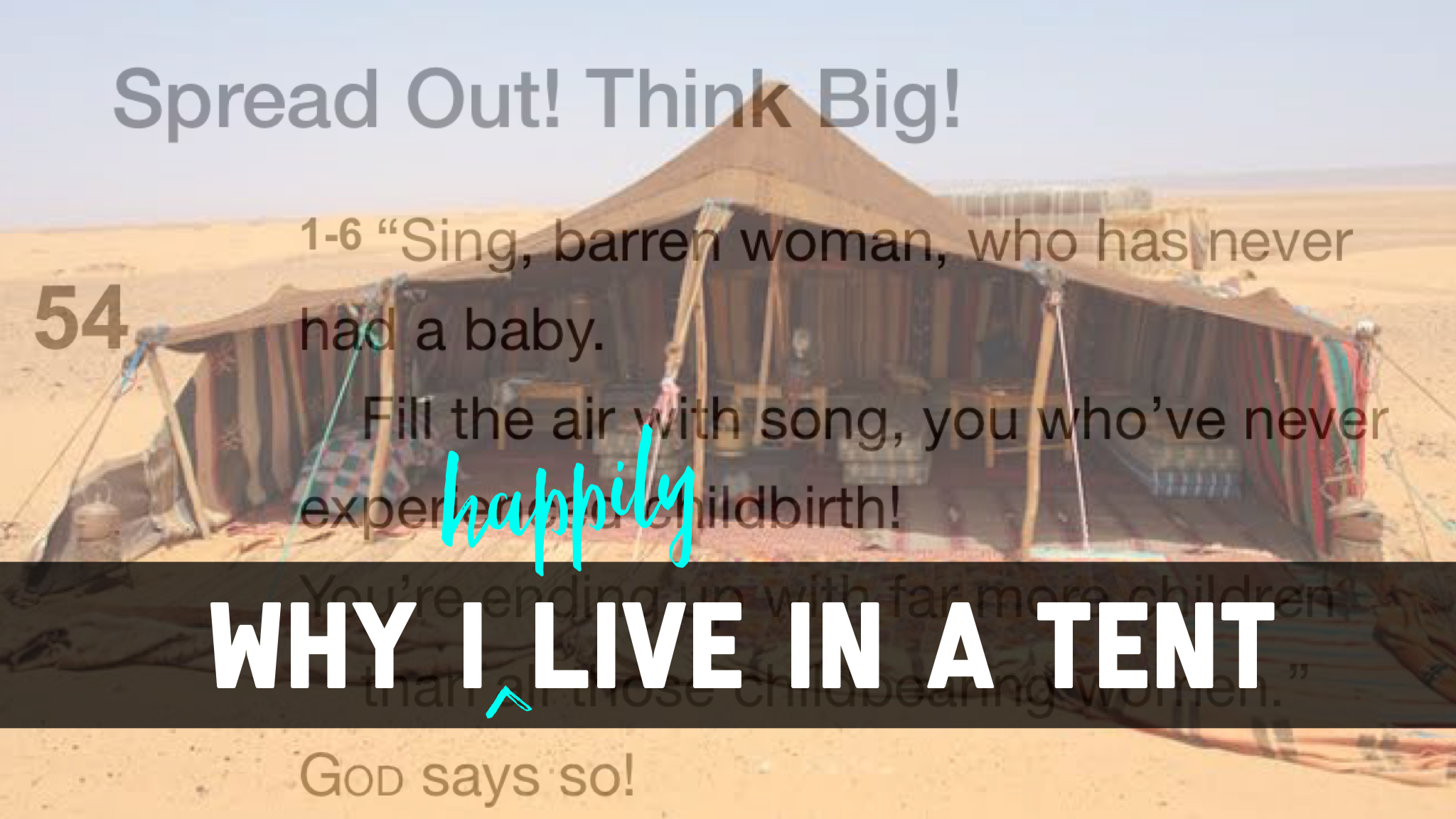
why I (happily) live in a tent

You know those years that become lifetime markers? Where your story becomes divided into before and after? 2002 was that year for me.

Amongst a whole lot of changes, challenges and growth it was also a year of great loss. I miscarried a much longed for baby and then my marriage of 8 years ended.

As dramatic as it sounds, it really felt like I was “done”. My greatest hopes for my future – to be a wife and mother – were dashed. I’m 28 years old and I’m done. And, as if my own fears and doubts weren’t screaming loudly enough, others gave voice to judgement and condemnation. “Divorced people can’t serve in the church.”

Done.

Through a dear friend, God illuminated Isaiah 54 to my heart and rarely has a portion of scripture ever spoken so directly and powerfully to my very core.

It’s long. And there are many layers to the significance of all 17 verses and the context of the scripture in the greater biblical narrative. But let me highlight just a few (reading from The Message translation).

“Sing, barren woman, you who never bore a child; burst into song, shout for joy, you who were never in labor; because more are the children of the desolate woman than of her who has a husband,” says the Lord.” v1

‭‭‬‬Boom! What?

“The Lord will call you back as if you were a wife deserted and distressed in spirit— a wife who married young, only to be rejected,” says your God.” v6

‭‭‬‬🙋🏼‍♀️

So incredibly affirming and embracing. He sees. He knows. He holds.

Amidst all of the upheaval I was processing two big decisions – an apparent call into generations ministry and what to do with the large family home of which I was now in sole possession.

“More are the children of the barren woman…” at that time there were at least 30 who would come under my ministry umbrella! And God in His grace called me to nurture an ever growing gaggle of children and families that shaped a culture and focus for ministry in the context He placed me. Also moulding a lifelong ministry message and opening my heart and arms to some incredibly special little ones He has gifted to my life over the years since.

But, to the main point of this reflection – the Tent.

“Enlarge the place of your tent, stretch your tent curtains wide, do not hold back; lengthen your cords, strengthen your stakes.” v2

‭At a time when it felt like my world and my dreams had been completely shrunk, God’s word to me was one of expansiveness and big picture dreaming. Spread out!!! Think big!! So, as I looked at this big 4.5 bedroom home – purchased with the dream of hosting a growing family but now just a home for one – God was shaping a vision for a different type of filling and a redirecting of my mother-heart to a different kind of loving.

Thus The Tent.

Make room. Make room for ministry, for meeting spaces, for parties, for storage; for a community trailer. Make room for guests, for those in need of emergency accommodation, for the convalescing, the international traveler, for the visitor and those needing a place to call home. Make room for dinner parties for 16 and takeaway on the couch for two. Make room for dreaming and writing, preparing and creating; for baking and making. Make room to embrace and to launch. Make room for tears, for doubts, for reflection, for grieving, for searching; for prayers. Make room for great joy and loud, loud laughter. Make room for deep learning, for growth, for failure and recovery. Make room for singing and dancing and trampoline jumping. Make room for babies and children, for youth and their leaders, for mentors and friendships, for family and colleagues. Make room for memories and moments.

Make room.

Stretch your tent curtains wide. Don’t hold back.

A vision for a physical location, but more importantly a mandate for a way to live. Make room. A desire for an ever-enlarging heart. For ongoing and greater generosity. For continuing openness even when wounding or grief would seek to close me down. For hospitality in its truest definition – welcome, inclusion, comfort and connection.

And now the Tent has relocated. But the physical aspect has only ever been one part. So even though this iteration is smaller (for now) the prophetic vision over it is still as large. The door is open, the kettle at the ready, the guest beds are made, everything is to be shared and my heart’s desire is to always be a place of welcome for all who would come.

The full text of Isaiah 54 (The Message translation) can be found here

being family to those without family

“Her is ours now!”

This was the declaration of a new 5 year old friend when she discovered I didn’t have my own family. She had inquired about it after a few visits where I’d shown up clearly without one! “Does she have a family?” Her dad assured her I had parents and siblings, but she was thinking more about the kind of family that would come along with me. After some reflection, she made the decision that this ‘no-family’ situation would just not do and announced my immediate and complete adoption into hers!

Out of the mouths (and hearts) of babes.

The reality is that there are many Singles who journey life in the void of all that we are designed to express and experience in family. That’s where you and we come in! The opportunity exists for us to be family to those without family. Here’s some thoughts to consider as we endeavour to do that and do it well.

not all singles are created equal

Every Single is unique. Personality and temperament; factors like extroversion or introversion, history, circumstances or life stage, contribute to ensuring every Single has a unique set of needs as well as contributions to offer. While some generalisations might be made about certain demographics, there are often more exceptions than inclusions.

assume nothing – talk about everything

The only way to ensure what is on your heart to offer to a Single in your world is going to be accepted in the manner you’ve intended is to avoid assumptions and ask lots of questions. What are the situations that you find most difficult? How can I best support you? Is it helpful if I did “this” or would it be better if I did “this”? I read/heard/saw this from another Single, is that your experience? How does it differ? etc Often, things done with the greatest heart to help and include miss the mark because of the misalignment of expectations that could be easily averted if communication had been clearer.

what you take for granted

In the busyness and monotony of your every day life it can be easy to take for granted some of the things you experience in family (and potentially, even begrudge them). The buzz of noise and chatter as family goes about their regular routine, the sharing of responses over something seen on tv, serving one another in practical ways, incidental contact that happens as you move around each other, externally debriefing your day, a kiss goodnight – all this and more takes place in your home constantly and, often, without much thought. Singles often experience deep longing for these experiences and also could benefit from the grace, capacity for compromise and others focus that these circumstances demand.

the gift of normal

Don’t underestimate how powerful it might be to include a Single friend in the normality of your life. As chaotic or mundane as it might feel to you, it could be an incredible gift to someone whose day to day is often absent the dynamic these family environments bring. It’s possible to inadvertently communicate to a Single person that they’re an imposition or separate to your family when there’s a sense that they require a level of ‘hosting’ that is disruptive, rather than a type of inclusion that is mutually beneficial.

singles have more to lose

True, the responsibility to extend invitation, action social planning or nurture relationships doesn’t rest solely on those who are friends to the Single. But, the reality is that in the instigation or execution of such interactions a Single has less to offer and more on the line. If your family invites a Single person to dinner – whether they say yes or no, you’ll still be having a family dinner; if they cancel last minute, you’ll still be having family dinner. For a Single – the contrast is stark and so the risk is greater. When a Single invites a family to their house, they can’t offer an existing social dynamic – you’ll need to bring that with you. Until you are there, nothing is happening! It might seem an obvious point to make but perhaps it’s a perspective you haven’t fully considered. It’s certainly a dynamic by which many Singles feel hamstrung.

monitor & adjust

Seasons and circumstances are constantly changing. What works in one stage of family or life rhythm will need to be adapted as things shift. A biological family navigates these transitions constantly and included others can also – but it requires communication. The courage to ask the questions as changes happen will ensure that relationships are kept strong and mutually edifying as each new season is embraced.

LISTEN HERE – for further ideas for being family to those without family

READ THIS (“arriving alone”) – a practical encouragement to support Singles by helping them overcome a simple yet often debilitating obstacle


At least we came!

Most Sundays at church I get to stand on the platform at some point and look out at all the brave souls who have made it to church that morning. I say ‘brave’ because I think sometimes (most times?) the well-dressed, sweet-smelling, generally-got-it-together people looking back at me are not really indicative of the true story of what it took to get them there!

For some reason, getting up on a Sunday morning – even an hour later than you probably do for work – can be the hardest task of your week. Kids that neversleep in decided to do it TODAY (or they wake at an hour that is un-godly … even on God’s day!!)! The ‘leisurely’ breakfast went feral when one of the children decided to be ‘helpful’ with a whole box of cereal. The weekly ‘you’re-not-wearing-a-basketball-uniform-to-church’ and the ‘no-you-can’t-wear-your-flowergirl-dress’ (or a combination of both) battles have been waged … with tears … from everyone! Husband/wife decided to drive “that” way instead of “your” way and then parked in the“wrong” place and did that “thing” they always do …etc etc … Continue reading