arriving alone 

One of the more difficult parts of Single life for me is arriving somewhere alone.

I hate it.

There’s something quite terrifying about those first few moments when I don’t yet know where I am going to connect or fit in. Arriving alone is a vulnerable, breath-holding experience.

There was one time when I arrived at an event that was already underway. I walked around the room and there were multiple conversations happening and none of them broke from their interactions to connect with me. So I just walked back out again! It was an intensely dramatic and reactive thing to do. But I just didn’t feel emotionally strong enough to take any further ‘rejection’, so I bravely ran away.

Arriving alone makes me feel very exposed. Even as a socially competent person, I feel a little adrift without the ‘fallback’ of a partner to talk to when other options aren’t available – or even to stand awkwardly beside while they are in a conversation.

I don’t remember feeling this way when I had a partner and attended events on my own. I suspect that was because it wasn’t an always thing and I was less self-protective or sensitive. Or perhaps now the contrast of the two experiences (arriving together or alone) makes the alone feelings more pronounced, I’m not sure.

Arriving with others sets up a different posture of expectation and confidence that changes events markedly. The prospect of a party, a church service, a family gathering and all manner of events or get-togethers, is dramatically altered by the knowledge that those awkward arrival moments will be somewhat alleviated by the company.

An invitation to drive together, meet out the front or save a seat for someone arriving alone can go a long way.

It may seem like a trivial thing, but I often think that if I – in my extroverted, outgoing-ness – can feel this so acutely that I’ve elected to stay home or arrive extra late … I can’t imagine how others might deal with these feelings.

What about you? Or what about the Singles in your world? I’d love to hear your thoughts and experiences. 

5 things every kid needs || nosey parents

#5 nosey parents

Every parent will know that the way kids and teens relate to their parents ebbs and flows throughout their life. 

There may be times when children are clingy and needy; they don’t like to be away from their parents. At other times kids seem so independent a parent can almost feel redundant. There’s the “please don’t make me kiss you” or the “drop me off around the corner” phase. There are times when you are the source of all knowledge, power and entertainment and the times it seems you can know, say or do nothing of value. 

When it comes to raising children in faith, regardless of what your child may think they need or want from you – every kid needs nosey parents – at every stage. They need parents who are interested in their spiritual condition and concerned for their spiritual development. 

To this end, parents can 

  • Develop a faith-culture at home 

Deuteronomy 6 encourages the incorporation of learning and sharing of faith into the normal practices of home life – eating together, bedtime routines, and the regular comings and goings of life. Just as you would expect your kids to engage in routines such as brushing their teeth, expectations around faith practices communicates high value. 

  • Know the questions your child is asking 

And if they’re not asking any – ask some of your own. Stories shared about interactions had with friends, news and current events, or movies and TV shows, are all opportunities to know how your child sees the world and where God’s perspective shapes that view. Are they caused to question God? Do they understand His heart towards people or circumstances? What do they know of His power and activity in the world? 

  • Recruit others to shepherd and invest in your kids 

Know the names of your child’s ministry leaders – know even more than that! Know the leaders your kids love and why. Help the leaders know your child and your family better. Encourage those who have an influence in your child’s lives and champion them as your most powerful allies. 

Ministry leaders and other parents can also be a rich resource for you as you navigate difficult topics or responses to behaviours and attitudes. 

  • Know what they’re learning in faith groups and activities

If you get the “nothing” or “I can’t remember” answers when you ask your kids what they learnt at youth or kids ministry go directly to the source. Ask the ministry leaders what discussions and activities were part of that week’s session. You can still demonstrate trust in your leaders while also having a high expectation of communication of topics, intentions and responses. 

** A note for ministries and leaders …

You can train your parents to be nosey. Firstly, by your responses to their inquiries. Any sense of reluctance to share or a lack of knowledge will communicate to the parents that their inquiries aren’t welcome or they are asking for something that you can’t give (which is concerning!). When you welcome and engage with parental inquiries you grow their confidence to ask and your genuine intent to partner with them. And secondly, by answering the questions they should be asking – even if they’re not. Offering information to parents about what you’re observing of their children in your ministry or in their faith development, builds their confidence. Sending emails or “take-home” sheets that empower parents to connect with their child on the topic or story of the week is a great resource. 

Parents – what ways have you been “nosey” in your child’s faith development? What have you found most or least successful?

Leaders – how have you encouraged “nosey parents”? What successes (or failures) have you had in this endeavour?

5 things every kid needs || think orange 

#1 a really big God

#2 someone else

#3 another voice

#4 uncommon sense

#5 nosey parents 

do all things really work together for good?


I have this verse (Romans 8:28) on my wall. 


Because I walk by the wall so frequently, I am constantly reminded of this promise and affirmed and strengthened by it. 

As with all scripture, this verse has the potential to be misinterpreted or misapplied which can lead to disappointment and disillusionment. 

Here’s three truths that are essential for understanding this text correctly. 

1. All things work out for good – even if they aren’t good now. 

This is a future promise not a present guarantee. Paul does not say “all things ARE good for those who love the Lord”, he says, “God WORKS all things for good”.  There’s a big difference. 

Our faith and trust in God allow us to interpret our current trials and pains through the lens of a future hope we have that these hurts will not be for nothing – that they will be caught up in God’s big picture plans for our lives and His glory. 

To look at some of my own life experiences – death of family members, family breakdown, miscarriage or a painful divorce are NEVER good in and of themselves. This verse doesn’t suggest that for those who love God divorce is good or for those who love God death and loss are good; not for a minute. It does promise us that in the hands of a loving Father those experiences can be redeemed and we can learn, grow, mature and flourish through them, because of them and inspite of them. 

2. All things work out for good – but sometimes even that good doesn’t feel good. 

Because we are not God and because of the many shortfalls in our character and ability to know the future, what we think is good for us and what God knows is good for us are not always the same. 

God’s plans to redeem all things for good may include the good of doing without things that He knows aren’t healthy or helpful for us – even if we want them. They may include us being humbled or learning painful lessons that ultimately grow and refine us. 

To fully appreciate the “good” God is bringing about we need to ask Him for HIS eyes to see and appreciate what He has in mind for us. It may not look good to us, but He is a perfect Father who only gives good gifts. He invites us to trust His big picture plan. 

3. All things work out for good – but the timing of the good is not ours to know or control. 

My maternal Grandparents were killed in a car accident together when I was 11 years old (and they were only in their early 60’s). Our family treasured the promise of this verse as we absorbed the news of their tragic death and prepared for the funeral and life without them. We learnt it as a song! At the funeral, a family member came to faith! The witness of Grandma and Pa’s lives and the confrontation of their death brought this lady into an eternal relationship with God. See, we said, God is even using this for good!!

I love that story. I love the grace of God to make this promise so tangible for us. It stood me in good stead for future trauma and tragedy that was ahead for us as a family and me personally. But the more common story is that it can often take more than a few days for the “good” to evidence itself. Sometimes it may be years in the making. Sometimes it may even remain unknown to us. 

Just because we haven’t seen the good yet doesn’t mean it’s not coming. God’s timing is always perfect. 

How have you seen this promise at play in your life? When do you find it hardest to hold on to? When has it been most encouraging?

Comment below or email me directly at kimberlyrsmithministry@gmail.com 

how prayer saved my year 12 exams


A few (cough) years ago I was finishing my year 12. Back in those days, exams were a significant portion of the overall results (50% in some subjects!) and so the exam week was very much considered “make or break” in terms of final outcomes. 

My PE exam was on a Wednesday. On the Tuesday night I studied until late with plans for a long sleep-in to be rested and ready for my afternoon exam. 

Except at about 8:30am I woke suddenly and just felt “off”. I was sick in my stomach and unable to shake the feeling that something was wrong. I went to Mum and tried to explain what I was feeling and had a sudden sense of the connection between what I was experiencing and my exam. 

I decided to ring a friend who was due to take the same exam. I got through to her mum who confirmed what I was starting to suspect – the exam was in the morning! My friend was already there!!!

The exam started at 9am. We lived more than 20 minutes drive away from the exam location. I was in my pyjamas! Reading time finished at 9:30am and after that point I would be unable to enter the room. 

I threw on some clothes. Mum grabbed me a banana for breakfast. We drove in – under that terrible tension of knowing that without breaking the law or putting ourselves at risk (Mum would do neither!) we were going to be cutting it so so fine. 

I think I got out of the car while it was still moving and ran flat out to the door of the venue. I burst in and the whole room was watching the door. They all knew the time constraint and were panicking on my behalf. 

I sat in my seat at 9:27am. 

The following Sunday I was at church and sharing the story in response to questions about how my exams had gone. An older couple questioned – what time was that? What day?

When I told them, they exchanged stunned looks with one another and then shared the fact that on Wednesday morning they had been praying together as they did most mornings. At one point the lady had interrupted her husband saying “I think we need to pray for Kim!” It didn’t make much sense to them but they prayed anyway. 

I asked them what time that was. 

8:30am 

She remembered the time because when my name came to mind she had looked at the clock to see if it prompted any recollection of what I might be doing at that time or an association to lead them in their prayers. 

This story is a powerful testimony to me. It reminds me of God’s faithfulness. It reminds me of His nearness. It reminds me of the power of prayer. 

And I know that it was equally powerful for the couple. It confirmed that they had heard God’s prompt correctly. It encouraged them to know God might use them in His plans for someone else. 

Oh, and I passed the exam and subject too! 😃

Do you have a story of an experience like this? Have you had a powerful encounter with prompts to pray or God’s miraculous provision through prayer? Please share!

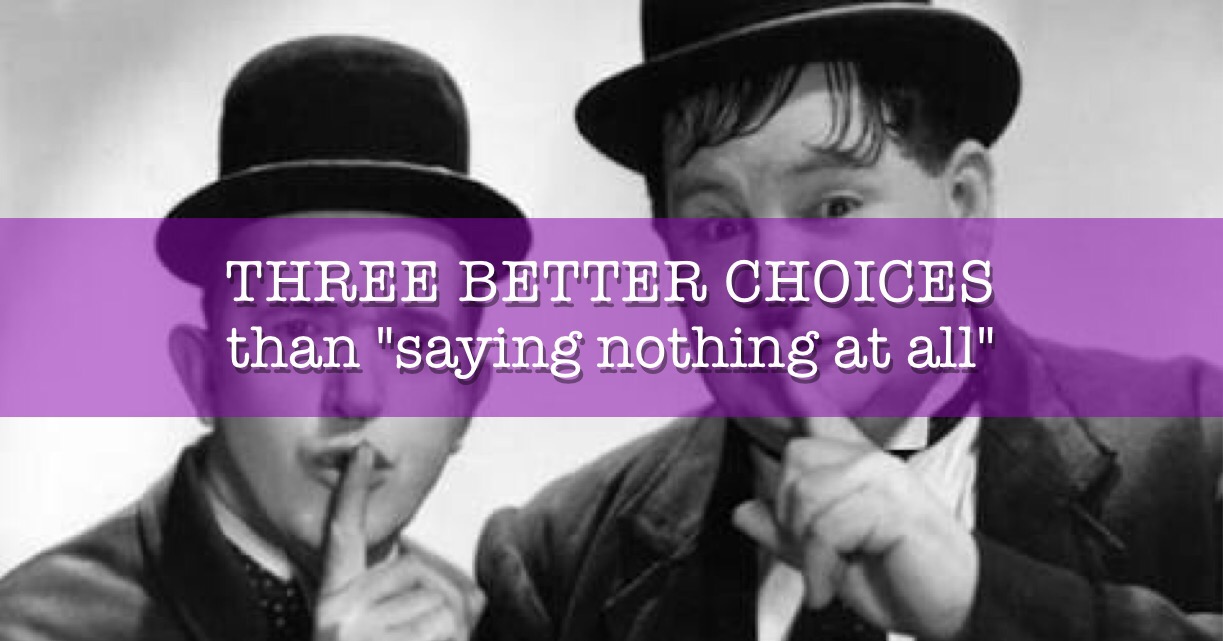
3 better choices than “not saying anything at all” 

“If you can’t say something nice, don’t say nothing at all!” – Thumper, Bambi

I’m sure we’ve all heard this quote (or a version of it – possibly without the double negative!) at some point in our lives. Our parents used it to kerb our critical opinions – particularly when we defended our outbursts because they were the “truth”. But then, we’ve probably all used it ourselves. Mostly as a passive aggressive (emphasis on the aggressive) way to say that we have a negative opinion but we’re far too polite to tell you what it is. Yes, because that’s an effective way of defusing a conflict – at no point ever in the history of defusing conflict!!!!

I love Kid President’s rewording. 


Here are three options to “not saying anything at all”. 

Choice #1 – think harder 

Emotion, defensiveness, fear and tiredness can all make us feel there is nothing nice to say. In times when our thoughts, feelings or option seem overwhelmed by the negative, we all can pause and think harder. 

Where is the potential positive? What can be encouraged or affirmed? What can be understood or explained? What alternate perspective could be explored? 

Choice #2 – choose honesty 

“Not saying anything at all” is a choice to withhold truth. Sure, there are times and places where hearing the truth would be more palatable but the truth is always our friend. 

In fact, the truth from a friend is the best. It’s better than a withheld criticism and it’s certainly better than silence – where we are left to guess what the other is thinking. 

Choice #3 – choose empathy

Any attempts we make to feel what another might be feeling will stand us in good stead to make a better response than silence. 

What might they be fearing? What disappointment might they be anticipating? What questions might they be asking? What insecurity or jealousy buttons are being pushed? 

an invitation to a sacred space

“Can I ask your opinion on something?” 

Just like that. Sitting across a cafe table. An invitation was extended to enter a very sacred space. 

Asking for another’s opinion is an act of great humility and vulnerability. Inviting someone’s comment on a decision, trusting someone with the concerns of your heart or mind, giving permission for another’s assessment of options you’re weighing up – these are all risky endeavours. 

You open yourself up to disagreement or conflict. You hand over your ability to claim ignorance on a different perspective. You reveal to the other that you know there’s a decision to be made. You invite a potentially higher degree of scrutiny of your actions on the issue. 

Invite others’ opinion. It’s an act of wisdom to seek wise counsel. Ask people who you trust to help you process decisions. Their distance from the issue can provide a more emotionally sober and unbiased perspective. Their wealth of experience and knowledge can be a great resource. And significantly, when opinions are invited they are likely to be more considered – minus the frustration of someone not feeling they have a chance to input. 

Recognise the sacred trust. If someone asks your opinion they have bestowed a great honour. They are communicating trust in you as a person and value in your wisdom. Tread gently, speak carefully; listen as well as speak. And be grateful. 

5 things every kid needs || uncommon sense


#4 uncommon sense

When we were growing up we were always that family. You know – that family who went to church, that family that didn’t watch certain videos or TV shows, that family who weren’t allowed to go to certain parties or events – that family. 

There were times when being part of that family was embarrassing. Those awkward moments of needing to explain to our friends how our ‘totally mean’ parents were not letting us do, buy or see something that made us different from our peers. But, ultimately, the consistency of the decisions our parents made and the reasoning they gave us to understand something of the values those choices represented, didn’t cause our social death as we feared they might! In fact, they were part of establishing our character and gave us a strong sense of confidence in boundaries well defined and maintained.

There is a degree to which a choice to live by God’s big picture plan for our lives and to walk in His ways will see us looking different than those living by another standard. There are times when using a God-lens to look at a decision or a choice of opportunities will cause us to form a different conclusion to those who view life through a different lens.

To grow and establish themselves in faith, our children need uncommon sense that will help them make wise choices. They need a sense of God’s perfect and amazing plans for their lives that empowers them to say ‘no’ to behaviours and attitudes that would take them down a different path. They need to be inspired by His love for them and His promises towards them in ways that cause them to process and translate life through HIS eyes – drawing them to wisdom.

We are often tempted to condense the Biblical narrative and the gospel down to a behavioural code to live by – particularly as it relates to young people. We teach obedience and sharing, apologising and forgiving, generosity and listening as the ‘moral’ to a Biblical story when the bigger picture is one of a completely new way to think, respond and act. God’s love in us calls us to see others and ourselves in a different light. His activity in our hearts ought to draw us to consider our actions and decisions as HE would consider them. More than ‘What Would Jesus Do?’ – why would He do that? What would motivate Him to turn the other cheek? What would cause Him to give so generously and unreservedly of Himself?

Where have you found that ‘uncommon sense’ needed in the lives of your kids? How have you gone about teaching them the values and ‘why’ of our motivation to make wise, God-honouring choices? 

5 Things Every Kid Needs || Think Orange

#1 a really BIG God

#2 someone else

#3 another voice

#4 uncommon sense

#5 nosy parents


why we MUST embrace conflict

I really don’t like conflict. In fact, I don’t think anyone does. 

Those who say they like conflict are either bullies who love a good fight OR are actually referring to the outcomes of conflict rather than the conflict itself. 

I love what healthy conflict accomplishes. 

Conflict achieves better results. 

Conflict ensures that all aspects of a decision, event or direction have been fully considered. When ideas are up for debate and discussion we refine and clarify them for best outcomes. Conflict means that we haven’t just settled for the easiest way or the idea that was presented first or loudest. 

Conflict refines our character. 

No one wants to be told that they’ve behaved inappropriately or that they’re being received in an unpleasant manner – but surely we’d rather the chance to change that through awareness and assistance rather than persist in ignorance? Conflict is necessary to acknowledge our sharp edges and give us the chance to smooth them down. 

Conflict strengthens relationships. 

Conflict builds trust. In relationships where hard conversations are lovingly navigated, misalignments recalibrated and, ways forward together are negotiated intimacy and trust are grown. Willingness to identify and endure conflict communicates a depth of commitment. Pressing in through the tough times is what forges strong relational connection. Ignoring issues over fear of conflict creates emotional distance, mistrust and, ultimately, separation. 

So how do we conflict well? 

HEALTHY CONFLICT – 

  • Debates issues not people.

Finding the best outcome means separating an idea from the person who presents it – otherwise we have to go with the decision that belongs to the person we like most or are more afraid of upsetting. We also have to be okay with our idea being trumped by a better one or refined by other thoughts without taking it personally. 

  • Is best when invited. 

Creating an environment where conflict is welcomed – through invitation and self-control in our responses – can diffuse some of the tension and apprehension. Giving others permission to speak frankly, critique honestly and call us to bigger and better in our behaviour and ideas won’t make conflict fun but will make it more healthy and edifying. 

3 ways to listen better


Did you know you can improve the quality of a speaker by improving the quality of your listening? You have the power to improve the communication capacity of others by engaging more intentionally when you listen. 

1. Look like you’re listening. 

When someone knows you are listening their language, tone and demeanour can be more relaxed. A person fighting for your attention will feel led to be more exaggerated, intense or dramatic in order to capture your interest and garner a response. 

Giving the speaker your full attention – looking at them, stopping what you are doing and facing your body towards them communicates value and engagement. They will be freed to more clearly communicate what they were wanting to say. 

2. Let your face know what you’re thinking. 

I have a very loud face. There has barely been an emotion I’ve felt that hasn’t demonstrated itself on my face – for better or worse!! 

For better, someone speaking to me rarely has to guess what I’m feeling. For the most part my face mirrors the feelings being communicated or the facial expressions they are displaying. In a psychological sense, this mirroring communicates empathy for the speaker – “I am feeling what you’re feeling.” 

Some people are naturally more blank. Their thinking face is expressionless. While you may well be following closely what the speaker is saying, they are not to know this from looking at you. You need to think about what your face conveys to the speaker. 

3. Affirm the speaker. 

Nodding your head, hmmm’ing, and saying “I see”, “oh really?” or, “uh-huh” let the speaker know you are listening even if there’s nothing much else for you to say in response. 

Note – you can’t use these when you’re not listening! It’s unfair to the speaker and ultimately damages their trust in your true attention. These sounds are verbal affirmations to keep going, I’m with you, tell me what happened next. In their absence, in your silence, the speaker is forced to concede they’ve lost their audience or elevate the tone, volume and intensity to try and win you back. 

‘Half-listening’ could very well double the speaking time. That’s bad maths. A speaker can lose focus on their main idea while trying to capture your undivided attention or elicit a response. 

Ultimately, your listening can make the speaker more concise and more interesting. 

What other traits have you noticed of good listeners? How have you found a good listener can improve your communication?