six truths about extroverts 

I’ve been an extrovert for many years now! Whilst not necessarily an expert, I do feel like I’ve been refining my extroversion skills over time. I think I can extrovert as well as anyone! 

Conversations about introverts and extroverts can tend to be quite polemic. In an attempt to be understood and validated we can often make sweeping generalisations about either temperament that are actually contrary to the goal of understanding. 

Here are a few thoughts that I think represent common misconceptions about extroverts and the nuances of how they tick. 

They aren’t all outgoing. One of the most outgoing people I know (Hey Paulie!!!) is an introvert. Introverts can be socially competent and dynamic. Conversely, not all extroverts are outgoing. While they may crave social interaction they may not be the ones to generate it. It can just be enough for them to be present in a socially vibrant space rather than the ones hosting or leading such interactions. 

They aren’t all good at meeting new people. Because of their need for social interaction at a high level many extroverts develop social skilfulness- but not all. Extroverts aren’t all naturally self-confident and often face the same fears as many others face when meeting new people or stepping into potentially awkward social environments. 

They need good people, not just any people. This may be more a function of age and maturity – but I find that not all people fulfill my extroverted need for social fueling. It’s not always enough to just be present in a large or loud social gathering – there needs to be social stimulation and satisfying personal interactions for energising to occur. While they may be good at small talk they can also crave deeper forms of communication and social exchange to feel more fulfilled. 

This isn’t an “extrovert’s world”. As much as introverts might feel ‘the world’ is innately geared toward the extrovert – extroverts could make a similar case. The very concept of people needing their own bedroom, a private office, or silence for effective work in exams or libraries – the general social norm of being in large public places but not talking to each other (waiting rooms, shopping centres, trains etc) – prayer meetings, lectures, and movie theatres where information is received without interaction – these are all potentially more satisfying for an introvert even though they would be perhaps deemed as “social” environments. 

They need physical rest in non-social places even if they don’t crave it. The energy they gain from being with others is physically finite. It doesn’t replace their need for sleep or to pause for physical renewal. In moments when they are emotionally deenergised by being alone, their bodies are still rejuvenating and necessary biological processes are taking place. 


Their need for others makes them vulnerable.
An introvert is completely self-sufficient in regards to reenergising. In different lifestages that alone time may be harder to find but ultimately a few moments behind a locked toilet door or in the car on the way to the next social gathering can top up their tank. An extrovert cannot replicate the social energy found in the company of others and is therefore reliant on others to re-fuel. Whilst all humans need other humans for a myriad of reasons, this aspect of the extrovert makes them needy of other people which puts them at the mercy of others. 

[Read more about Extroverts & Quiet Times]

celebrating mother’s day

As a gift to our Mums and families on Mother’s Day, our church photography team offered family portraits. I love that our church did this! We were excited to think of all the mums who would love the chance to have a quality photo taken with their brood – for free! Winner, right?

What I didn’t anticipate was an extra blessing that came from offering this service. One that swept me – and others – up in its expression of God’s heart for His family and generated such a great buzz amongst those who were present. 

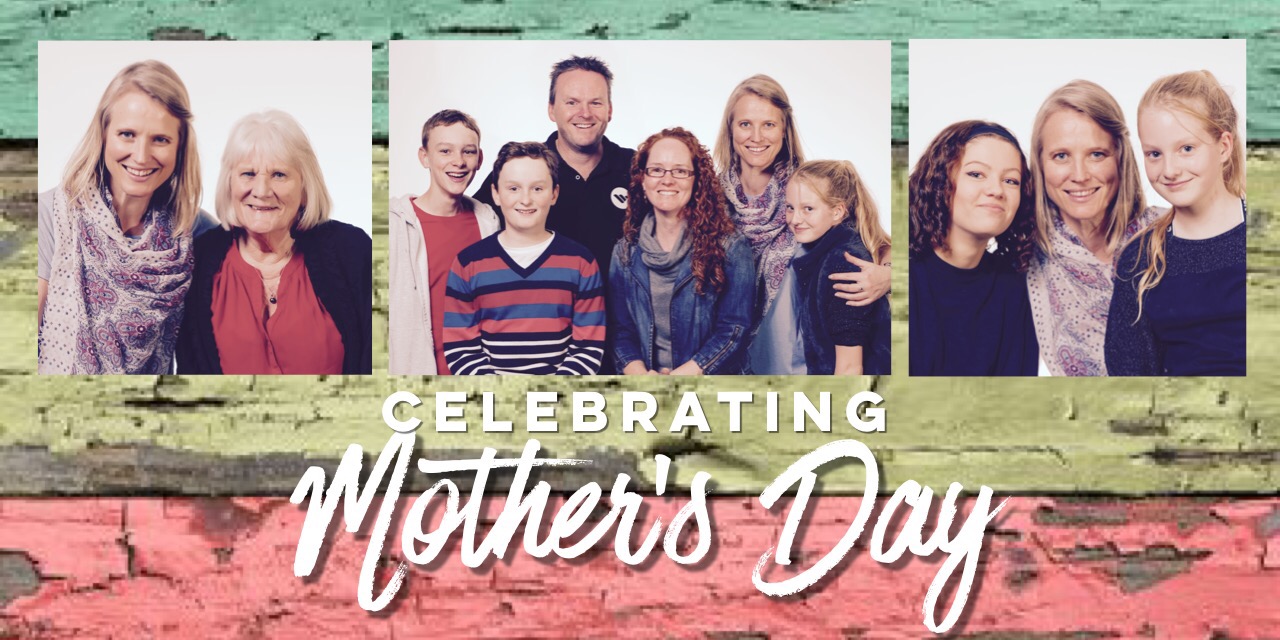
It’s all summed up by these three photos. 


The first photo is my Mumsy and me. Isn’t she the cutest? Bless her little silver socks off! If she’s lucky enough, I might get it printed on a coffee mug so she can look at us all the time! 

But here’s where the fun started. 

The middle photo is of my great friends, the Whites … and me! As they rounded up their children for the photo Sharyn walked past me and said, “Get ready, you’re in the next photo!” I replied, “Me?” And the answer came, “Yeah, of course, you’re family!” It’s no wonder my smile was so cheesy and bright! 

Of course, the photo itself doesn’t make me family. But it captures a heart and relationship that is very much about being family. These guys have consistently extended themselves to include and support me in ways I have come to rely on and I love the relationships I share with them – individually and collectively. Such a blessing. 

The third photo is a “3 generations” photo. Elise came alongside me and said “So, family photo? Y’know, spiritual mum and all that.” (Of course I am far too young to be a biological mother to someone her age. Cough. Cough. Not really. Sigh.) And then she called out to young Alex and said, “It’s family photo time!” Of course, Alex’s eyes lit up at the idea of her mentor (and hero) including her. And so the three of us snuggled up for a shot. 

Together, these photos reflect what celebrating Mother’s Day looked like for me. An opportunity to honour and love on my own Mum; being included in a family’s celebration and expression; and acknowledging the special role of spiritual mothers. 

As people lined up for photos in our foyer, those relationships were captured in various combinations, with similar feelings of honour, inclusion and gratitude. 

Mother’s Day is simultaneously one of my favourite days and one of my most difficult. I have long ago made the decision to celebrate the day (read “I will celebrate Mother’s Day“) because despite my grief and longing there are many women who are worthy of recognition and honour. This year I found that in celebrating others I, too, was celebrated and it was a truly memorable day. 

I WILL celebrate Mother’s Day


This Sunday would have been my 14th Mother’s Day. An early term miscarriage saw the hope of that ignited and then grieved (& grieved again, differently, surprisingly; sporadically over the years). 

I still find it hard to believe that I’m not a mother. As I move deeper into my forties I am forced more often to face the biological realities but for the most part I’ve just lived with an expectation that (husband &) children would be part of my world. 

And then comes Mother’s Day. 

In many ways it’s a day that represents the hopes and dreams that are deep in my heart and the grief that those are unrealised. There’s a wistfulness; a longing that is undeniably present. Envy and jealousy rear their heads. I wish for the hand drawn cards, the dodgy school stall gifts, the crumbs in the bed from a delivered breakfast. And even more than that, just the day to pause and whisper in my heart “I am a mother” and celebrate all that it would mean for me to be that. 

The reality of Mother’s Day is that it’s a hard day for many. Those grieving the loss of their own mothers – to death or broken relationship, struggling with infertility, facing difficult family dynamics, processing illness (etc) often approach Mother’s Day with fear, anxiety or an overwhelming desire to hide away and avoid. 

But here’s the decision I’ve made and make again this weekend. I WILL celebrate Mother’s Day. 

Of course, I will celebrate my Mother (who I am abundantly grateful for) but I will also celebrate my friends who are mothers. Because I love them and I love that they have produced mini-thems and I want to champion them in this infinitely important role. I will help lead our church in honouring our mums and encourage them with the full resource of the church to keep Mum-ing well. This Sunday, we will cheer for all the women in our church who “mother” us – with their love and care, their modelling of Christian womanhood, their role in the lives of women and girls (& guys alike) needing the investment and wisdom they offer. 

I know some will disagree with me but I don’t think we ought to care for our non-mothers or those grieving in our midst by not celebrating those who are mothers. I believe the idea that we might not acknowledge mothers in deference to those who are wounded and hurting isn’t what family (in its broadest sense) is meant to look like. 

Rejoice with those who rejoice. Mourn with those who mourn. Rom 12:15

Do we not celebrate someone who graduated from university because not everyone has? Do we not high five someone who ran a marathon because not everyone has? Do we not congratulate someone on their 90th birthday because not everyone lives to celebrate theirs? No. That would be crazy. Families are full of people with a diverse range of experiences – both positive and negative – and one of the things that makes us family is our ability to journey the breadth of those experiences with one another. Where we carry one another in our grief and difficulty and we multiply joy by celebrating one another’s successes and wins.

Our tendency toward comparison and the associated emotional processing means that a day like Mother’s Day can make us feel more of the grief and heart-sickness of longing and loss – but our reality is actually unchanged from this Sunday to the next. In reality I am just as likely to feel the pang of jealousy watching a mum with her child at a cafe this afternoon as I am to feel it while the mothers stand to be acknowledged on Mother’s Day at church. 

I don’t mean to diminish the significance of the day – I just dearly hope to bring some perspective that might free us to more genuinely celebrate others as we ought. 

So, let’s celebrate our mums this weekend because they are worth celebrating. Let’s be sensitive to those who will struggle with this day (hot tip – don’t assume anything – ask lots of questions to help you best connect with someone for whom Mother’s Day may – or may not – be difficult. Let them direct you.) Let’s see this day as one of many in the life and journey of our family – where everyone gets a turn to be celebrated and those who need the extra love and support find that amongst us too. 

“Maybe there’s something wrong with me?”

This was the conclusion of a 25 year old (yes, 25 years old!) single contestant/participant on the first episode of the new series of Married at First Sight when reflecting on her life status. 

She is 25. She’s single and doesn’t want to be. There must be something wrong with her. 

Imagine me sitting opposite her in a coffee shop (because that’s what I’ve been doing) and this is what you’d hear me say. 

There are two options here. Either there IS something wrong with you – in which case, you should fix that – you shouldn’t marry someone you haven’t met before on a reality TV show meets psychological experiment. OR there ISN’T something wrong with you – in which case you shouldn’t marry someone you haven’t met before on a reality TV show meets psychological experiment. 

Then I would let her pay for the coffee. 

The more I think about the “maybe there’s something wrong with me” question that has the potential to plague single people of all ages and stages (more so for some than others) – the more I think it’s a question we need to face and not avoid or dismiss. Because the haunting nature of that question has the capacity to powerfully derail an individual in their living of a fruitful and fulfilling life. 

So single dude, single lady, IS there something wrong with you? No really, is there? Don’t answer “well there must be because I’m single” – think beyond that. Is there anything wrong with you? While that possibility lies unchallenged in your psyche it will have an unhealthy control over your sense of self and could lead you to finding yourself sitting in a limousine questioning whether or not the decision to marry someone you’ve never met is a good idea. Or making other very bad decisions in life and love. Find out if there’s anything wrong with you and work to fix it. Get that question off the table. 

It might not change your relationship status but it will change your perspective on it.

You’re probably not single because there’s something wrong with you. Firstly, some of you haven’t even had the chance for a prospective partner to find out what’s wrong with you. And secondly, look around – have you seen some of the people who ARE married? There are some twisted, broken, weird and altogether unpleasant people who are married! There’s stuff wrong with them and they’re married!

Here’s a word of advice for you without the price of the coffee. Take the question off the table. Move on to more productive spends of your emotional energy. 

5 things every kid needs to grow in faith || someone else

#2 someone else 

My favourite part of a baptism is hearing the God-story.

I love when people stop to really reflect on how God has been at work in their life and they share the ways He has revealed Himself to them and drawn them to Himself. It points to a very creative and loving God. Each person tells us a different story of a unique encounter or series of encounters they had that made clear God’s call on their life and led them to respond. God is so good.

On one such occasion I witnessed, a 14 year old girl was sharing her story. She had been raised by Christian parents and attended church all her life but, when she was 13, she had attended a state wide youth camp with our church youth group. There were several hundred youth there from all parts of Melbourne and beyond; from various denominations and church expressions. She talked about her experience of that weekend and the impact it had on her developing personal faith, “I didn’t realise there were so many other people who did this Christian thing, I thought it was just our church.”

It seems almost comical to think that she might not have known, but her church experience had been limited to just our church and we were the only Christians she knew. It was significant for her to discover there were more. Because, as much as youth culture talks about the drive to stand out and be different, there is a deep yearning in our young people to find belonging and acceptance in likeness. Whether it is in shared fashion style, music tastes, sporting interests or leisure pursuits; young people find connection and comfort with others who affirm their style, taste, interests and pursuits.

Kids who are developing their own faith need SOMEONE ELSE (or multiple someones) who hold to the same core beliefs they do. They crave the affirmation that the faith they hold and the values they’re ascribing to are held by people other than themselves (and other than their own family). Christianity is, by Jesus’ own description, counter-cultural and as our society becomes increasingly pluralistic it is ever more likely that they will have friends and family and people in their basketball teams and neighbours in their streets that would not hold to the same beliefs.

It is one thing for their parents and grandparents to believe. It is significant for them to have leaders and other grown ups who believe similarly (more on that next blog). But it is also important that they have peers who share their beliefs. It reminds them that God is bigger than just their own family’s experience of Him (and #1 of the 5 things every kid needs to grow in faith is a really big God) as it continues to inform their understanding of who God is and how He operates.

We are all no doubt familiar with that powerful feeling of finding others with whom we find that “Oh, you too?!” connection. There is something profoundly validating about finding a like-mind, heart or soul. Our children need that too. It is significant to their faith development. Regardless of how independent and unique they might want to be they also crave the sense of being understood and affirmed for who they are and the choices they make.

5 things every child needs – Think Orange.

#1 a really big God 

#4 uncommon sense 

5 things every kid needs to grow in faith || a really big God

 #1 A REALLY BIG GOD 

I love giraffes. They’re so graceful and elegant. And tall. They’re really tall.

Not only are they great to look at, they’re also incredibly intricate in their creation.

In order to keep blood pumping through their long legs and neck they have a heart that is TWO FEET long!! They also have valves in their neck that stop blood from exploding their brains when they lower their head to drink.

My favourite of their amazing features is a sponge like collection of veins (the rete mirabile) that is at the base of their brain. It expands to fill with blood while their head is lowered so that when it is raised (potentially a height shift of over 12 feet) they don’t pass out. The blood slowly releases to keep the brain oxygenated while the heart works to stabilise the blood flow. How cool is that?

[hear more about giraffes in the podcast of my sermon from Sunday Feb 14]

Knowing all this, every time I see a giraffe I remember again how clever God is! How His creation is so intricate and complicated and ingenious. It’s amazing. Ahh-maze-ingggg!!

But then I think how the giraffe is just one of hundreds of animals God made. And animals are only one aspect of God’s created world. There’s the birds and the plants, the oceans and the mountains, the planets and the solar systems, and then …then …there are humans!! Our bodies are so complex and so functional and there are so many different types of us! Wow! Like really, wow!

He is a big, powerful, creative, loving and active God.

When it comes to supporting kids growing in their faith one thing they need is a REALLY BIG GOD. They need to know that everything about Him is bigger and better than we could even imagine. He made the giraffe, and the tiny ant, and the infinite galaxies, and you. His story is long and big and we have just joined it for a small part. He has been making and loving people for thousands of years. Guiding them. Helping them. He has been faithful to people who have not been faithful to Him. He has used children and kings; people who made really dumb decisions and mistakes, as well as people who were humble and seeking Him. For thousands of years He has had people talk about Him and wonder if He’s real or not. He’s had people wonder if He really made the earth or if His promises are actually true. And He has kept loving and pursuing us and using us to write His love note to the world.

He is a really big God!

Sometimes, in our attempts to explain God to our kids we inadvertently shrink Him (only in our minds – He can’t actually be shrunk). We try to describe and define Him and we are limited by our own understanding and our ability to ariculate the revelation of God to us.

Our kids need to hear about a God who is big. Big enough to know and be everywhere. Big enough to always be in control. Big enough to know every star in the universe AND their names and thoughts and fears. Big enough to have their future in His hands and to not be scared by their questions or doubts. They need a God who can be trusted at all times.

What might it look like for us to consciously consider the language we use? To be intentional in the ways we respond to our kids’ wonderings. To not limit them in their questions or shut down their doubts. God is big. He is big enough to handle whatever you are thinking, feeling or fearing.
5 things every kid needs – Think Orange

#1 a really big God

#2 someone else

#3 another voice

#4 uncommon sense 

#5 nosey parents 

Guest Blog – 2 weeks screen free!

I invited Sharyn White (inset with husband Scott) to share some reflections on her family’s fortnight of no screens. Read on for her insights into the challenges and surprises of the process. Through this project her kids raised over $1600 for our church’s building fund by collecting sponsorships from family and friends.

From the first day I sat my son down in front of the television with the purpose to entertain him to now, 11 years later when I let him play on the computer for a couple of hours straight, I have wondered if I’m being a good parent by allowing him to do this, or a bad parent.  There is something about screens as a form of entertainment that leaves me uneasy.

So when my children decided to attempt two weeks of no screens to raise money for a project they are passionate about, I was excited and slightly terrified.

We have three children:  Harrison(11), Riley (10) and Alexandra (7).  Depending on homework or sporting commitments, they can spend up to two hours in front of a screen on a weekday.  On a Saturday and Sunday, that number could go as high as five hours if you include a game of football or an afternoon with a friend.  I’d like to think five hours is the exception, but in the footy season it’s probably not (and then there’s cricket in the summer!).

I am really aware that for some reading this these numbers constitute child abuse, and for others they might be small in comparison.  I desperately want to justify them to make myself feel better, but will restrain. They are what they are.

My biggest fear in attempting the challenge was what we were going to do with all those free hours.  How was I going to keep my kids entertained?  And by entertained, I guess I mean out of my hair and under control.

Surprisingly, entertainment was never an issue.  Screens were quickly replaced by a range of other activities, which the kids thoroughly enjoyed.  And other than some board games and a couple of outings on the weekends, the kids initiated their own play.  They never once asked to get in front of a screen. 

The kids didn’t struggle to find new ways to spend their time, but they did struggle.

The first week was tough.  The kids weren’t bored, instead they were very tired.  Every afternoon involved fights, tears and tantrums.  I could see that at the end of a school day, they just wanted to sit and switch off in front of a screen.  These meltdowns were so absurd, and the effect of screens so glaringly obvious that in these moments if I didn’t laugh I would cry.  It was really hard to watch my kids adjust.  It was so tempting to put them in front of a screen knowing that it was all that was needed to bring peace and rest to the house.  But it also made me more determined to see this challenge to its end.

I’ve always known that screens provide a lot of entertainment for very little effort.  It’s called instant gratification.  Screen-time can be both mindless, and stimulating.  But what shocked me most during the challenge was how conditioned my kids are for that type of activity; so conditioned that it affected their physical and mental capacity when it was removed.  Remaining pleasant, being creative and staying engaged took more effort than they were used to.

Fortunately it only took one week for that conditioning to change.  The second week was a completely different story.  Their capacity to positively engage in their surroundings increased, and the rewards were great.  They spent longer on homework, they settled into other activities for longer periods of time, and I think the familiarity with certain board games allowed them to find this form of entertainment relaxing.

I discovered through the challenge that if screens equal instant plus gratification, then removing or restricting a child’s screen-time doesn’t remove or restrict the gratification part of that equation, but the instant part.  My kids loved their screen-free challenge.  Harrison even spoke of extending his time because he could identify the benefits.  The entertainment and the enjoyment were there.  But they had to adjust to the effort it took and the character traits required to get these things in their different forms.

Harrison would identify the benefits of the screen-free challenge as better quality school work, learning new board games, and spending more time with mum and dad.  As their mother, I too enjoyed all those benefits.  But I also loved to see them grow in perseverance, their consideration of others, creativity, patience and the list goes on.

I would recommend taking up the screen-free challenge to any family.  Give it a go, and you might discover some interesting things.  But if that’s not your cup of tea, then can I encourage you to remove some of the ‘instant’ that invades your children’s lives; whether it be in the form of play, extra-curricular activities, dinner magically appearing on the table or a fresh pile of ironed washing. 

My kids are capable of more than I give them credit for.  And it is a joy to see them thrive on discovering that for themselves also.

“12 thoughts of Christmas” #11: Looking Back

At the end of each year I have a staff review with my Senior Pastor, perhaps you do something similar at your work. We look at the year that was: highlights and challenges. We reflect on the things we’d identified as work areas for the year. We pause and acknowledge the growth and fruit that we see in me personally and in the various ministries and people I oversight as part of my role.

I’m terrible at it!! Because I can’t remember past the last few weeks!! It’s true. Before the meeting I go to other people in the office and in my life and say “help me out, what happened this year?!” It feels like the last month has enough happening to fill a list of highlights and challenges on its own!

Looking back is an essential part of doing life well. Without looking back we can be so consumed with the now that we lose sight of how far we’ve travelled and all that we’ve done, learnt, experienced, given, received, released, achieved and become. And most importantly, we neglect a great opportunity for gratitude and celebration!

Before the new year and all it contains consumes your time and brain space, can I encourage you to spend some intentional time looking back? Reflect on significant events and milestones. Acknowledge the difficult experiences you may have had – with your testimony being, at the very least, that you survived!! 🙂 Note the changes you saw in your family, your relationships, your children, your physical or work environments. Reflect on the impact you and your family were able to make in the lives of others – giving to charities or a sponsor child, serving at church, investing in your neighbours – it is always a privilege to be used to bring joy to others. Remember the new things you saw or tried, the traditions you started or continued, the skills you developed, the successes you achieved and the failures you recovered from.

There should be quite a list, but if you’re like me and have trouble remembering too much passed the recent weeks perhaps you could ask others to contribute to the discussion.

Pause to give God thanks for the year that was. Whether it’s a year that you’d love to do again or one you are happy to see the end of. Nothing is for nothing in God’s economy – everything you experienced will be used by Him to refine and strengthen you and to prepare you for the things that are in store.

Share your thankfulness with others. Display a “Top 10 list” on your fridge, post it on Facebook, share it in an email, write it in your diary … or even share it here below.