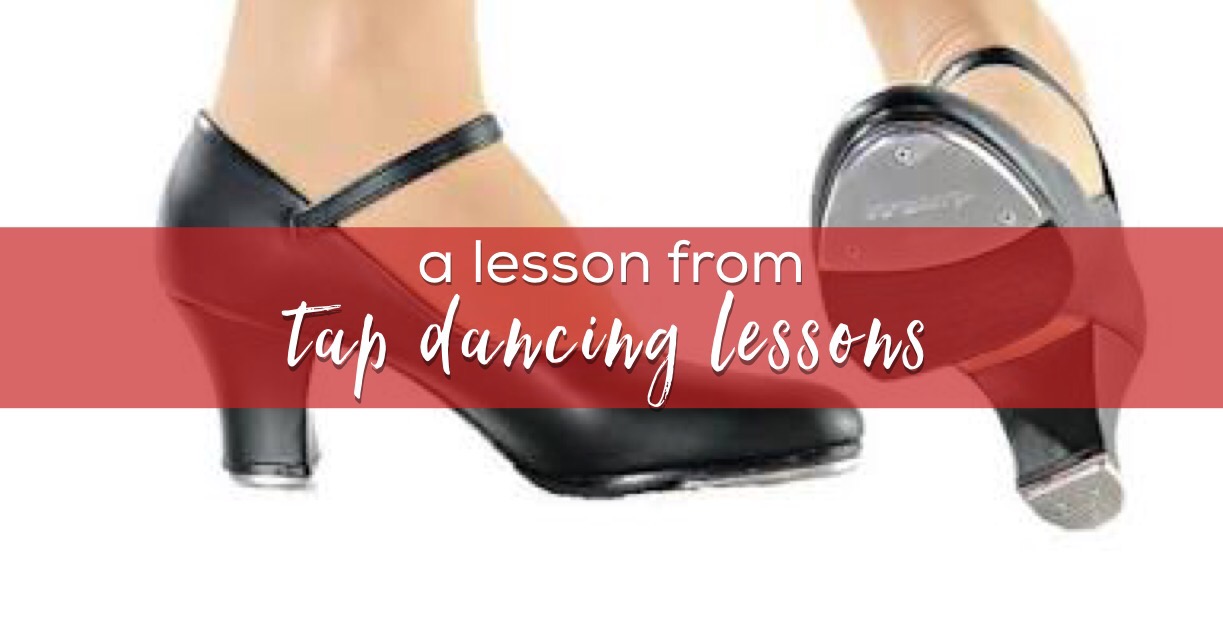
a lesson from tap dancing lessons

A most exciting development occurred at Monday night’s Tap Dancing Class.

A new girl joined!

Do you appreciate what that means? It means that am no longer the new girl! I’m not the least experienced. I’m not the most lost!

It came alive for me when we started doing warm up drills and I was in the “you girls keep going” group – not Miss Abbie’s “let me walk you through that in slow motion” group.

Looking across at the deer in the headlights expression on the new girl’s face I was awash with empathy. I know that feeling, I know that fear!

But the second wave of feeling was the growing realisation that I had advanced in my own skills – not just when compared to the new girl – in and of myself. I could do the drills that Miss Abbie was giving us. I could look ahead at where I was going not just down at my feet (to check if they were doing the right thing, you can never be too sure!) I was able to go fast enough to work up a sweat and feel the strain in my muscles. The clickety clack of my taps were vaguely rhythmical and consistent.

Yay for development! Yay for progress!

We went on to practising the routine and, although happy with my recall and general ability to keep up, there were still those parts that I haven’t quite got right yet. And we’re not even half way through the song, there is still much more choreography to learn, remember and master. But it was a nice little moment to pause and reflect on how far I’ve come.

There’s this week’s encouragement from my tapping adventures. Pause a moment. Take a quieting breath. Look around. There still might be lots to learn and more to improve – but look how far you’ve come! Don’t compare yourself to anyone else, just compare you then to you now – you last week, you a year ago; you this morning.

Philippians 1:6 He who began a good work in you is faithful to complete it.

Happy tapping! 🙂

do all things really work together for good?


I have this verse (Romans 8:28) on my wall. 


Because I walk by the wall so frequently, I am constantly reminded of this promise and affirmed and strengthened by it. 

As with all scripture, this verse has the potential to be misinterpreted or misapplied which can lead to disappointment and disillusionment. 

Here’s three truths that are essential for understanding this text correctly. 

1. All things work out for good – even if they aren’t good now. 

This is a future promise not a present guarantee. Paul does not say “all things ARE good for those who love the Lord”, he says, “God WORKS all things for good”.  There’s a big difference. 

Our faith and trust in God allow us to interpret our current trials and pains through the lens of a future hope we have that these hurts will not be for nothing – that they will be caught up in God’s big picture plans for our lives and His glory. 

To look at some of my own life experiences – death of family members, family breakdown, miscarriage or a painful divorce are NEVER good in and of themselves. This verse doesn’t suggest that for those who love God divorce is good or for those who love God death and loss are good; not for a minute. It does promise us that in the hands of a loving Father those experiences can be redeemed and we can learn, grow, mature and flourish through them, because of them and inspite of them. 

2. All things work out for good – but sometimes even that good doesn’t feel good. 

Because we are not God and because of the many shortfalls in our character and ability to know the future, what we think is good for us and what God knows is good for us are not always the same. 

God’s plans to redeem all things for good may include the good of doing without things that He knows aren’t healthy or helpful for us – even if we want them. They may include us being humbled or learning painful lessons that ultimately grow and refine us. 

To fully appreciate the “good” God is bringing about we need to ask Him for HIS eyes to see and appreciate what He has in mind for us. It may not look good to us, but He is a perfect Father who only gives good gifts. He invites us to trust His big picture plan. 

3. All things work out for good – but the timing of the good is not ours to know or control. 

My maternal Grandparents were killed in a car accident together when I was 11 years old (and they were only in their early 60’s). Our family treasured the promise of this verse as we absorbed the news of their tragic death and prepared for the funeral and life without them. We learnt it as a song! At the funeral, a family member came to faith! The witness of Grandma and Pa’s lives and the confrontation of their death brought this lady into an eternal relationship with God. See, we said, God is even using this for good!!

I love that story. I love the grace of God to make this promise so tangible for us. It stood me in good stead for future trauma and tragedy that was ahead for us as a family and me personally. But the more common story is that it can often take more than a few days for the “good” to evidence itself. Sometimes it may be years in the making. Sometimes it may even remain unknown to us. 

Just because we haven’t seen the good yet doesn’t mean it’s not coming. God’s timing is always perfect. 

How have you seen this promise at play in your life? When do you find it hardest to hold on to? When has it been most encouraging?

Comment below or email me directly at kimberlyrsmithministry@gmail.com 

3 better choices than “not saying anything at all” 

“If you can’t say something nice, don’t say nothing at all!” – Thumper, Bambi

I’m sure we’ve all heard this quote (or a version of it – possibly without the double negative!) at some point in our lives. Our parents used it to kerb our critical opinions – particularly when we defended our outbursts because they were the “truth”. But then, we’ve probably all used it ourselves. Mostly as a passive aggressive (emphasis on the aggressive) way to say that we have a negative opinion but we’re far too polite to tell you what it is. Yes, because that’s an effective way of defusing a conflict – at no point ever in the history of defusing conflict!!!!

I love Kid President’s rewording. 


Here are three options to “not saying anything at all”. 

Choice #1 – think harder 

Emotion, defensiveness, fear and tiredness can all make us feel there is nothing nice to say. In times when our thoughts, feelings or option seem overwhelmed by the negative, we all can pause and think harder. 

Where is the potential positive? What can be encouraged or affirmed? What can be understood or explained? What alternate perspective could be explored? 

Choice #2 – choose honesty 

“Not saying anything at all” is a choice to withhold truth. Sure, there are times and places where hearing the truth would be more palatable but the truth is always our friend. 

In fact, the truth from a friend is the best. It’s better than a withheld criticism and it’s certainly better than silence – where we are left to guess what the other is thinking. 

Choice #3 – choose empathy

Any attempts we make to feel what another might be feeling will stand us in good stead to make a better response than silence. 

What might they be fearing? What disappointment might they be anticipating? What questions might they be asking? What insecurity or jealousy buttons are being pushed? 

an invitation to a sacred space

“Can I ask your opinion on something?” 

Just like that. Sitting across a cafe table. An invitation was extended to enter a very sacred space. 

Asking for another’s opinion is an act of great humility and vulnerability. Inviting someone’s comment on a decision, trusting someone with the concerns of your heart or mind, giving permission for another’s assessment of options you’re weighing up – these are all risky endeavours. 

You open yourself up to disagreement or conflict. You hand over your ability to claim ignorance on a different perspective. You reveal to the other that you know there’s a decision to be made. You invite a potentially higher degree of scrutiny of your actions on the issue. 

Invite others’ opinion. It’s an act of wisdom to seek wise counsel. Ask people who you trust to help you process decisions. Their distance from the issue can provide a more emotionally sober and unbiased perspective. Their wealth of experience and knowledge can be a great resource. And significantly, when opinions are invited they are likely to be more considered – minus the frustration of someone not feeling they have a chance to input. 

Recognise the sacred trust. If someone asks your opinion they have bestowed a great honour. They are communicating trust in you as a person and value in your wisdom. Tread gently, speak carefully; listen as well as speak. And be grateful. 

why we MUST embrace conflict

I really don’t like conflict. In fact, I don’t think anyone does. 

Those who say they like conflict are either bullies who love a good fight OR are actually referring to the outcomes of conflict rather than the conflict itself. 

I love what healthy conflict accomplishes. 

Conflict achieves better results. 

Conflict ensures that all aspects of a decision, event or direction have been fully considered. When ideas are up for debate and discussion we refine and clarify them for best outcomes. Conflict means that we haven’t just settled for the easiest way or the idea that was presented first or loudest. 

Conflict refines our character. 

No one wants to be told that they’ve behaved inappropriately or that they’re being received in an unpleasant manner – but surely we’d rather the chance to change that through awareness and assistance rather than persist in ignorance? Conflict is necessary to acknowledge our sharp edges and give us the chance to smooth them down. 

Conflict strengthens relationships. 

Conflict builds trust. In relationships where hard conversations are lovingly navigated, misalignments recalibrated and, ways forward together are negotiated intimacy and trust are grown. Willingness to identify and endure conflict communicates a depth of commitment. Pressing in through the tough times is what forges strong relational connection. Ignoring issues over fear of conflict creates emotional distance, mistrust and, ultimately, separation. 

So how do we conflict well? 

HEALTHY CONFLICT – 

  • Debates issues not people.

Finding the best outcome means separating an idea from the person who presents it – otherwise we have to go with the decision that belongs to the person we like most or are more afraid of upsetting. We also have to be okay with our idea being trumped by a better one or refined by other thoughts without taking it personally. 

  • Is best when invited. 

Creating an environment where conflict is welcomed – through invitation and self-control in our responses – can diffuse some of the tension and apprehension. Giving others permission to speak frankly, critique honestly and call us to bigger and better in our behaviour and ideas won’t make conflict fun but will make it more healthy and edifying. 

3 ways to listen better


Did you know you can improve the quality of a speaker by improving the quality of your listening? You have the power to improve the communication capacity of others by engaging more intentionally when you listen. 

1. Look like you’re listening. 

When someone knows you are listening their language, tone and demeanour can be more relaxed. A person fighting for your attention will feel led to be more exaggerated, intense or dramatic in order to capture your interest and garner a response. 

Giving the speaker your full attention – looking at them, stopping what you are doing and facing your body towards them communicates value and engagement. They will be freed to more clearly communicate what they were wanting to say. 

2. Let your face know what you’re thinking. 

I have a very loud face. There has barely been an emotion I’ve felt that hasn’t demonstrated itself on my face – for better or worse!! 

For better, someone speaking to me rarely has to guess what I’m feeling. For the most part my face mirrors the feelings being communicated or the facial expressions they are displaying. In a psychological sense, this mirroring communicates empathy for the speaker – “I am feeling what you’re feeling.” 

Some people are naturally more blank. Their thinking face is expressionless. While you may well be following closely what the speaker is saying, they are not to know this from looking at you. You need to think about what your face conveys to the speaker. 

3. Affirm the speaker. 

Nodding your head, hmmm’ing, and saying “I see”, “oh really?” or, “uh-huh” let the speaker know you are listening even if there’s nothing much else for you to say in response. 

Note – you can’t use these when you’re not listening! It’s unfair to the speaker and ultimately damages their trust in your true attention. These sounds are verbal affirmations to keep going, I’m with you, tell me what happened next. In their absence, in your silence, the speaker is forced to concede they’ve lost their audience or elevate the tone, volume and intensity to try and win you back. 

‘Half-listening’ could very well double the speaking time. That’s bad maths. A speaker can lose focus on their main idea while trying to capture your undivided attention or elicit a response. 

Ultimately, your listening can make the speaker more concise and more interesting. 

What other traits have you noticed of good listeners? How have you found a good listener can improve your communication?

8 questions to ask in every season


Our lives are a series of stages and seasons. Sometimes they pass faster than we’d like – when things are great it can seem like time moves too quickly (like holidays, for instance!). Other seasons just seem to go on forever – sickness, waiting, uncertainty, grief – these are seasons we’d love to skip through and yet they can seem interminably long.

Much of this is out of our control. We’re at the mercy of our age, our ageing bodies, the decisions of others or God’s sovereign (but ‘secret’) plans. So the only thing left for us to do is maximise the season we’re in.

Here are eight questions to ask to ensure that whatever season we’re in – however we feel about it – we’re not wasting this time.

1, Where is God?

There is no season in our lives that God is not present. Even when He feels distant – He is not. Look for Him. Be aware of how He is making His presence known – as teacher, comforter, defender, peace, joy … God is always ALL of those things, but in specific seasons we experience different aspects of His character in new or increased ways.

If there is a season for everything, then God is in every season. Look for Him.

2, What can I learn?

Each season holds opportunities to learn new things. What can I discover about myself? What can I learn about other people? When we are forced to walk a path we didn’t want or intend to we often meet people or experience things we might not otherwise have encountered. What can that teach us? What can we learn about the world around us and the character within us?

3, What can I develop?

Some seasons feel like they are ‘on hold’ seasons but they can actually be opportunities to develop skills and character we might otherwise not. Maybe part of the purpose of this season is for you to grow in patience, confidence, empathy, trust, compassion or a particular skill.

4, What does it reveal of me?

For better or worse, various seasons will show our “true colours”. In some situations you might discover that you are stronger or braver than you thought – or it might reveal that you’re NOT as strong or brave as you thought. A season might reveal impatience or intolerance. It might uncover a heart or passion for a cause or a specific group of people. It may reveal a deep trust in God or a strength you didn’t know you had.

5, What is it preparing me for?

Sometimes that’s a bit self-evident. If you’re studying something in Uni it’s probably a preparation for you to USE that study in some sort of work. (That’s the hope, anyway!)

Maybe it’s not quite as clear or obvious as that – but something of this season will be a preparation for a future season. Nothing is ever wasted. Some of your darkest seasons can be preparing you for a unique ministry to others who will go through similar experiences. Some of your greatest joys can be building reserves to draw on through more challenging times ahead.

6, What am I tempted by or to?

In seasons of struggle – of loneliness, grief, sadness, frustration, rejection, or difficulty – we are often tempted to self-soothe or distract to avoid facing them. When we are experiencing dissatisfaction or disappointment, when there is a sense of hopelessness in the season we are in we can turn to things like food, exercise, approval, pornography, alcohol, work, perfectionism, relationship – all manner of temptations or ‘escapes’.

Any of these things can lead us to addiction or to patterns of unhealthy behaviour when we try to avoid or ignore the realities of our season rather than face them.

7, What needs to be resolved?

Is this season you’re in the result of something that is unresolved? It may not be – but it’s a question worth asking. Is your broken relationship with your family because there’s forgiveness that needs to take place? Is there conflict or disconnect to resolve? Do you need to forgive? Do you need to ASK for forgiveness? Do you need to stop blaming someone for something? Do you need to stop blaming yourself? Do you need to get outside or professional help? That’s not to suggest that all our difficult seasons are our own doing, but it is a good question to ask to make sure we’re not being our own worst enemy!

8, What can I give or enjoy?

The uniqueness of each season – difficult or otherwise – will also hold unique opportunities to bless others or experience joy. Sometimes the joy will be harder to grasp and sometimes blessing or serving others will be the last thing we want to do, but maximising the season often comes on the back of taking a posture of focusing on others.


why I don’t do online dating

I have been single for many years and my desire to be married is well-documented. People often ask me for my perspective on Online Dating.

Because of how open I am to finding a suitable Mr Kim and the fact that I even advocate that friends should be in the business of making introductions, people are often surprised to discover I don’t do online dating.

Here are the three main reasons for that decision.

  1. I don’t think God is asking me to. 
    Super Christian rationale, I know! But it’s true. More than I want to be married – I want what (and who) God wants for me, so I’m cautious of running ahead of Him in this.
    I don’t expect Him to deliver a guy to my door (how weird would that be!?) but so long as I am putting myself in places – both physically and emotionally – where I would be open to His guy showing up, I think I’m doing all that I need to or can.
    In my current life stage and style, I am regularly in places where quality single Christian men would also be and I know lots of people who would/could/should know the quality single Christian men – I don’t feel like I need to pursue or create other contexts to make a meeting more possible.
  2. I don’t like the idea of meeting a guy outside of his context. 
    We all like to put our best foot forward, particularly when introduced to prospective partners and, more than anywhere else – online! I feel like I could most definitely be the best version of myself – or an even better version of myself – online. You can literally edit yourself in real time (I wish I had that function in real life!).
    Meeting a guy apart from his friends, family or workmates means that I’m only getting his version of him. There is so much about his character, his values and his general manner that I might never get to fully experience without seeing him interact with his family or meeting his friends or seeing how he responds to a ‘wrong’ decision on a basketball court. (I have a couple of personal stories that support this theory – perhaps for another blog.)
  3. I fear it would draw me to judgement and discrimination.
    I have checked out several dating sites – there’s often a certain amount of material you can look at without signing up or revealing anything of yourself. As I scrolled through the profiles – with minimal information provided – I found myself making really quick judgements and discriminating mostly on appearance or other shallow ‘preferences’. I consider myself to be a discerning person, and would back myself to make wise choices – but, what if God wants me to be with someone shorter, less educated, more outdoorsy, more bookish, older, younger or who lives further away than the choices I might otherwise make for myself? And what if it’s less about who I want for me and more about who I might be for someone else?

Disclaimer – this is MY personal experience, sense and decision (for now). I’ve been to the weddings of couples who’ve met online. I’ve seen God use this platform to bring together His choice of partners. People who do use this service may process these three points in a different way than I have. There’s no judgement or criticism from me but maybe these are cautionary thoughts for those considering it?

//FEEDBACK TIME//

Do YOU use Online Dating (or have you)? Have you reached a different conclusion than mine? I would LOVE to hear your story. Use this link to give some anonymous feedback for me to use to give another perspective on this topic in a follow up blog – “Why SOME PEOPLE do Online Dating”.


pumpkin soup mindset

Have you ever noticed how so many cafes have Pumpkin Soup on the menu? Now we’re in official soup season we might see some specials of a variety of different soups but Pumpkin Soup is on the printed, year round menu. 

In my expert, soup-eating-cafe-crawling opinion there are three main reasons this is so. 

1. It’s easy. 

Like, super easy! At its most basic – you chop up some pumpkin, maybe add an onion, boil it to death in some chicken stock, blend it up and there you go. A dash of cream, a sprinkle of chives and some crusty bread on the side and it’s cafe ready. 

2. It’s safe. 

For the non-adventurous diner, Pumpkin Soup is a low risk order. “Hmm Pumpkin Soup, I wonder what that might be?” It’s soup, made from pumpkins. You know what you’re gonna get. 

3. It’s available. 

A nice big pot of soup, frozen into individual serves is perfect for a quick buzz in the mickey-groover (aka microwave) ready to serve on demand. 

Now, I’ve had my share of Pumpkin Soups when working in cafes and looking for a simple, low cost lunch option to fuel my writing. But every time I do, the above three thoughts come to mind. Because 1. I don’t like ordering (or paying for) things I know I could make at home, 2. I enjoy dining out for stretching my culinary palette – give me some Morrocan spices, give me an ingredient I don’t recognise that makes me feel like I’m being a little daring to order it. And 3. I want to see my lunch served from that big steaming pot of yumminess or see a pile of vegetable scraps being scraped into a bin that make me think there may still be some nutrients active in my food. 

In context to these thoughts – I wonder if cafes aren’t missing the opportunity to show themselves as more creative, current or keen to bring us on something of a culinary journey each time they choose Pumpkin Soup over the myriad of other winter warmers that might be available? A Pumpkin Soup mindset might be easy, familiar, safe and practical – but it’s hardly going to set the cafe world alight or bring any great education or change to the palettes of cafe crawlers. 

Which made me wonder, where else does the Pumpkin Soup mindset manifest itself? The answer that first came to mind was, “pretty much everywhere” but the thought that quickly followed (associated with feelings of frustration and discomfort) was “in church life; in our faith”. 

The Pumpkin Soup mindset is the enemy of relationships, church cultures, faith walks, communities and families that we desire to be dynamic, vibrant, thriving and growing. 

How often are we tempted to make choices based on what is easy, safe and available when none of those things is likely to bring about best outcomes? Where in the call to be a disciple or make disciples was easy, safe and available part of the deal? I’m not talking complicated, unsafe and exceptionally difficult just for the sake of it, but when we’re looking to grow in our personal faith or to encourage our faith communities to greater obedience, greater acts of love and service, greater witness – the Pumpkin Soup mindset is just not going to cut it. 

Next time you’re in a planning meeting, chatting over a problem with a friend, making a big decision, looking to God for guidance on an issue, choosing a course of action, or seeking to grow in your faith, reject the Pumpkin Soup mindset. Be ready to explore a variety of flavours, ingredients or cuisines – be open to the challenge, the unknown, the extra effort and the faith-required options that God might call you through to His best.