
curiosity breeds connection – the power of empathy

When I was a young girl, I wrote poetry. Instead of journaling, I recorded all of my teenage angst and emotions in prose – book after book, page after page, pouring out my heart. I reflected on relationships and events, narrating life as I observed it. I’ve kept some of those books, although I’m not entirely sure why, since (for the most part) I have no intention of ever releasing them for anyone to read.

One particular entry, written by 15 year old Kimmy, was a bumbling attempt to process my emotions after experiencing a broken heart. I can remember very clearly the boy, the relationship, the experience. I had fallen hard, and we were as deeply invested as teenagers can be – but the relationship had come to an end.

The final line of the poem says: “People tell me to get on with my life, but he was my life.”

Could it get any more dramatic? Kimmy was clearly feeling the full depths of love lost and trying to navigate the emotional minefield and social implications of breaking up. He was my life! I have no doubt that in that moment, it felt like a true statement.

However, on the next page – dated the very next day – there was a new poem, written about a different boy! It opened with the line: “He smiled at me today.” It would appear the broken heart had recovered – and if not completely mended, had at least been distracted enough for the attention of another boy to become poem-worthy. It’s a mildly embarrassing snapshot and memory, but very real in the moment. And I dare say, a realistic capture of me in my teenage years.

That moment was decades ago now, in a very different time. If 15 year old Kimmy were navigating life today, experiencing those same emotions, the same devastation, the same yo-yoing of feelings and the same immaturity – but in an era of internet, devices and social media – I am completely certain that it all would have been plastered across my various accounts and apps.

I would have been sharing without caution or consideration of the implications – using social media as a place to vent and process my feelings. In a culture of sharing, high visibility and low filters, I doubt my level of emotional intelligence would have risen above that of any other teenager. The whole story would have been public for everyone to see. Opening myself up to the scrutiny and commentary of peers whose prefrontal cortexes were no more developed than my own.

I’m sure many would have expressed sympathy – maybe even a few sad face emojis – but then, when I shared my miraculous recovery and redirection of affection the next day, those same peers would have judged and commented again. I would have opened myself up to all kinds of criticism, and to the stories others might tell about me – about my choices, my character, my responses. All of it public. Exposed. Vulnerable.

I am eternally grateful that the era I was raised in means I just have a single copy of my handwritten words, sealed in a diary, in a box, hidden in my garage – rather than a digital footprint with a public audience and content no longer in my control.

That small vignette – this snapshot of my teenage years – compared to what life might be like if I were a teenager today, moves me to the deepest empathy for what young people face now. That one story alone makes me ache for the challenges and complexities teenagers must navigate in our current culture.

I am 100% convinced that 15 year old Kimmy would not have handled social media well. That she wouldn’t have had the maturity to make good choices about what to share or with whom. She would have been highly susceptible to the comments, likes and views of others – an my teenage years were hard enough without that!

When you think about your teenage self, what do you imagine you would have been like if social media existed back then? Not how you’d use it today – but how the teenage you would have used it.

That’s the point of empathy. That’s how we are able to empathetically engage with what young people are facing today.

Emerging generations need our empathy. They need our empathetic responses.

Empathy is the posture of seeking first to understand – desiring to fully know the experience of another in order to appreciate their perspective and support, encourage, and connect with them. Empathy moves us to question and inquire. It calls us to find a place of commonality in our shared human experience, even if that life is lived differently – in another environment, culture, era, or set of social norms.

The opposite of empathy is judgement.

Judgement comes more effortlessly. It’s easy to criticize what we don’t understand – to observe behaviour, response, decisions, and actions, and to draw conclusions rather than be drawn to curiosity.

Any time we find ourselves saying things like “those young people” or “they always” or, the classic “in my day…”, we’re perpetuating a generational gap that will ultimately cause us to lose our voice and influence.

A desire to understand will lead to far more fruitful engagement with young people. When we give them space to share their perspectives, priorities, and worldview, we nurture the kind of connection that opens doors. Allowing us to be trusted advisors and helpers.

Empathy is a muscle that must be exercised.

It’s a discipline we must choose, again and again, if we’re to stay within hearing distance of others. A posture of empathy means that moments of misunderstanding, confusion, or even exasperation become doorways – opportunities for greater connection – if we engage curiosity instead of criticism.

“I just don’t understand young people” becomes “Help me understand.”

Tell me more!
What do I need to know about how the world feels for you?
What would help you feel that I understand enough to be trusted – to be helpful – to be a voice of wisdom gained from my lived experience?

How might you come to believe that I am coming from a place of care and understanding? That my desire is for you to flourish and live the best version of life possible.

The challenge is clear for all of us. The next time we hear ourselves or others making sweeping statements or generalisations about young people, might we pause – suspend judgement – and seek first to understand.

I remember enough about being 15 to recall how certain I was that adults didn’t understand me or the age I was living in. I rejected advice, dismissed opinions, and scoffed at how out of touch old people were with life as I knew it. Young people today are no different. They are no more mature, no more cognitively or emotionally developed. The teenage brain is not just a smaller version of an adult one. Its chemistry and biology are entirely different.

Perhaps it starts with replacing statements with questions. I’m sure it starts with suspending judgement and conclusions. And we will most likely face resistance and hesitation. But each attempt – each expression of curiosity and a desire to understand – builds relational trust and maintains proximity. That proximity allows us to be of greatest value to young people: in life, in faith, in decision-making, in protecting their hearts. And ultimately, in setting them up to win.
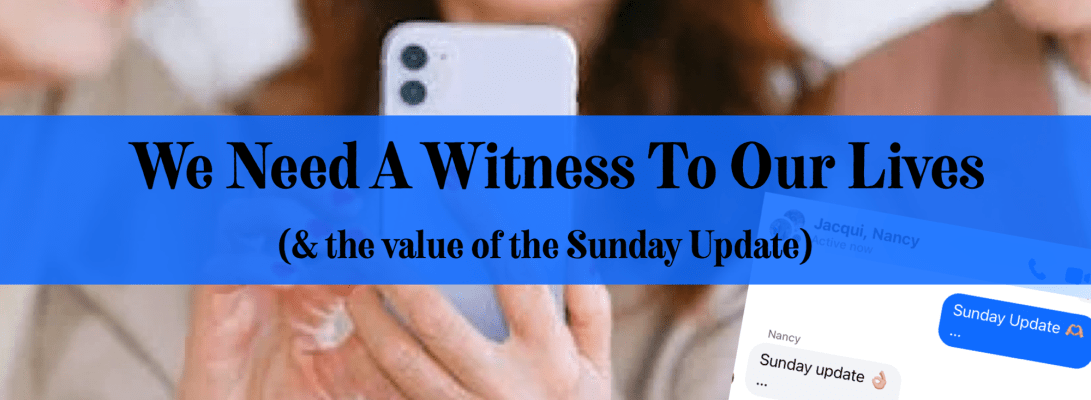
We need a witness to our lives (& the value of the Sunday Update)

There’s nothing like an old RomCom to break through the decision fatigue that comes from scrolling the endless options for watching on the various streaming services. “Shall We Dance?” is a 2004 flick that is good for its genre and suitable to crochet to (if that’s anyone else’s criteria but mine).

But it was this 40 second clip (below) that arrested me and brought me to immediate and fast-flowing tears. Always, when processing feelings and responses, when seeking to understand and be understood, language is key. And these words made sense of my lived experience in a way that helped me name it for myself and explain it to others.

In response to the question of why people get married, Beverly Clark (played by Susan Sarandon) says this …

Because we need a witness to our lives. There’s a billion people on the planet, I mean, what does any one life really mean? But in a marriage, you’re promising to care about everything. The good things, the bad things, the terrible things, the mundane things. All of it. All the time. Every day. You’re saying, “Your life will not go unnoticed because I will notice it. Your life will not go unwitnessed, because I will be your witness.”

It’s been a constant challenge for me in my singleness (& living alone-ness) that there are so many parts of my life that are not known to others. Or perhaps even more accurately, there is no one who knows all about my life. On the phone to my mum I might mention where I’m driving to for work. At work I might tell someone of a dinner I’m going to. In conversation with a friend I tell them of the headache I had last night. At church I share about a recent preaching trip. Another friend helps me process a decision. The neighbour over the road knows I’m away when I ask him to put out my bins. Random social media postings alert to location or activities for anyone curious enough to look. But constantly I find myself speaking to someone about the latest episode of an event or issue in progress only to realise they hadn’t known the first chapters were even happening. “I didn’t know you were unwell.” “When were you away?” “Why were you waiting for a plumber?”

The words of this dialogue resonate. We need a witness to our lives.

For those of you who are married – I imagine your spouse knows every one of those things I mentioned above (even if they may forget). Some of them without you really having to announce or go out of your way to highlight. Those living with family or in a share house would experience that to varying degrees. But it feels like something of an innate need or desire. The feeling of being tracked (in the most appropriate and non-creepy way). The wish to not be the only one who knows your story. (It’s inextricably linked to the fear I expressed in my blog post How long ‘til they realise I’m dead? )

It has been good (and hard) to name that experience. To give language and voice to the challenge of it, the way it can feed a sense of loneliness and isolation, the weariness of the intentionality required to bring people along with you on your life’s trail.

Introducing the Sunday Update

When I managed to share this concept with my girls (through the blubbering and snot that generally accompanies such conversations) along with empathy and space to feel all my feelings – a practical resolve was what has come to be called the “Sunday Update”.

Three of us are in the chat (there are always three, right?) and we each take the time to give a bit of a précis of the week ahead. Where we’ll be on each day. What projects, decisions, discussions, or concerns we’re carrying into the week. What we’re hoping to achieve or bring conclusion to. What we need to focus on, what we need to remember to do. It’s written down so then we are able to refer to it throughout the week. The good, bad, terrible, and mundane things.

Consequently the messages we exchange are more informed. “How was traffic on the way to the office today?” “What time did you get home from the show last night?” “How did that meeting go?” “How is that crocheted baby gift coming along?” “How was school drop off?” “Did the people like your baking?”

Each Sunday (or sometimes Monday 😉 … ) we give a brief review of how we felt about the week before. Summarise some highlights. Express regret over the things that didn’t quite happen as we’d hoped. And then again give the agenda for the week ahead.

We need a witness to our lives (or maybe two). For some, we have that ready made – built into the natural makeup of households and families. But for others it might need more intentionality. Not only do we need a witness – we can BE the witness.

“Your life will not go unnoticed. Because I will notice you.”

I’m in my writing era

Today marks the start of some Long Service Leave I’ve taken with the intention of doing some writing.

It’s been ten years since I published my book and in recent months/years my regular writing practices have been somewhat thwarted. By self-doubt, negative internalized-external voices, by life and all its things! But today is the day I’ve been mentally and emotionally preparing for, anticipating, dreading, praying and seeking counsel about, fearing, hoping, worrying, and getting excited for. It’s here!

There are new chapters to add to the original book ahead of a reprint (the print run was exhausted quite a while ago!). There are some blogs and reading plans/devotionals just waiting to be put to paper and published. And there’s another book to write … maybe more than one? As always, there is no shortage of ideas or ministry imagination and opportunity.

As anyone aspiring to the work of writing will tell you, it’s an undertaking fraught with self-doubt, discouragement, and fear. There’s something so permanent about written words – especially published ones! For someone who speaks, shares, studies, and converses for a living (& a hobby!) I can find myself alarmingly hesitant. Who wants to read this anyway? What would I know? Do people already know *this*? Who am I kidding? Who am I to think these words need capturing let alone sharing? On and on in an endless loop.

For me, writing is a stewardship. A belief that entrusted to me are perspectives, insights, wisdom, stories, and language that God would have me share for more than just me. “When God gives you a message, it’s for ministry” is something my friend Suzie said to me that pushed me over the edge to actually begin writing my first book. He doesn’t teach me just for me. He doesn’t encourage me just for me. He doesn’t gift me with the heart and capacity to discern, unpack, and articulate just for my edification.

Stewardship requires that I write. Trust makes me pick up my pen. Faith gives me expectancy for fruitfulness. History reminds me of God’s faithfulness to use my offerings for His purposes and glory.

And with that, the writing season is officially open!

“I have lost the back of my chair” – security, support, & singleness

There’s a people group in Northern China – the Uyghur people. When the women lose their partners, they enter a period of mourning that is quite ritualized. As part of this they have a phrase they repeat over and over that, when directly translated to English, means “I have lost the back of my chair.”

It’s a rich and relatable metaphor for all genders, ages, and stages. I have lost the back of my chair.

Go on, do it now. Lean forward from wherever you’re sitting and imagine the chair back (or bedhead, or wall) was no longer there. What would you have lost?

Rest. Support. Comfort. Security.

This is a great physical representation of what it can often feel like for Singles – particularly those who are single-again through divorce or death. I have lost the back of my chair, I’ve lost my security, my rest, my support, my comfort. Without that behind me I am unprotected, I am potentially destabilised, and I am more easily fatigued.

Writer Anabelle Crabb talks about the concept of learned helplessness in marriage. The reality that in a marriage roles are delegated to each partner that make the household functional. They’re assigned by skills or expertise, or interest and passion; or more pragmatically due to other circumstances (who is working in or out of the home, schedules, life stages etc). Over time, as you continue doing these tasks you get better at them. One of you is the master of the roast, one of you does all the tech programming, one of you keeps track of finances; one of you is the grocery shopper. But as you get better at it, the other partner who no longer does it at all unlearns it. Not only are they not perfecting or improving, they’re atrophying in capacity as it gets longer and longer since they last had to do or remember it. And so, when a person finds themselves Single-again they need to relearn a whole lot of things and compensate for the loss of the skills and responsibilities of the other. The same might be true for people living away from family and friends. New to an area or establishing themselves independently. Experiencing changed circumstances.

That’s where community can step in. Here’s how church family gets to be family to those without family. Here’s where the village can embrace and support. We say ‘don’t worry, we’ve got you, we’ll be the back of your chair. You can rest into us. You
can rely on us. You can depend on us to be your support and your strength.’ For those who’ve lost the back of their chair – or those who through various circumstances find themselves without one.

But, to keep the chair analogy going just a little longer, what would happen if the back of your chair was there sometimes but not others? If every time you leant forward you weren’t sure if it would be there when you sat back again? Sure, any offering of help is great and any relief offered ought to be welcomed. But for the benefit to be sure enough for a person to feel truly unburdened consistency is an important factor.

That’s where the security comes in. We need to be reliable means of support to others. Not just to offer once to mow the lawns but to commit to doing that regularly. Not just to program your TV or network your printer – but to be willing to come back when it stops working or needs upgrading.

It’s true for all of us. Whatever our living situation and personal circumstances. We need each other and life is made more manageable and enjoyable when we don’t need to sit forward as it were. Where we can truly recline with confidence that we are held and supported.

finding affirmation in the call

Prior to a conversation with my Senior Pastor in 2003, I had never even considered paid vocational ministry. He asked for a meeting and let me know that his sense of God’s plans for the healing, growth and future health of the church included an emphasis on Generational ministry and he thought there was a role for me to play. Despite growing up in church, serving in ministry since I was old enough to be trusted to look after babies and toddlers in the creche (which I think was aged 8!), directing and leading on holiday youth camps, regularly leading kids’ talks and worship in church, and rarely missing a Sunday service; until that moment, it had never even crossed my mind to consider doing any of that as a job!

Perhaps it was because I’d never known a female pastor before. Maybe it was influenced by the fact that most of my church contexts had not always had a paid Senior pastor let alone any other staff. In light of where my life path has taken me since, it seems almost comical to reflect on now, but it just had never been on my radar.

And so, in the office of my Senior Pastor I responded with surprise and nervous laughter at the suggestion. Not long after this moment, I was reading the story of Moses as recorded in Exodus 3 and found a completely relatable narrative.

God speaks to Moses through a burning bush (that bit is less relatable – but bear with me). He has heard the cry of the Israelites, sees their suffering and misery under slavery in Egypt, and He has a plan to rescue them that appears to be largely centred on Moses. It seems Moses responded with surprise and nervous laughter also! He is immediately gripped with self-doubt and fear. “Who am I that I should go?” “…what will I say to them?” “What if they don’t believe me or listen to me…?”

I didn’t mean to be quoting directly from scripture in that meeting in my Senior Pastor’s office but it turns out I was doing a terrific Moses impersonation! Who me? But what do I know? What if I can’t? He also suggested that I would be preaching and at that point I actually laughed out loud.

Here’s the thing, though. I’ve read further in the story and I know that Moses took his questioning and hesitance just a little bit too far. In fact, he said “Please pick someone else!” and the Bible says the Lord’s anger burned against Moses and well, there were consequences. It’s a life motto of mine to always make new mistakes (rather than repeat one that’s already been done) so I decided to arrest my fear-inspired protestations and just say yes!

Initially, that was just a yes to further conversations. It was yes to being open to what God might be saying and to trusting the process of discernment with church leadership, trusted friends and in my own heart. There were some other affirming experiences and words along that journey including the prophetic application of this scripture – Isaiah 54 – The Tent. There was initially resistance from some in the congregation and there were a few spicy conversations had both with me and about me (She’s divorced! She’s a she! etc) but a few months later the church affirmed my appointment to staff as the part time Children’s & Youth Coordinator.

Over 14.5 years of being on staff there I would go on to add theological study to my education qualifications, increase my hours to eventually be full time, lead and develop teams in a fast growing church and expanding ministries, and explore gifting, skills and calling in an environment of great opportunity and support. When I finished my time there I was an Associate Pastor and subsequently moved into a denominational state role.

Ministry life is a wild ride. Like any job there are days that feel more like work than others. As we say in the business, there’s a lot that’s not included on the brochure when it comes to pastoral ministry. There’s a lot that they don’t even include in the fine print because you might not sign on if you knew (assuming we’d read the fine print anyway, who does that? 😉 ). But my anchor through all the challenging times and just as significantly in the fruitful and elating times, has been my sense of call.

I am here at God’s invitation and wholly reliant on Him to do in, for and through me whatever best advances His Kingdom and brings Him glory. It’s my privilege to partner with Him in this way.

The first time I preached a sermon to our morning congregation, a family stood up in protest (of a woman preaching) and made an aggressive exit from the room (and subsequently the church). In that moment, shaken and distracted, it was my confidence in God’s call that recalibrated me. In the conversations that followed (and on numerous occasions across my ministry life subsequently), under the weight of accusation of rebellion and sinfulness, in being challenged as to my knowledge of or obedience to scripture, in the confrontation of others’ deeply held convictions and in the wrestle of my own understanding and the reality of a future reckoning; it was the call that was my true north. Not a call to that specific church or role, but to a broader understanding of how He had equipped me and what He had deposited in my heart to burn as conviction and passion for my part in His mission.

In times of deep personal disappointment (there is nothing quite like ministry and its intense ‘peopleness’ to reveal some of the less than desirable aspects of ones character), loss, failure, falling short of my own and others’ expectations, or when feeling the profound overwhelm of the never-ending task of pastoral ministry and mission – it’s the belief that God has led me here, will use me here, will empower me here, and will comfort me here that sustains me. There is no other place to look that has any security or holds any more clear truth.

When someone makes a step toward Jesus, when a person preaches their first sermon or serves in kids ministry for the first time, when God reveals wisdom for untangling complex issues in a pastoral meeting, when someone says “I think that sermon was just for me”, when you’re present for breakthrough in prayer, when (in my case) I’m facilitating a workshop or mentoring a leader or calling out gifting, when you’re front row for the activity of God – these are the moments the call is clarified and affirmed. These moments call for my favourite hashtags – #dowhatyoulovelovewhatyoudo #canyoubelievewegettodothis You know it if you’ve felt it. The profound sense of being exactly where you should be, doing and being those things you were called to do and be.

There have been many moments in the past 20 years were I’ve begun to reprise my role as Moses. When new frontiers brought new fears. When open doors led to places seemingly beyond my capacity. When situations arose that were outside of my experience and expertise. When hurts were suffered. What will I say? What if they don’t believe me? What if I fail? What if I’m rejected? What if it’s too hard? God answers, “I will be with you!” “It is I who sent you!” “I will help you speak and will teach you what to say.”

That’s when I set down my Moses script and remember my yes. There is confidence in the call.

there’s no such thing as constructive criticism

“Can I just give you some constructive criticism?”

You’ve heard that, you’ve probably said it. But the truth is, constructive criticism doesn’t exist!

Giving hard feedback is hard. When it falls on us to be the ones to tell someone they’ve not met the mark in some way, it’s not a pleasant feeling. We anticipate the disappointment or even defensiveness of the receiver and we reach for language that in some way might soften the blow.

Constructive criticism.

These words are opposites of one another. To be constructive is to seek to build up, but criticism is the act of review for the purpose of finding fault (read : to tear down). Critique is a more neutral or positive word but it is different to criticism.

In fact, science tells us that the use of this phrase confuses the brain of the receiver. When you say “I have some constructive criticism for you”, the brain of the listener is conflicted – constructive or critical? Friend of foe? Safety or threat? So, the body’s systems elevate to process the confusion of what is happening in their brains. As you can imagine, this does not create the most receptive environment for whatever challenging conversation might follow.

Ultimately, the phrase “constructive criticism” is used to make ourselves, the giver of the feedback, feel better. Like somehow in framing our thoughts as constructive criticism we might more adequately prepare the receiver for a difficult conversation. Perhaps in that phrase is an attempt to communicate to the receiver that we are sensitive to the potential wounding or disappointment our words might carry.

It might seem semantic to make a big deal of such a nuance. But a healthy feedback culture is built on relational trust and emotional safety. For feedback to be beneficial and edifying it must happen in the best possible context – where anything that might impede the productivity of such a conversation is sought to be removed. (Don’t do it when they/you are tired or rushed. Don’t do it publicly. Don’t do it when emotions are elevated. Etc) This simple nuance of language might achieve two outcomes. Firstly, not adding psychological confusion to the other thought processes required in a feedback interaction. And secondly, forcing us as givers of feedback to be more considered in our approach, not excusing ourselves from doing the work to find better language and deliver feedback in the most helpful way.

Further reading

let me give you some feedback

how to ask for feedback 2of4

how to GIVE feedback 3of4

how to RECEIVE feedback 4of4

Story stacking vs I-jacking

Recently, I was having dinner with a group of friends when the conversation led to stories about Zoom. One person recounted a hilarious tale of a woman changing into her pyjamas in full view of the online prayer meeting! And we were away! Each of us was firing off other funny stories we’d seen or experienced. One after the other, not stopping from the laughter of the previous one before the next one began. It was loud and entertaining and our sides hurt from laughing.

This is story stacking and it’s so fun! Whether it’s stories about poo or vomit (everyone has a poo or vomit story!) or sharing favourite ice cream flavours or recalling funny incidents that happened on public transport … the energy is high as stories ping around the group. Each one prompting the recall of another, sometimes with a competitive edge as the tales get taller and more dramatic!

On another occasion, in a group of people, we were talking more seriously about the difference between those people who are expert and highly knowledgeable in their field and those who have the capacity to convey that intelligence to others in helpful ways. I reflected on a really difficult experience I’d had with an ultrasound technician. He had to inform me that I had miscarried early in a pregnancy and he did it in such a cold and callous way. It made an already terrible situation just that little bit harder. Straight away another person jumped to a story of when they needed an X-ray and started to recount their experience.

This is I-jacking. This is when, in response to one person’s sharing, we leap straight away to something that is about us. Or when, no matter the subject of conversation, we manoeuvre the focus back to ourselves or what we want to talk about. Sometimes it’s harmless. It could be an acceptable story stacking situation. But lots of times it’s really unproductive to healthy communication. It can shut someone down. It can dishonor a person’s sharing. It can diminish a person’s experience. It can communicate disinterest in others. It can make you a bad conversationalist! Or, as in my example above, it can actually be quite hurtful. To raise something personal or vulnerable and not have it acknowledged before the conversation moves on to someone or something else.

Story stacking or I-Jacking. One can draw all present into a dynamic social interaction. And the other? Well, that makes you a less appealing conversation partner and is probably not you putting your best foot forward relationally.

So, the trick is knowing how to spot a story stacking moment and how to avoid I-jacking (intentionally or otherwise). It’s a nuanced business but, generally, a story stacking moment is about light hearted or objective things. Like funny Zoom stories or tales of wardrobe malfunctions. If the topics are more personal, deep or reflective, or are initiated by the serious questioning of someone in the group – that’s not the time for story stacking. We must hold space for an individual to share fully and be responded to appropriately.

Story stacking is possibly the one sport I could medal in at an Olympic level! I love it! I love hearing other people’s fun stories. I have so many great stories (that I often forget about until someone else shares and prompts a memory) and I love me a good story tell! And then I love – perhaps the most – how my storytelling might prompt someone else to contribute and get to participate in the “collective effervescence” of a group deep in storytelling mode. But I recognise (first in others which made me question it in myself) that story stacking can so easily come across as I-Jacking if the initial story teller was hoping for the chance to say more or go deeper. It looks like attention stealing. It looks like disrespect. It can communicate a lack of welcome or inclusion.

ASK ONE QUESTION!

This is my social trigger, the mantra I’m repeating (or at least trying to remember to repeat) in my head while you’re speaking. Don’t jump straight in with an anecdote or a solution or a story of my own. Hold the space for the speaker just a little longer. “When did that happen?” “Why is that?”“How do you feel about that?” “What happened next?” “Does anyone have this on video?”

So often, when we are listening to others speak we’re looking for points of intersection. We are naturally wired to desire inclusion and connection so we’re trying to find our place in the topic that’s being discussed. Someone says “I really loved my holiday in Italy!” And our first thought might be to say “oh, I went there in 2019!” or, alternatively, to immediately highlight the disconnect “yeah, I’ve never been to Europe” or perhaps even more tempting “oh, I’ve been there twice now!”. In any of those responses, we’ve just made the conversation about us.

Ask one question. It’s a form of social discipline to train ourselves to stay with the speaker just that little bit longer – to value them, to learn about them, to be equipped to understand them better. Often, in the speaker’s response to that second opportunity you can gauge how desiring they are of a further chance to engage or how willing (or hopeful) they are for the conversation to bounce on around the group.

Story stacking or I-jacking. Watch for it around you, watch for it in you. Becoming more alert to the more appropriate conversation genre will increase your social intelligence and make sure you’re the one people want to be seated next to at the dinner parties!

bridges, wineskin and armour (images of an unknown future)

In my previous blog, THE RIVER HAS MOVED, we saw the profound image of the Choluteca Bridge in Honduras. When Hurricane Mitch came through the area in 1998, the resultant flooding washed away the roads to the bridge and, when the waters receded, the Choluteca river had changed its course. It no longer flowed under the bridge rather had charted a new path alongside it. The bridge was left structurally sound but with no function. It didn’t bridge anything anymore.

As we find ourselves in the emerging stages of life after (and with) Covid, the Choluteca Bridge can serve as a metaphor for what many of us might be facing. The river has moved. Things have changed. Not everything is where we left it back at the start of 2020 when we found ourselves rapidly responding to the impacts on our work, family, communities, ministries and organisations as the pandemic swept the globe.

My writing ended with two questions

  1. How has the ‘river moved’ in your life, family, organisation, work, or ministry?
  2. What might you need to do differently as a result?

In this blog I want to offer two further metaphors or imagery as we consider our response to these questions.

NEW WINESKINS

In Mark 2:22, Jesus says shares this metaphor “No one pours new wine into old wineskins. Otherwise, the wine will burst the skins, and both the wine and the wineskins will be ruined. No, they pour new wine into new wineskins.”

Historically, wineskins were made from the hide of an animal, such as a goat. Partially fermented wine was stored in them. As the fermentation process continued it would produce gas that expanded the wineskin and stretched it. After the wine was consumed, to try and repeat this process using the same wineskin would be impossible as the hide was not elastic enough to stretch a second time. Instead, the fermentation process would likely split or pop the wineskin.

There are many ways this metaphor can apply to our lives – Biblical scholars often speak of the need to create new structures and new institutions, to not be rigid in holding to patterns and processes of the past but to be flexible, adaptable and stretch-able like new wineskins. But we must also acknowledge the challenge that Jesus was bringing not just to structures and systems but to us! To people’s hearts and minds. That we would submit ourselves to be new vessels for God’s mission and work. That we would be positioned ready to sustain future growth and change, elastic enough to allow for His Spirit to stretch and shape and mould us.

UNDERSTANDING THE TIMES

The Biblical story of David and Goliath is well-known. The Israelites, under King Saul, were in a battle with the neighbouring Philistine army which has been going for about 40 days and was at a bit of a standstill. The Philistines had a giant on their side (like, a literal giant who was over 9 feet tall!) and he was big, loud, strong and scary! He could lift more in a single battle weapon than most of the Israelite army guys weighed! He had been taunting and intimidating the Israelites to come and fight him. The prize was that the winner would have the entire losing nation as their servants. The Israelites were so scared they were going to lose and the people of God would go into servitude that they didn’t even send anyone to try and fight him.

David is a young boy who comes to the battle line to bring food for his older brothers. He’s not a soldier. He hears Goliath mocking and ridiculing the Israelites and he’s wondering why the people of God are so afraid. “I can do this! God has rescued and protected me in the past – he can surely equip me to beat this guy!” (You’ve gotta believe the Israelites were feeling slightly mocked and taunted from within at this point! The teenage boy, David, had more faith than all of them put together!)

King Saul approves David going to fight Goliath and the Biblical account tells us that “Saul dressed David in his own tunic. He put a coat of armour on him and a bronze helmet on his head. David fastened on his sword over the tunic and tried walking around, because he was not used to them. “I cannot go in these,” he said to Saul, “because I am not used to them.” So, he took them off.” (1 Sam 17:38-39

The picture here is of a still-developing young boy with an ill-fitting armour. Perhaps the helmet wobbled on his head and fell in his eyes and the breastplate reached to below his knees. They would have been weighty and cumbersome. Not what he was used to wearing out in the field as a shepherd, and not something he felt comfortable to wear to battle.

Physically and metaphorically, Saul’s armour was the old while David is a picture of the new. David was a new kind of warrior preparing for a different kind of battle. We know that in the end David took Goliath out with a well-executed swing of his sling shot – hitting Goliath between the eyes – the only unprotected part of his body. Felling him and allowing David to come close enough to execute him with his own sword (with the fairly gruesome detail of chopping his head off that is usually rushed over in the kids books and definitely not included in the illustrations!).

If God is doing a new thing, if we are looking to new frontiers, to different parameters of war, to a whole different battle ground – the old armour might not do the job.

As we look ahead to 2022 and beyond, we need to consider a whole new way of facing what lies before us. What has changed? How have dynamics altered? What new strategies and ways of thinking does it require of us? Might the old armour not only not serve purpose (after all, David didn’t need to protect himself from anything, did he?) but might it actually impede future progress? I can’t imagine David’s rock slinging might have been so on target if his helmet was slipping from his head and the heavy tunic was restricting the movement of his arms.

In 1 Chronicles 12, we see an older David who is king-in-waiting while the wheels are starting to fall off Saul’s Kingship. A band of men begin to assemble around David. All sorts of groups offering various battle equipment and fighting skills. Then, in verse 32, there were 200 chiefs from Issachar. The description of their contribution is that “they understood the times and they knew what Israel should do”.

As important as any tactical or practical offering is the ability to see what’s happening and respond accordingly. To know the lay of the land. Who is the opposition, what are our assets, what’s the goal, what’s the best strategy, what’s changed, what’s required, who is best, how is best, when is best?

QUESTIONS

And so we add to our previous question as we consider what we might need to do differently as a result of the changes that have taken place around us.

  1. What are we doing to allow God to renew and refresh us to be receptacles of the new wine, the new thing that He might want to do in and through us?
  2. Do you understand the times? Have you taken inventory to really know the new lay of the land so as to know what to do in response?

I’m grieving

I’m having a moment to recognise how much grief there is – in me and around me.

This weekend, I was meant to be in Perth for a full 3 days of ministry. These are the things I love. Seven different workshops and preaches across three days to multiple different groups. The opportunity to invest in leaders who are engaging in Generations ministries across a number of churches. The privilege to be God’s voice of direction, correction, encouragement, inspiration or blessing as I deliver the messages He placed on my heart to bring.

But instead, I spent too many hours wrestling technology and sound and lighting and recording and editing and uploading … a whole lot of things that have absolutely zero to do with my gift and skill set! And I found myself becoming frustrated as every minute I spend on those things is a minute I’m not working on what I’m really being asked to do. Every ounce of energy and thought and focus spent watching to see that the screens were sharing correctly and the sun wasn’t shining on me in a weird way and that the delivery truck out the front of my house wasn’t going to start reversing and have its sensors beeping into my audio feed … had the potential to draw me away from the content I was delivering and the moment I was trying to hold for the people I was recording for.

And the people! Oh wow, do I miss the people!? I love the moments of exchanged encouragement – waiting in the coffee line, washing hands in the bathroom, sitting at a lunch table, in prayer response and worship. I miss the points of connection as we realise we share mutual friends, or similar life journeys or an interest in Disney movies or the work of Patrick Lencioni. I miss seeing the faces of people as I’m speaking. The nods of affirmation, that eyebrow-up-head-tilt-back movement that signifies an “aha moment” – the laughter over a mispronounced word or some other self-deprecating joke, the bent heads over notebooks that make my heart leap to know that God has nudged them in a personal way – “That’s for you! Remember that!”

And I’m also sad that I’m not in Perth! That for the second year in a row I haven’t been able to visit my friends there or see the beautiful beaches and sunsets or have my retreat time at Hilary’s Harbour. I miss being on the plane and going somewhere. I miss exploring new places and meeting new people.

And that’s just today.

More broadly, I’m missing meals and games nights in people’s houses and meetings in real life. I’m tired of rescheduling and cancelling and “waiting to see” and adjusting and reducing. Living in a relatively new town (I was here barely 4 months before Covid kicked in), I feel like I’m losing momentum on developing new relationships and routines. My friendship circle is shrinking. The freedoms of living regionally are overshadowed by how many of my people are on the other side of the ‘ring of steel’. My calendar mocks me with a holiday scheduled for last May that has been bumped and bumped and will likely just end up cancelled. I miss what psychologists term “collective effervescence”. The sense of “energy and harmony people feel when they come together in a group around a shared purpose” – the raucous laughter, the passionate exchange of ideas, the robust search for creative outcomes, reminiscing and story telling (that’s hard to recreate in the clinical environment of a Zoom meeting.) I’m genuinely weary from being depleted of extroverted emotional energy.

Etc, etc, etc … wah wah wah. That’s just me – having a pity party for one.

But then I consider my family and friends and I scroll through social media and watch the news and there are so many more stories of grief and loss. Those who can’t visit sick loved ones in hospital or farewell dying family members or attend funerals. Those whose weddings or parties or graduations or celebrations have been shifted and reimagined and cancelled or been adjusted and reduced to something far less than they’d hoped. Sports teams not able to play finals. Concerts cancelled or performed to empty theatres. Newborn babies taking weeks and months to be met. Increased financial pressures on families. Rising rates of Domestic violence and abuse in homes. Ever increasing numbers of children in out of home care. More businesses closing down after each lockdown. Families separated by oceans. Mental health struggles.

Etc etc etc … so much collective grief. So much loss. Languishing and fatigue. Depression and uncertainty. It’s real.

So, I’m having a moment to recognise how much grief there is – in me and around me.

I am easily able to identify good things in my life and the world around me. There is still much joy to be found – so much to celebrate, embrace and be grateful for. I am not without conscience that my lot is a far easier one to navigate than many many others. I’m ok.

But there is space for lament. In fact, it’s healthy to realistically assess what we’re seeing, feeling and experiencing. It’s right to acknowledge the hard and the non-preferred and the downright crappy. There is a “time for everything and a season for every activity”. We achieve nothing through suppressing our grief or forcing optimism.

Maybe you need to take a moment too? To have a cry or a rant or a release of some sort. To acknowledge the loss and grief you’re experiencing – personally or vicariously. And perhaps by doing so, to make room in your heart and mind for the energy required to keep going and to see the potential and hope in what’s still possible and the joy there is yet to be discovered.